[Bit#166] Sea Turtle Shell Biology: How Evolution Created Natural Armor
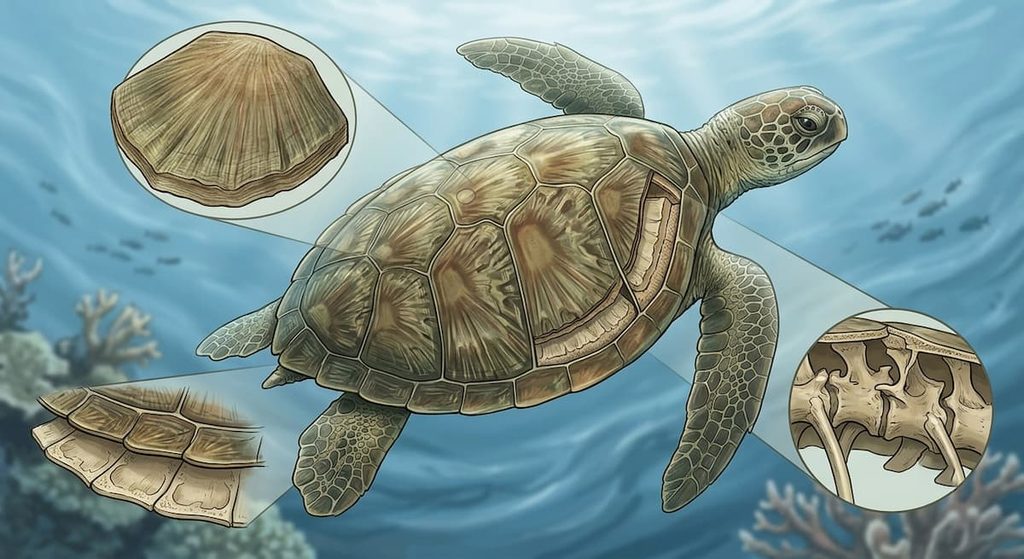
The shell of a sea turtle is not just a shield. It is a complex living engine perfected over hundreds of millions of years of oceanic evolution. It is a fused masterpiece of rib cage and spine, engineered to resist immense water pressure, physical shocks, and chemical corrosion. How did this extraordinary natural armor come to be? This article explores the evolutionary origins, structural shock absorption, chemical resistance, sensory neural network, and bio-inspired engineering applications of the sea turtle shell.
1. Evolutionary Origins: A Natural Armor Forged from Ribs
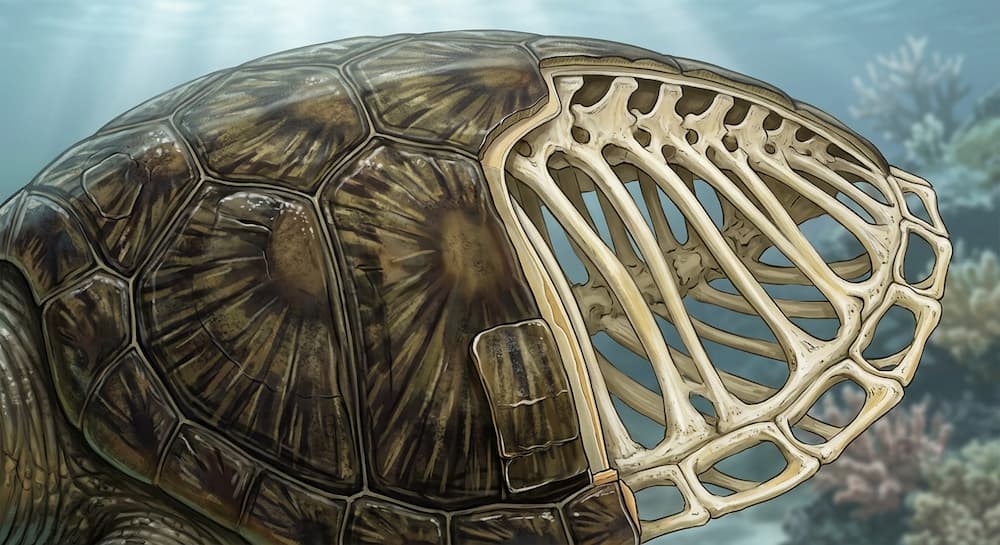
Did you think a sea turtle’s shell was just a simple outer casing? In reality, it is the evolutionary result of the animal’s internal skeleton. To be precise, it is a fused structure formed by the ribs and spine expanding broadly toward the back. A turtle cannot shed its shell like clothing. This is because the shell itself is the turtle’s skeletal structure.
Take a look at other reptiles or mammals. Most animals move their ribs up and down when breathing. This expands the chest space holding the lungs. However, a sea turtle’s ribs are completely fixed in a rigid plate form. Since they cannot move their ribs to breathe, how do they maintain respiration? Sea turtles use specialized muscles inside the shell to pull and push internal organs, forcibly compressing and expanding the lungs. It is a truly unique way of breathing.
Examining the skeletal remains of turtle ancestors from about 240 million years ago reveals an interesting fact. Back then, early turtle ancestors began widening their lower chest bones first to dig into the ground or endure attacks from predators. As solid bone plates wrapped around the body, their defense capability surged dramatically. However, in exchange for that protection, they lost a flexible torso and gained a sluggish way of moving.
The surface material resting on top of the bones is also very special. The outer surface of the shell is covered with rigid protein scales called keratin. It is the exact same substance that makes up human fingernails or hair. Tough keratin armor plates layer over the hard internal bone plates beneath, forming a dual-layer barrier. Thanks to this flawless double structure, they can withstand even the powerful bite force of tiger sharks. This system, where the endoskeleton transformed to function like an exoskeleton, is one of the most radical design modifications in evolutionary history.
2. Shock Absorption and Chemical Resistance Secrets
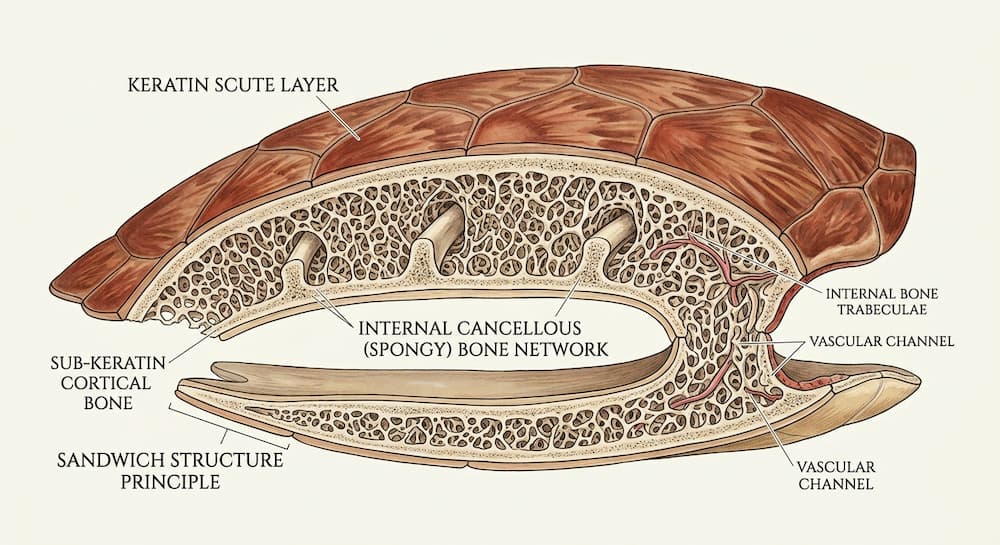
A sea turtle’s shell possesses an astonishing structure that withstands massive hammers or intense pressure. If it were merely hard, it would shatter easily when subjected to strong impacts. Yet, a sea turtle shell absorbs impacts perfectly. Why is that?
The secret lies in the internal architecture of the shell. Cut a sea turtle shell in half, and you will see it forms a sandwich layout. The outer and inner sides consist of dense, hard bone layers. Sandwiched between them is porous cancellous bone full of microscopic gaps. When a heavy external impact hits, this sponge-like cancellous bone structure compresses minutely to disperse energy waves. It acts as a natural airbag absorbing shock.
On top of this, the shell completely blocks chemical attacks. When ocean acidity rises due to acid rain or marine acidification, typical sea creatures with calcified shells face a crisis as their bodies dissolve. However, a sea turtle’s shell remains entirely unaffected.
This is thanks to the keratin layer encapsulating the sea turtle’s shell. Keratin is a chemically stable, insoluble protein. It does not react easily even when exposed to strong acids or chemical substances. Furthermore, keratin scutes overlap and interlock tightly like fish scales. This physically prevents acidic liquids or external hazardous substances from penetrating into the internal bone tissue.
This is precisely why sea turtles can swim completely unharmed for decades in oceans filled with pollutants due to environmental contamination. It is a flawless biological armor equipped simultaneously with physical shock absorption and a chemical defense shield.
3. Neural Sensing: Can a Turtle Feel Pain Through Its Shell?
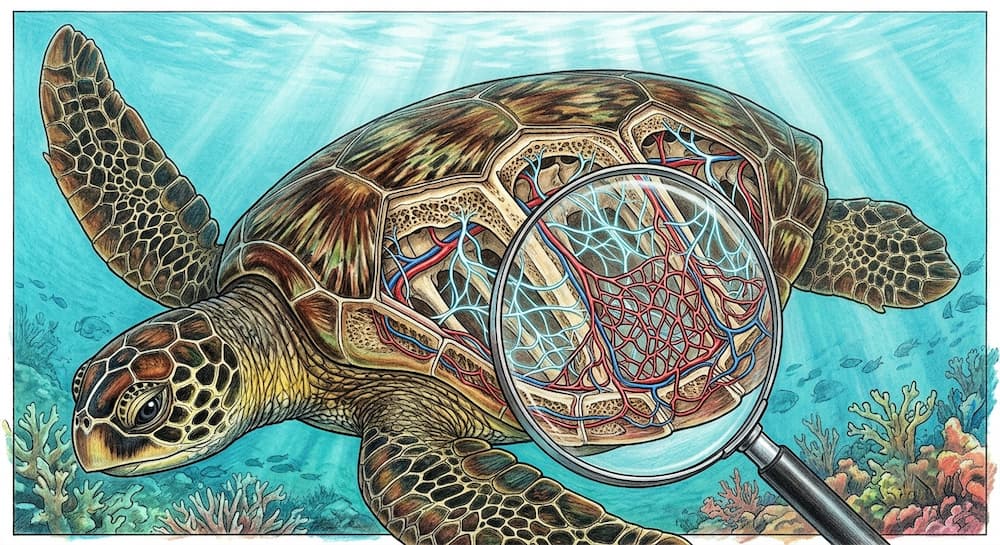
Did you think a sea turtle’s shell was like a hard rock or an inanimate object? Actually, that is not the case at all. A sea turtle’s shell is a living neural network with highly sensitive perception. Even a very light friction or stimulation on the shell surface is recognized by the turtle instantly.
Between the hard bone structure and the outer scale layer, countless neural networks and microscopic blood vessels are densely intertwined. Extremely sensitive tactile receptors are deployed in large numbers beneath the periosteum covering the bone and directly under the outer surface. It works under the exact same principle as a human feeling vibration or pressure when tapping gently on a fingernail. Turtles also detect subtle water flows touching the shell, sudden pressure shifts, and tiny scrapes across their entire body.
Thanks to this delicate neural network, turtles can navigate dark ocean environments with precision. When passing through soft seaweed forests or approaching sharp reefs, they turn their bodies to avoid them. Even if a predator touches them lightly, they notice right away and swim off quickly to escape. They even feel the refreshing sensation and stimulation directly when rubbing their bodies against rocks to scrape off attached barnacles or debris.
Therefore, if a turtle’s shell cracks or gets a hole, the turtle experiences tremendous pain. Shell damage is not just a cosmetic issue. It is a critical injury where bones and nerves are destroyed, causing extreme stress. The sturdy armor in its entirety functions as a sophisticated sensory organ communicating with the outside world.
4. Bio-Inspired Engineering: Transforming Future Technology
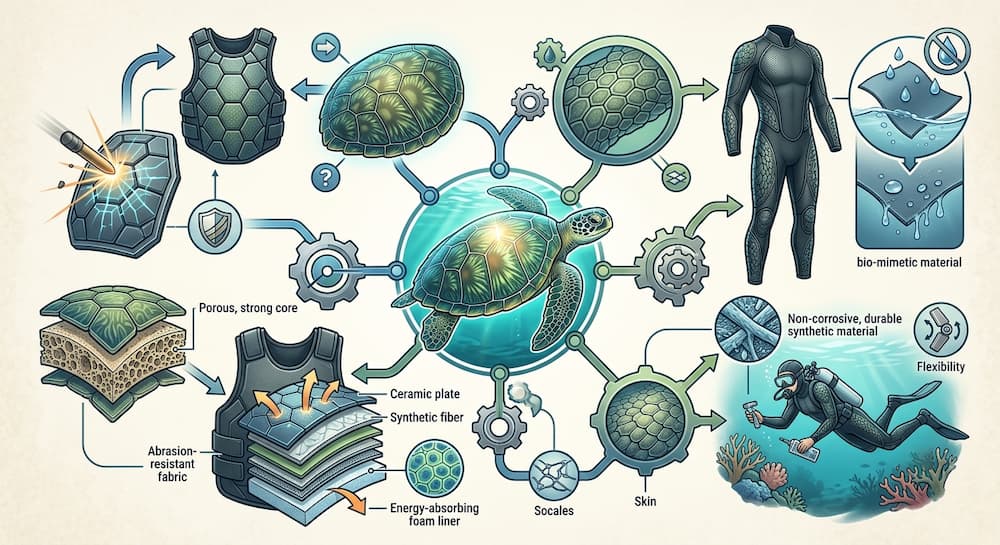
A sea turtle’s shell is a supreme design blueprint of natural engineering tested over hundreds of millions of years. Numerous scientists and engineers have begun studying this shell. Why? Because modern industry urgently needs materials that absorb external impacts while remaining extremely lightweight and resistant to chemical corrosion.
The primary field taking notice is advanced materials and body armor development. Do you remember the sandwich structure where porous cancellous bone is squeezed between hard bone layers? Researchers are imitating this flexible cushioning structure to create new shock-absorbing materials. Traditional body armor is hard but exceptionally heavy. However, applying the turtle shell design allows the creation of new materials that are much lighter yet disperse heavy impacts efficiently.
Architecture and transportation engineering actively adopt this biomimicry technology as well. The keratin structure of sea turtle shells is applied when building the outer hulls of submersibles or diving equipment. It disperses immense water pressure in deep depths. Anti-corrosive coating technologies that do not erode even when exposed to acidic seawater or salt are also being developed by copying the keratin arrangement of the shell.
It is the most complete armor created by nature through a long evolutionary process. A sea turtle’s shell goes beyond a single animal’s survival tool, re-emerging as an innovative future key to overcoming human limitations and driving new technologies.
Conclusion
A sea turtle’s shell, encapsulating hundreds of millions of years of survival know-how, holds meaning far beyond a simple shield. This organic system, where bone, nerve, and keratin exist in perfect harmony, is close to a biological miracle.
Inside this biological structure we once carelessly regarded as a simple hard shell lies a massive key capable of changing future science. When facing a turtle’s shell, why not recall the sophisticated scientific design carrying hundreds of millions of years rather than seeing it as a mere shell?
![[Bit#40] Bats: Incubators of Viruses and Guardians of the Ecosystem](https://hiddenbitknowledge.com/wp-content/uploads/2026/05/18539a864303-768x432.jpg)
![[Bit#36] The Mystery of the Octopus: Secrets of an Alien Highly Intelligent Organism](https://hiddenbitknowledge.com/wp-content/uploads/2026/05/79e43c3db89e-768x512.jpg)
![[Bit#57] Wildfires and Ecosystems: The Bio-Mechanism of Destruction and Rebirth](https://hiddenbitknowledge.com/wp-content/uploads/2026/06/8b81363e2c58-768x512.jpg)
![[Bit#139] Why Do Plant Roots Always Grow Downward? The Secret Gravity Sensor Inside](https://hiddenbitknowledge.com/wp-content/uploads/2026/08/main.Plant-root-768x432.jpg)
![[Bit#39] The Miracle of Hibernation: The Secret of Animals Surviving at Zero Degrees](https://hiddenbitknowledge.com/wp-content/uploads/2026/05/4585f0920812-768x512.jpg)
![[Bit#121] The Secret of Hermit Crab Housing: How Chemical Signals Lead to New Shells](https://hiddenbitknowledge.com/wp-content/uploads/2026/08/main.hermit-crab-768x512.jpg)