Can Animals Recognize Each Other by Voice? [Bit#190]

Close your eyes and listen to someone speaking. Even without seeing their face, you can often tell who is talking. A family member, a friend, or a familiar colleague may be recognizable after only a few words.
Now imagine listening to a group of birds calling, monkeys making noises, or meerkats communicating across a field. To human ears, many of these sounds may seem almost identical. If we cannot easily tell the animals apart, can they recognize one another by sound?
Research suggests that some animals can do exactly that. Their calls may carry information about the individual producing them, and experiments have shown that certain species respond differently depending on whose voice they hear.
The surprising part is that recognizing an animal’s voice does not always require a dramatic difference in pitch or a completely unique call. Sometimes, the information is distributed across several subtle acoustic features that are difficult for human listeners to notice.

Why Do Animal Calls Sound So Similar to Us?
Human hearing is not equally sensitive to every sound pattern. We are particularly experienced at recognizing human voices because we hear them throughout our lives. We learn to associate familiar vocal patterns with particular people, often without consciously analyzing how their voices differ.
Animal calls are another matter. If you rarely listen to a particular species, you may have little experience distinguishing its individuals. Their calls may share a similar pitch, rhythm, or overall structure, making them difficult for you to tell apart.
But a sound that seems nearly identical to us may contain differences in its frequency, timing, or spectral structure. Frequency describes how rapidly a sound wave vibrates and is closely related to perceived pitch. Spectral structure describes how sound energy is distributed across different frequencies.
These characteristics can vary among individuals. The shape and size of the vocal apparatus, the way an animal produces a call, and the animal’s behavior can all influence the sound it makes.
No single feature necessarily acts like a perfect acoustic fingerprint. Instead, several small differences may combine to make one individual’s calls distinguishable from another’s.
There is another important distinction, too. Scientists can sometimes identify individual animals by analyzing recordings, but this alone does not prove that the animals themselves recognize those differences. To investigate recognition, researchers need behavioral experiments that show how animals respond when the identity of a caller changes.
Zebra Finches Reveal a Hidden Layer of Identity

Zebra finches are small, social birds that use different vocalizations in their daily interactions. Their calls may sound simple to us, but researchers have found that these sounds contain information that helps distinguish individuals.
In a 2018 study, researchers Julie Elie and Frédéric Theunissen investigated whether zebra finches could identify different callers across their vocal repertoire. Rather than examining only one kind of sound, they tested multiple call types and measured how well birds distinguished individual vocalizers.
The results revealed an important pattern: individual identity was not equally clear in every type of call. Contact calls carried strong individual signatures, whereas calls associated with aggressive encounters were less individualized.
The researchers also tested the birds’ ability to discriminate between callers in controlled listening tasks. The birds learned to distinguish vocalizers, demonstrating that the differences were not merely detectable by acoustic analysis. The animals themselves could use the sounds to tell individuals apart.
Why would different calls carry different amounts of identity information?
A vocalization has a job to do. A contact call can help maintain communication between animals, so identifying who is calling may be particularly useful. A call produced during an aggressive encounter may place greater emphasis on communicating the immediate situation.
These functions can overlap, and the study does not establish that every call has one exclusive purpose. However, the findings show that a bird’s vocal identity is not necessarily encoded in one universal signature that remains equally clear in every sound it produces.
In other words, recognizing a zebra finch may require learning the distinctive patterns associated with more than one type of call.
That is a more sophisticated problem than simply memorizing one familiar sound.
How Scientists Test Whether Animals Recognize Voices
Researchers cannot ask an animal whether it recognizes a familiar caller. Instead, they can use playback experiments, in which recorded sounds are played to an animal while its behavior is observed.
The key is to design a test that distinguishes recognition from a general reaction to sound.
For example, an animal might respond because a call is loud, unusual, or associated with danger. Such a response does not necessarily mean that the animal knows who produced it.
A stronger test changes the identity of the caller while keeping other aspects of the situation as consistent as possible. Scientists can then compare the animal’s responses to familiar and unfamiliar voices, or examine whether it notices an unexpected change in who appears to be calling.
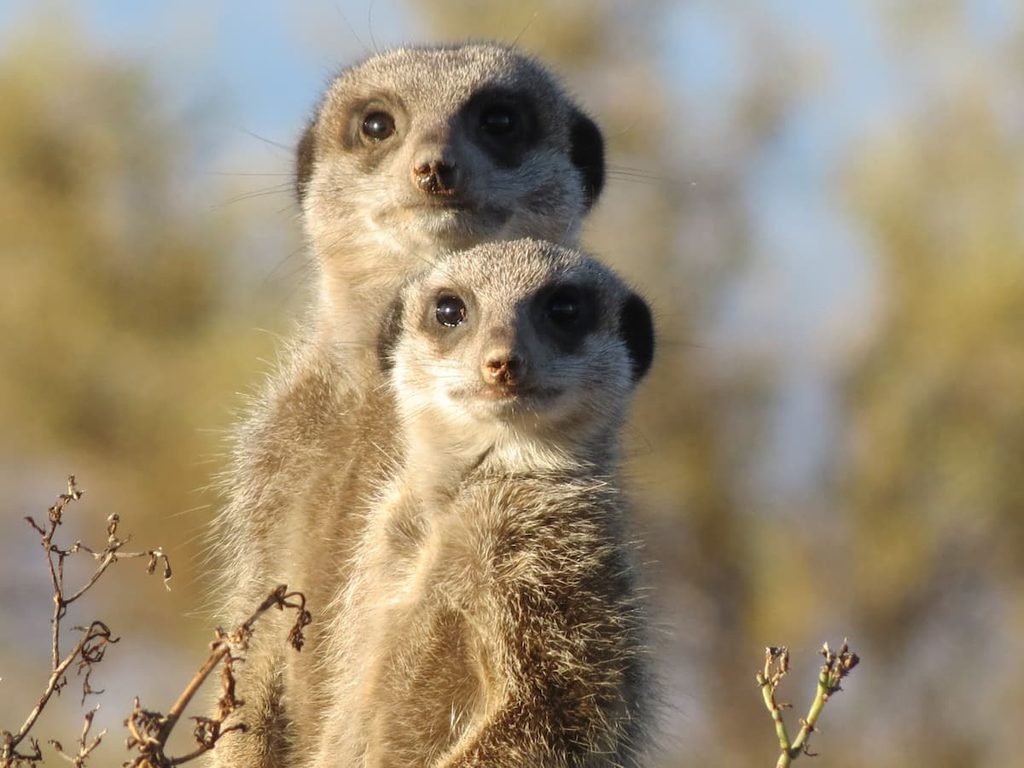
One particularly interesting example comes from wild meerkats.
Meerkats live in social groups, where knowing which individual is nearby may be useful. In a 2012 study, researchers played recordings to wild meerkats in a carefully controlled setup. During the test condition, the same individual’s voice appeared to come from two different places at the same time, creating a physically impossible situation. A control condition presented a possible arrangement.
The meerkats showed stronger responses to the impossible scenario than to the control. The researchers interpreted this difference as evidence that the animals recognized the caller’s identity well enough to detect the inconsistency.
This is compelling because the test did not simply ask whether a meerkat reacted to a sound. It examined whether the animal’s response depended on the relationship between the caller’s identity and its apparent location.
However, the conclusion should remain specific. The experiment supports vocal individual recognition in wild meerkats under the tested conditions. It does not prove that meerkats identify every group member from every call, or that they understand the situation exactly as a human would.
Marmosets Can Notice When a Caller Changes
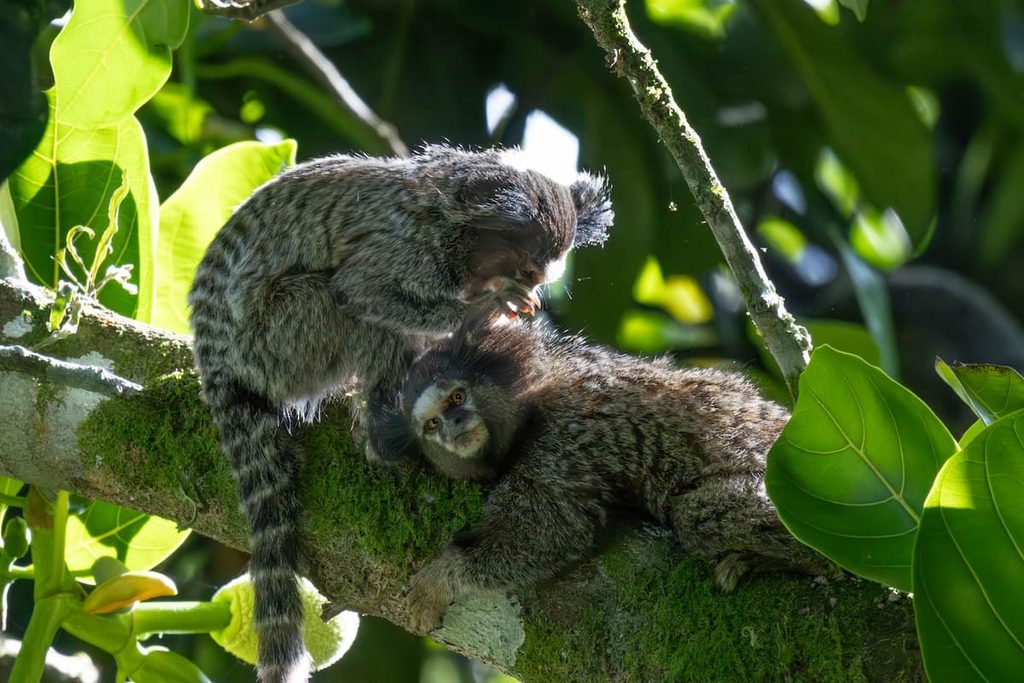
Common marmosets provide another example of how voice recognition can operate during ongoing communication.
These small primates produce distinctive long-distance calls known as phee calls. Animals can answer one another, creating exchanges in which one caller responds to another over a series of vocalizations.
Researchers Cory Miller and A. Wren Thomas studied whether marmosets could detect a change in the identity of the caller during these exchanges.
Their playback experiments used recordings from one individual to engage the animals in calling. At selected points, the researchers inserted a call from a different individual. They then compared the marmosets’ responses with those observed when the expected caller identity was maintained.
The animals produced fewer answering calls to the unexpected caller than to the control stimuli. Under some conditions, their response timing also changed.
These results suggest that marmosets can monitor who is calling during an ongoing vocal exchange. They are not simply responding to the broad category of sound known as a phee call. The identity of the individual producing that call also matters.
This ability could be useful in a social environment where communication takes place over distance and visual information may be limited.
Still, the experiment does not establish that marmosets interpret every call as a personal message in the human sense. It shows that caller identity can influence their behavior during vocal communication.
What Makes One Voice Different From Another?
If an animal can recognize another individual by sound, what exactly is it hearing?
The answer is unlikely to be a single universal feature.
A voice can vary in its fundamental frequency, which is related to the perceived pitch of a sound. Calls can also differ in duration, frequency distribution, timing, and the way their acoustic energy changes throughout the call.
Some of these features may be strongly influenced by the animal’s anatomy. Others can change with the type of call, the animal’s behavior, or the immediate context.
A 2016 study of macaque vocalizations examined how acoustic information contributes to caller identity. The researchers analyzed calls from eight macaques and found that individual features, including fundamental frequency and duration, could provide useful information but were not consistently reliable on their own. Combining multiple features allowed much more accurate classification of the callers.
This distinction matters. A listener may not be able to identify an individual by one obvious characteristic, such as a high or low pitch. Instead, recognition may depend on a combination of details that work together.
Think of recognizing a human voice. Two people may speak at similar pitches, yet sound different because of their resonance, rhythm, articulation, and other characteristics. The same general principle helps explain why animal calls that seem alike to us may still contain information that distinguishes their producers.
The exact acoustic cues vary across species and call types. It would be misleading to assume that every animal uses the same features, or that one feature is always the most important.
Does Every Animal Recognize Its Neighbors by Sound?
Not necessarily. Evidence from one species cannot automatically be extended to all animals.
Vocal recognition is likely to be especially useful in situations where individuals regularly interact, communicate over distance, or need to distinguish particular social partners. But the usefulness of this ability depends on an animal’s ecology and behavior.
Some animals rely heavily on vocal signals. Others may depend more on visual, chemical, or other sensory information. Even within a single species, a particular call may carry strong information about individual identity while another call may not.
Researchers must also distinguish between recognizing a species, identifying a type of call, and identifying the individual that produced it. These are different abilities.
An animal that responds appropriately to a warning call may recognize what the call means without knowing which individual made it. Conversely, an animal may identify a familiar caller even when the meaning of the call is not the main focus of the interaction.
There is also a difference between identifying an individual and understanding its social relationship to the listener. Knowing who produced a sound does not, by itself, demonstrate that an animal recognizes kinship, remembers a long-term friendship, or experiences a particular emotion.
Those questions require separate evidence.
The Voices We Cannot Distinguish
When a group of animals calls, it can sound to us like a chorus of nearly interchangeable noises. But our difficulty in distinguishing those sounds says as much about our own listening experience as it does about the animals producing them.
For certain species, calls contain individual differences that can guide behavior. Controlled experiments show that zebra finches can discriminate callers, wild meerkats respond to an apparent contradiction in a caller’s identity, and common marmosets can detect a change in the individual calling during an exchange.
These abilities are not evidence that animals hear the world exactly as humans do. Rather, they show that their auditory systems can extract information that matters in their own social lives.
A sound does not need to be obviously different to every listener to be informative. It only needs to contain differences that a particular listener can detect and use.
The next time a group of birds calls from the trees, their voices may still sound almost identical to you. But for an animal listening nearby, those calls may reveal more than the species making the noise. They may help answer a much more specific question: Who is calling?
Scientific Sources
- Elie JE, Theunissen FE. “Zebra finches identify individuals using vocal signatures unique to each call type.” Nature Communications. 2018;9(1):4026. PMID: 30279497. DOI: 10.1038/s41467-018-06394-9. Read the study on PubMed
- Townsend SW, Allen C, Manser MB. “A simple test of vocal individual recognition in wild meerkats.” Biology Letters. 2012;8(2):179-182. PMID: 21992821. DOI: 10.1098/rsbl.2011.0844. Read the study on PubMed
- Miller CT, Thomas AW. “Individual recognition during bouts of antiphonal calling in common marmosets.” Journal of Comparative Physiology A. 2012;198(5):337-346. PMID: 22277952. DOI: 10.1007/s00359-012-0712-7. Read the study on PubMed
- Fukushima M, Doyle AM, Mullarkey MP, Mishkin M, Averbeck BB. “Distributed acoustic cues for caller identity in macaque vocalization.” Royal Society Open Science. 2015;2(12):150432. PMID: 27019727. DOI: 10.1098/rsos.150432. Read the study on PubMed