How Did Wolves Become Dogs? The Hidden Story of Dog Domestication [Bit#223]
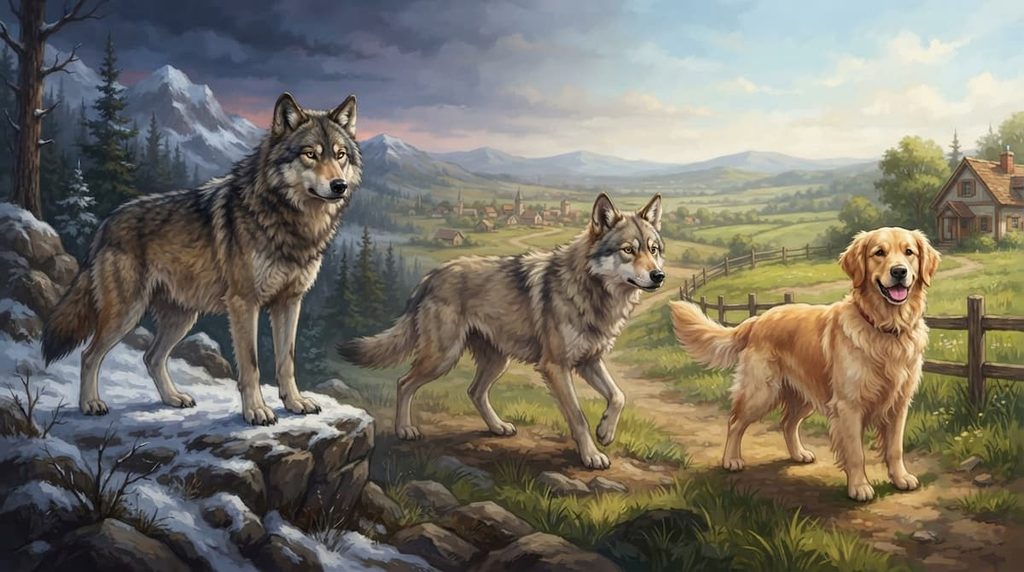
A dog lying beside a human seems completely ordinary today.
But the relationship behind that scene began thousands of years before houses, farms, or even cities existed.
Dogs were the first animals to enter a domestic relationship with humans. They were living alongside hunter-gatherers before sheep, goats, cattle, and horses became part of human society.
So how did it happen?
The familiar answer is simple.
Humans domesticated wolves, and those wolves gradually became dogs.
The basic idea is correct. Dogs belong to the gray wolf lineage.
But ancient DNA has revealed a problem with the simple version.
Scientists still cannot point to one ancient wolf population and say, “That was the ancestor of all dogs.”
They also cannot identify one place where humans suddenly decided to domesticate wolves.
Instead, the evidence points toward a much longer process involving ancient wolf populations, human communities, movement across Eurasia, and changing relationships between the two species.
The origin of the dog may therefore be less like a single invention and more like a long evolutionary relationship.
The Ancestor of Dogs Was Not Simply Today’s Wolf

Dogs are classified as Canis lupus familiaris, while gray wolves belong to Canis lupus.
Genetic evidence makes their relationship clear. Dogs originated from the gray wolf lineage.
But this does not mean that modern dogs simply descended from the wolves living today.
A major clue came from ancient wolf DNA.
In 2022, researchers compared dozens of ancient wolf genomes spanning roughly 100,000 years with genomes from modern and ancient dogs.
The results showed that dogs had stronger genetic affinities to some ancient wolves from eastern Eurasia than to ancient wolves from Europe.
Yet even that was not the whole story.
Some dog populations, especially those associated with the Near East and Africa, also showed ancestry related to wolves from western Eurasia.
The researchers therefore proposed a more complicated history involving at least two distinct ancient wolf-related sources.
The important point is that the exact ancestral wolf populations have not been identified.
Some of them may have disappeared. Others may have contributed ancestry that became mixed with other populations before the genetic trail could be followed directly.
This creates an important distinction.
Saying “dogs came from gray wolves” is well supported.
Saying “dogs came from the wolves we see today” is not.
Modern wolves are close relatives of the ancestral populations involved in dog origins, not simply the living parents of every dog.
Did Wolves Come to Humans First?
This is where the story becomes much less certain.
Why would a wild predator begin living around humans?
One possibility is food.
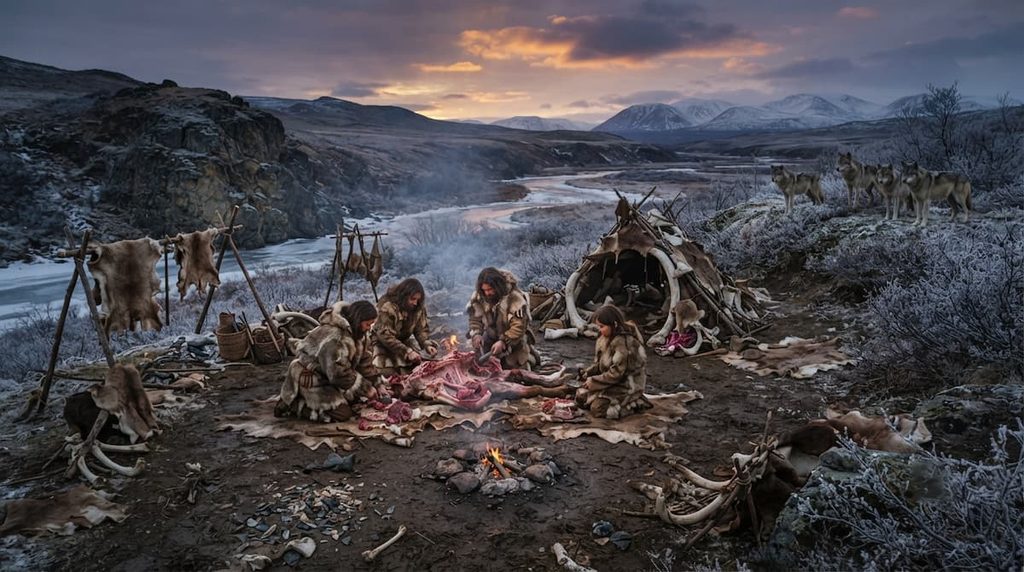
Ice Age hunter-gatherers left animal remains and other edible resources around their camps. Wolves already lived in these environments and could exploit whatever food they found.
But wolves were not all equally comfortable around humans.
Some may have stayed far away.
Others may have been more tolerant of people and able to approach camps without immediately being killed or driven away.
If those wolves gained enough food to survive and reproduce, living near humans could become an advantage.
Over many generations, this could favor animals that were less fearful or aggressive toward people.
This idea is often called the commensal pathway.
Another possibility is that humans actively captured and raised wolf pups, eventually selecting animals that were useful or easier to handle.
Both ideas have been discussed by researchers.
Neither gives us a complete answer.
The fossil record cannot show us the exact behavior of a wolf thousands of years ago, and ancient DNA cannot directly tell us whether a particular animal voluntarily approached a human camp.
So the popular story of a prehistoric person finding a wolf puppy, raising it, and accidentally creating the first dog should not be treated as established history.
What the evidence supports more strongly is that humans and wolves repeatedly interacted, and that some wolves were better suited to living in human-dominated environments than others.
That created an opportunity for domestication.
And it may have begun before humans consciously understood that anything unusual was happening.
The First Dogs Were Not Modern Pets
There is another problem with the usual story.
When people imagine the first dogs, they often picture primitive versions of today’s pets.
That is misleading.
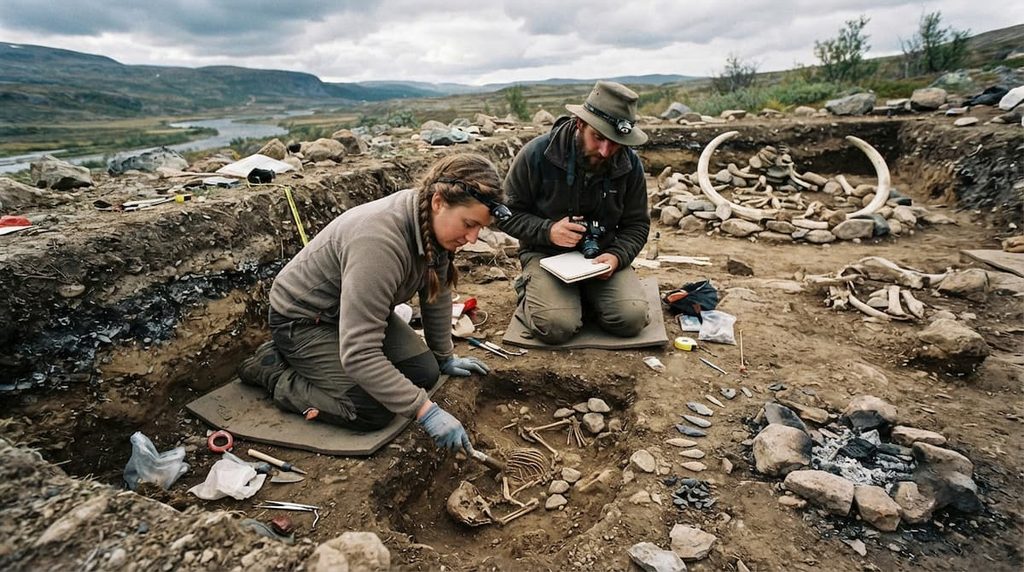
The earliest dogs lived during the Ice Age. Their humans were hunter-gatherers who moved through landscapes rather than living in modern-style houses.
And identifying an ancient dog is surprisingly difficult.
Wolves and early dogs can have very similar skeletons. Archaeologists can study skull shape, teeth, body proportions, burial context, and other clues, but appearance alone is not always enough.
This became obvious when researchers tested some of the oldest remains that had previously been called dogs.
Several famous remains dating back more than 30,000 years had once been interpreted as possible early dogs. Later genetic analyses showed that some were actually wolves belonging to extinct ancient populations.
That distinction matters enormously.
A canid that looks somewhat like a dog is not necessarily an ancestor of dogs.
This is why ancient nuclear DNA has become so important.
In 2026, researchers analyzed 216 ancient canid remains from Europe and obtained genome-wide data that could distinguish dog ancestry from wolf ancestry in 141 of them.
The oldest dog genome recovered in that study came from Kesslerloch in Switzerland and dates to about 14,200 years ago.
The result was striking.
That ancient dog shared ancestry with later dogs found in different parts of the world.
It was not simply an isolated animal that appeared and disappeared.
Its genetic history was connected to the later history of dogs.
Dogs Were Already Moving Across Eurasia
Another 2026 study pushed the story even further back.
Researchers recovered nuclear and mitochondrial genomes from ancient canid remains including a specimen from Pınarbaşı in present-day Türkiye dating to about 15,800 years ago and a specimen from Gough’s Cave in Britain dating to about 14,300 years ago.
The results indicated that genetically similar dogs were already distributed across Europe and Anatolia by at least 14,300 years ago.
This changes the way we should imagine the early history of dogs.
The first dogs were not necessarily confined to one small community.
They were already moving through a human world.
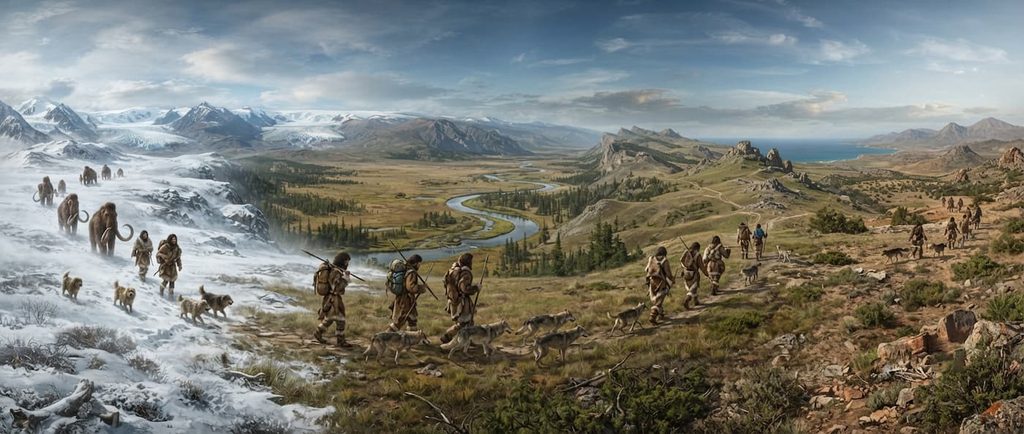
The researchers found evidence consistent with dogs being exchanged among culturally distinct hunter-gatherer groups.
That means a dog could move between human communities even when those communities themselves remained genetically and culturally distinct.
One group did not necessarily have to conquer another group to acquire dogs.
Dogs could travel through social networks.
And this creates an important clue about domestication.
If dogs were already widespread across western Eurasia more than 14,000 years ago, the process that produced them must have begun earlier.
The exact starting point remains hidden.
But the archaeological and genetic evidence increasingly suggests that by the Late Upper Paleolithic, dogs were already established enough to move between human societies.
Dogs Became Dogs Before Agriculture
This is one of the most surprising parts of the story.
Dogs were not created by the agricultural revolution.
They were already present before humans had developed the farming societies that later produced sheep, goats, cattle, and horses as domestic animals.
A 2020 study of 27 ancient dog genomes found that by around 11,000 years ago, dogs had already diversified into several major genetic lineages.
That means the dog had already been through a long evolutionary history before most of the animal domestication that people commonly associate with early farming.
The history of dogs also became connected to the movement of humans.
As human populations moved across Eurasia, dogs moved with them.
But dogs did not simply mirror human population history.
In Europe, for example, the arrival of farming populations from Southwest Asia produced major changes in human ancestry. Dogs also experienced genetic changes, but older European dog ancestry persisted to a considerable degree.
The 2026 European study found that dogs associated with later farming populations retained substantial ancestry from earlier European dogs linked to hunter-gatherers.
This suggests that dogs were not merely animals transported by humans like possessions.
They had their own population history.
Different dog populations met, mixed, persisted, or disappeared as human societies changed.
The animal that began as part of an ancient human-wolf relationship eventually became a record of human movement itself.
So Who Domesticated Whom?
The phrase “humans domesticated wolves” makes the process sound much simpler than it probably was.
It sounds as though humans made a deliberate decision to take a wild species and turn it into a useful animal.
But domestication can begin through repeated interactions.
Imagine wolves living around hunter-gatherer communities.
Some avoid people.
Some approach camps.
Some are aggressive.
Others tolerate humans.
If tolerant wolves gain access to food and survive near people, their behavior can become advantageous in that environment.
Humans then respond to these animals.
Some are driven away.
Some are tolerated.
Some may eventually be fed, kept, or used.
Over many generations, the relationship can become increasingly close.
Eventually, humans begin selecting animals intentionally, while the animals themselves are already adapted to life around humans.
That does not mean wolves literally domesticated themselves.
Humans were an essential part of the process.
But it does mean that domestication may not have started as a single human decision.
The first step could have been an ecological relationship that gradually became an evolutionary one.
And this may explain why it is so difficult to identify one exact moment when the wolf became the dog.
There probably wasn’t one.
The Dog Is More Than a Domesticated Wolf
Once dogs became established, their relationship with humans continued to change.
They could help with hunting, detect danger, guard camps, and eventually perform many other roles.
But their importance was not only practical.
Dogs became members of human communities.
Their movements followed human migrations, yet their own genetic history remained distinct.
Ancient DNA now allows researchers to watch those histories intersect.
A dog found thousands of years ago can tell scientists not only something about dogs, but also about the people who lived with them.
This is especially powerful because dogs moved between human groups.
A human population might remain genetically distinct while dogs were exchanged between communities.
That means dogs provide a different record of prehistoric connections than human DNA alone.
The history of dogs therefore contains two stories at once.
It is the story of an animal changing from a wild wolf lineage into a domestic species.
But it is also the story of humans repeatedly meeting, moving, trading, and changing.
We Still Do Not Know Where the First Dog Was Born
After decades of archaeological and genetic research, scientists still cannot point to one place and say, “This is where the dog began.”
The evidence does not identify a single human group responsible for domestication.
It does not identify one ancient wolf population as the definitive ancestor of all dogs.
And it does not tell us exactly whether the first step was driven mainly by wolves approaching human camps, humans adopting wolves, or some combination of processes.
What we do know is becoming much clearer.
Dogs originated from the gray wolf lineage.
Their ancestors were ancient wolf populations, not simply modern wolves.
Ancient DNA shows that at least two distinct wolf-related sources contributed to the ancestry of dogs, although the exact populations and the precise sequence of events remain uncertain.
By roughly 15,800 to 14,300 years ago, genetically identifiable dogs were already present across parts of western Eurasia.
By around 11,000 years ago, dogs had already diversified into several major genetic lineages.
And throughout this history, dogs moved with and between human populations.
That changes how we should think about the origin of the dog.
The important question is not simply:
When did humans tame the first wolf?
A better question is:
When did humans and wolves begin changing each other’s evolutionary futures?
We may never find the individual wolf that became the first dog.
But ancient DNA is showing us something more interesting than the identity of one ancestor.
The dog was not created in a single moment.
It emerged from a relationship.
A wild predator entered a human world. Some members of its lineage became increasingly suited to that world. Humans changed their behavior toward those animals. The relationship deepened, populations moved, and generations of evolution gradually separated the dog from its wild relatives.
The modern dog is therefore more than a tame wolf.
It is the evolutionary record of two species learning to live together.
Scientific Sources
- Bergström A, Furtwängler A, Johnston S, et al. “Genomic history of early dogs in Europe.” Nature. 2026;651(8107):986-994. PMID: 41882126. DOI: 10.1038/s41586-026-10112-7. Read the study on PubMed PubMed
- Marsh WA, Scarsbrook L, Yüncü E, et al. “Dogs were widely distributed across western Eurasia during the Palaeolithic.” Nature. 2026;651(8107):995-1003. PMID: 41882128. DOI: 10.1038/s41586-026-10170-x. Read the study on PubMed PubMed
- Bergström A, Stanton DWG, Taron UI, et al. “Grey wolf genomic history reveals a dual ancestry of dogs.” Nature. 2022;607(7918):313-320. PMID: 35768506. DOI: 10.1038/s41586-022-04824-9. Read the study on PubMed Nature
- Bergström A, Frantz L, Schmidt R, et al. “Origins and genetic legacy of prehistoric dogs.” Science. 2020;370(6516):557-564. PMID: 33122379. DOI: 10.1126/science.aba9572. Read the study on PubMed PubMed
- Lord K, Larson G, Murphy WJ, Ostrander EA. “Genomic ancestry, behavior, and the domestication of the dog.” Proceedings of the National Academy of Sciences of the United States of America. 2025;122(48):e2528616122. PMID: 41284861. DOI: 10.1073/pnas.2528616122. Read the study on PubMed