Is the Central Dogma Still True? [Bit#194]
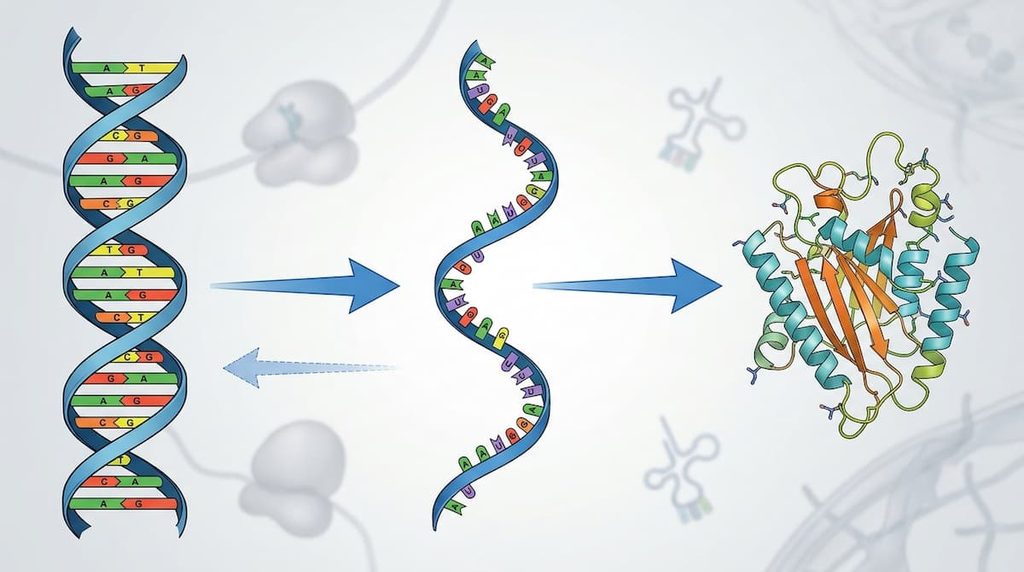
The central dogma of molecular biology is often introduced as a simple sequence: DNA makes RNA, and RNA makes protein. It is one of the most familiar explanations in biology, describing how genetic information helps cells build the molecules they need to function.
But biology is rarely as simple as a three-step diagram. Some viruses use RNA to make DNA. Cells produce RNA molecules that never become proteins. And certain proteins can influence how other proteins fold, allowing biological information to persist in unexpected ways.
These discoveries raise an important question: if information can move in directions that a textbook diagram does not show, is the central dogma still true?
The answer depends on what the central dogma actually says. The familiar DNA-to-RNA-to-protein pathway is a useful introduction to molecular biology, but it is not a complete statement of the original principle proposed by Francis Crick. Understanding the difference reveals why some discoveries changed our understanding of gene expression without disproving the central dogma itself.
From a New Idea to a Fundamental Principle
During the middle of the twentieth century, scientists were working to understand how hereditary information was stored and used. DNA had emerged as the central candidate for carrying genetic information, while experiments on RNA and protein synthesis were beginning to reveal how cells turned that information into functional molecules.
In 1958, molecular biologist Francis Crick introduced the central dogma as part of this emerging framework. He later clarified its meaning in a 1970 paper titled Central Dogma of Molecular Biology.
The distinction matters because Crick was not simply saying that DNA produces RNA and RNA produces protein. His central concern was the transfer of sequence information, meaning information encoded in the precise order of molecular building blocks.
DNA and RNA are built from nucleotide sequences. Proteins are built from sequences of amino acids. Cells can transfer sequence information between these molecules through processes such as transcription and translation.
Crick’s central dogma placed a specific restriction on this process: once sequence information has passed into a protein, it cannot be transferred back out of that protein to determine a new sequence in another protein or a nucleic acid.
In other words, a protein does not provide a molecular template that can be read backward to reconstruct the DNA sequence that originally helped produce it.
This is more precise than the familiar three-step diagram. The diagram describes a common route through which genetic information is expressed. The original dogma addresses which directions of sequence-information transfer are possible.
What the Familiar DNA-to-RNA-to-Protein Pathway Explains
To understand the central dogma, it helps to follow the ordinary process of protein production.
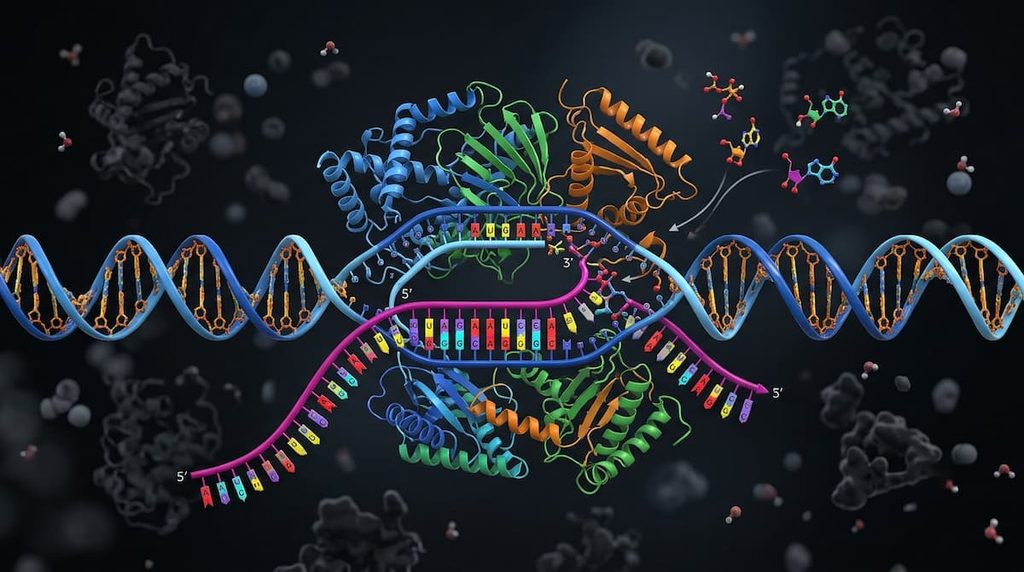
First, DNA stores genetic information in its nucleotide sequence. Before a cell divides, its DNA can be replicated so that the genetic material can be passed to daughter cells. DNA also serves as a template for producing RNA.
This process is called transcription. An enzyme reads a DNA template and synthesizes a complementary RNA molecule. For a protein-coding gene, the resulting messenger RNA, or mRNA, carries information that can be used to build a protein.
The next step is translation. Ribosomes read the mRNA sequence in groups of three nucleotides called codons. Each codon specifies an amino acid or a stop signal. With help from transfer RNAs and other components, the ribosome assembles an amino acid chain.
That chain then folds and may undergo additional modifications before becoming a functional protein.
This pathway explains how the information encoded in many genes is converted into molecules that perform essential cellular tasks. Enzymes speed up chemical reactions, receptors detect signals, and structural proteins help maintain the shape of cells and tissues.
However, not every RNA molecule is translated into protein. Some RNAs help build ribosomes, some transfer amino acids during translation, and others regulate gene expression or participate in additional cellular processes.
The central dogma therefore does not mean that all RNA must become protein. Nor does it mean that every gene is active in every cell. The pathway describes a fundamental form of information transfer, not the full complexity of gene regulation.
The Discovery That Made the Story More Complicated
One of the most important developments came in 1970, when researchers reported evidence for an enzyme that could synthesize DNA using RNA as a template.
The enzyme became known as reverse transcriptase. It is associated with retroviruses, including viruses that use an RNA genome and produce a DNA copy during their life cycle.
This process reverses the direction emphasized in the familiar textbook diagram:
RNA → DNA
At first glance, this may appear to overturn the central dogma. If genetic information can move from RNA back to DNA, how can the original model still hold?
The key is that Crick’s original restriction did not prohibit all movement against the familiar direction. It prohibited the transfer of sequence information from a protein into another protein or a nucleic acid.
RNA-to-DNA transfer involves two nucleic acids. It does not require a protein sequence to be converted back into a nucleotide sequence. Reverse transcription therefore challenges the oversimplified diagram, not the central dogma as Crick defined it.
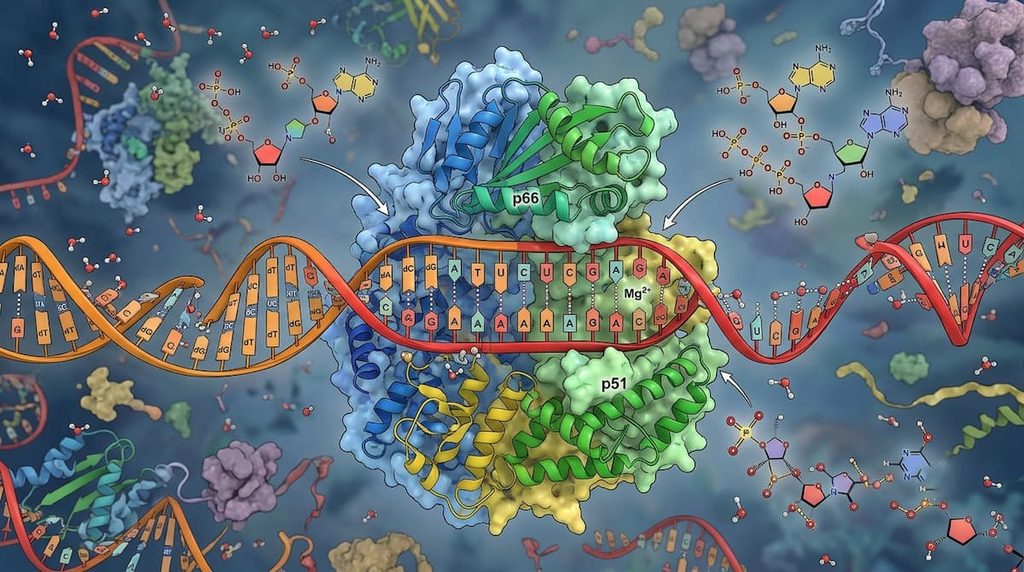
Reverse transcription also has biological significance beyond retroviruses. In humans and other organisms, the enzyme telomerase uses an internal RNA template to extend chromosome ends. This is a specialized process that helps maintain telomeres, the repetitive DNA regions at the ends of chromosomes.
The details differ between retroviral replication and telomere maintenance, but both illustrate a broader lesson: molecular biology includes information-transfer routes that are not captured by a single forward arrow.
The discovery of reverse transcriptase was not a reason to discard the central dogma. It was a reason to describe the possible pathways more accurately.
DNA Is Not the Whole Story of Gene Activity
Another source of confusion comes from epigenetics, the study of changes in gene activity that can occur without changing the underlying DNA sequence.
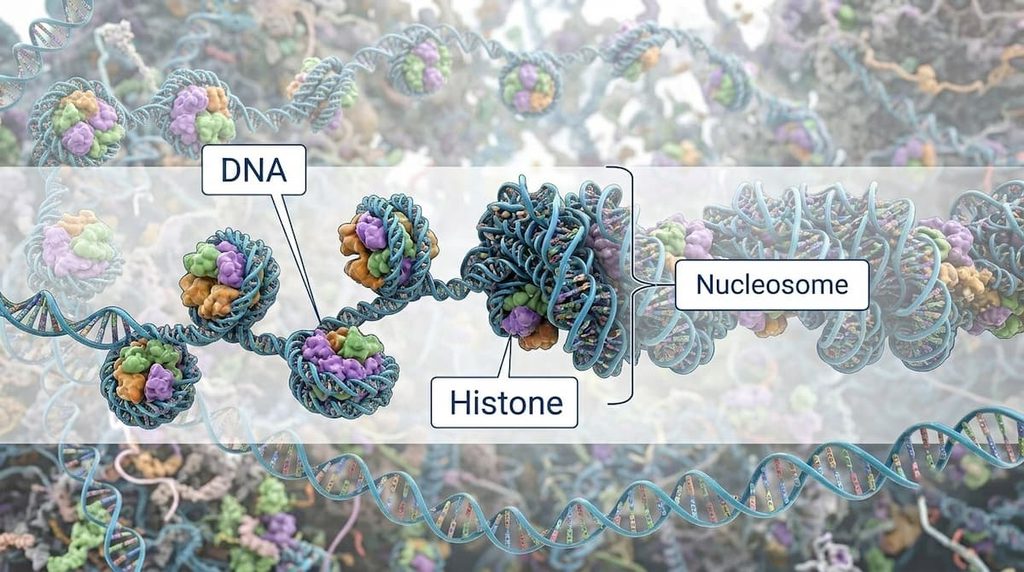
Cells in the same organism generally carry very similar genomes, yet a nerve cell behaves differently from a muscle cell. One reason is that different sets of genes are active in different cell types. Regulatory proteins, chemical modifications to DNA, and modifications to histone proteins help control which regions of the genome are accessible and how strongly genes are expressed.
Some of these regulatory states can persist as cells divide. In certain circumstances, molecular states can also be transmitted across generations.
Does this mean that information has moved from proteins back into DNA?
Not necessarily. A protein can influence gene activity without its amino acid sequence being copied into a DNA sequence. A histone modification can alter the expression of nearby genes without rewriting the nucleotide order of those genes. Likewise, an RNA molecule can regulate a gene without being translated into a protein.
These are important forms of biological regulation and inheritance, but they should not automatically be treated as violations of the central dogma. The answer depends on whether the process transfers sequence information in the specific sense used by Crick.
Epigenetics makes the relationship between genotype and phenotype more complex. It does not, by itself, demonstrate that proteins can be reverse-translated into genes.
Prions: Can a Protein Carry Inheritable Information?
Prions present a more unusual challenge.
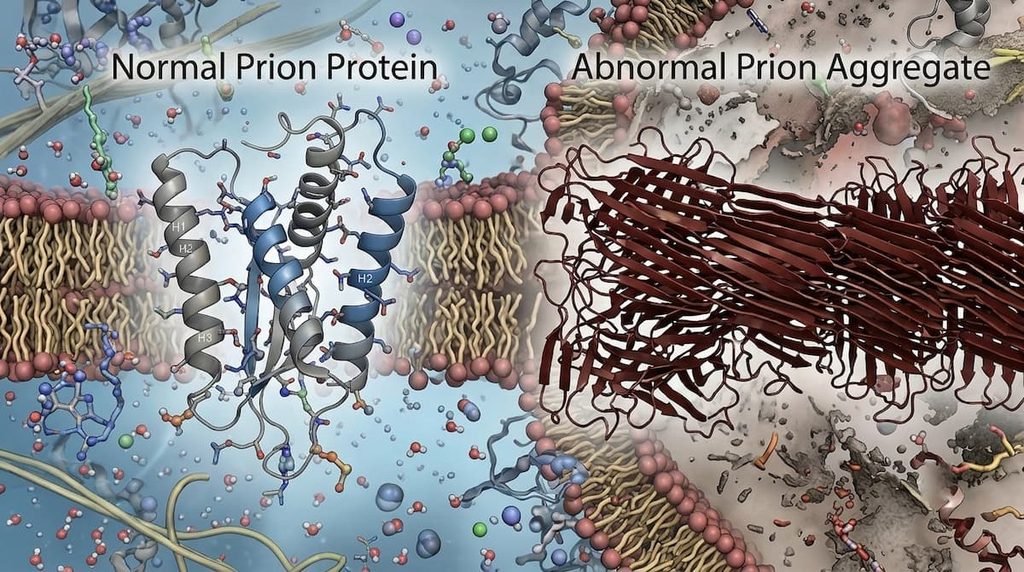
A prion is a protein that can adopt a particular misfolded shape and promote the same or a related shape in other copies of that protein. In mammals, the best-known examples are associated with serious neurodegenerative diseases. Prion-related phenomena have also been studied in fungi, where some protein conformations can be inherited and influence cellular traits.
Unlike viruses, prions do not need a genome made of DNA or RNA to propagate their characteristic protein conformation. Instead, the existing protein structure helps guide other protein molecules into a similar state.
This is striking because it shows that biological inheritance is not always reducible to the simple transmission of a DNA sequence. A protein’s conformation, meaning its three-dimensional arrangement, can itself carry information that is passed on through molecular interactions.
Does this disprove the central dogma?
The answer is more complicated than a simple yes or no. Some researchers, including evolutionary biologist Eugene Koonin, have argued that prion-mediated inheritance challenges the central dogma by allowing information to flow from proteins into genetic systems. Other interpretations distinguish the propagation of a protein’s shape from the residue-by-residue transfer of sequence information that Crick’s original definition addresses.
The distinction is crucial. When a misfolded protein causes another protein to adopt a similar conformation, the amino acid sequence of the first protein is not being translated backward into a DNA sequence. The information being propagated is structural rather than a direct copy of the protein’s amino acid sequence.
In some biological contexts, prion-associated states may interact with genetic variation and influence which traits persist. That makes the relationship between proteins and genomes more complicated, but it does not establish a general mechanism for translating protein sequences into DNA.
Prions therefore expose an important question about the meaning of biological information. If information includes structure, behavior, and heritable cellular states, then the familiar central-dogma diagram leaves much out. If the term refers specifically to residue-by-residue sequence transfer, the distinction between structural inheritance and sequence information remains essential.
What About CRISPR and Modern Gene Editing?
Modern biotechnology provides another reason to examine the central dogma carefully.
CRISPR-based systems can guide molecular machinery to specific DNA sequences. In some applications, engineered systems can also introduce precise changes into genetic material. Prime editing, for example, uses a modified CRISPR-associated protein together with a reverse-transcriptase component and a specially designed guide RNA to help install targeted DNA changes.
Such systems may appear to blur the boundaries between information storage, molecular recognition, and sequence editing. But the presence of reverse transcriptase or a protein that recognizes a particular nucleic acid sequence does not automatically mean that information has flowed from a protein’s amino acid sequence into DNA.
The relevant question is not simply whether a protein participates in changing DNA. Proteins routinely copy, repair, cut, and modify nucleic acids. The question is whether the protein’s own sequence serves as the source of a newly specified nucleic acid sequence.
A protein that edits DNA according to instructions encoded in an RNA guide is not doing the same thing as a protein whose amino acid sequence is directly read to generate a corresponding DNA sequence.
Researchers have discussed hypothetical and engineered systems that might eventually transfer information from proteins into nucleic acids. These possibilities are scientifically interesting, but they should be distinguished from established natural processes. The ordinary operation of CRISPR and prime editing does not, by itself, demonstrate a violation of the central dogma.
So, Is the Central Dogma Still True?
The central dogma remains a useful and influential principle of molecular biology, provided that its original meaning is kept distinct from the simplified diagram commonly used to teach it.
DNA-to-RNA transcription and RNA-to-protein translation remain fundamental processes. Reverse transcription shows that information can also move from RNA to DNA. Regulatory RNAs and epigenetic mechanisms demonstrate that gene activity depends on more than the simple production of proteins. Prions reveal that protein structure can support forms of inheritance that cannot be explained by the DNA-to-RNA-to-protein diagram alone.
These findings do not all challenge the central dogma in the same way. Some expand our understanding of the pathways through which sequence information moves. Others raise broader questions about what counts as biological information and inheritance.
The strongest conclusion is therefore neither that the central dogma has been disproved nor that the three-arrow diagram explains everything. Rather, the original principle is more precise than the simplified version, and modern biology requires several complementary concepts to explain how genetic sequences, molecular structures, and cellular states interact.
That distinction matters in research as well as in education. Scientific ideas are not strengthened by treating every new discovery as a revolution, or weakened by pretending that a familiar diagram contains every detail. They become more useful when their claims are defined clearly enough to test.
The central dogma continues to help scientists understand the limits of sequence-information transfer. The discoveries that surround it remind us that life is not just a set of instructions being copied and read. It is a dynamic system in which molecules interact, structures persist, and information can take more than one form.
Scientific Sources
- Crick F. “Central Dogma of Molecular Biology.” Nature. 1970;227(5258):561-563. PMID: 4913914. DOI: 10.1038/227561a0. Read the study on PubMed
- Temin HM, Mizutani S. “RNA-dependent DNA polymerase in virions of Rous sarcoma virus.” Nature. 1970;226(5252):1211-1213. PMID: 4316301. DOI: 10.1038/2261211a0. Read the study on PubMed
- Ille AM, Lamont H, Mathews MB. “The Central Dogma revisited: Insights from protein synthesis, CRISPR, and beyond.” Wiley Interdiscip Rev RNA. 2022;13(5). PMID: 35199457. DOI: 10.1002/wrna.1718. Read the study on PubMed
- Koonin EV. “Does the central dogma still stand?” Biology Direct. 2012;7:27. PMID: 22913395. DOI: 10.1186/1745-6150-7-27. Read the study on PubMed
- Daus ML. “Disease Transmission by Misfolded Prion-Protein Isoforms, Prion-Like Amyloids, Functional Amyloids and the Central Dogma.” Biology (Basel). 2016;5(1). PMID: 26742083. Read the study on PubMed


