Why Does Alcohol Make You Sleepy but Disrupt Sleep? [Bit#209]
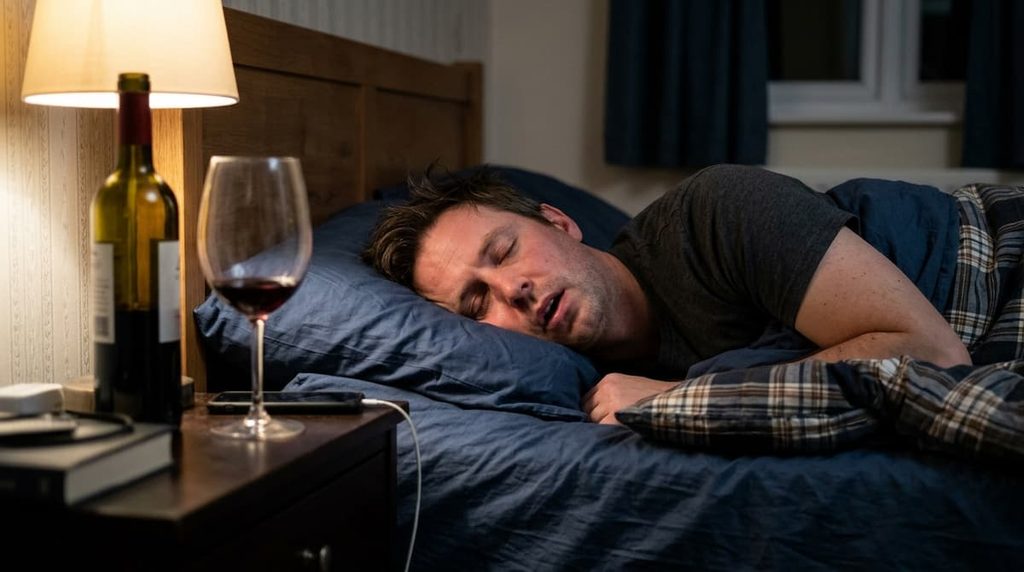
A drink before bed can make something seem very simple.
You have had a long day. You drink alcohol, start to feel relaxed, and before long, your eyes become heavy. Falling asleep may seem easier than it usually does.
It is easy to interpret that feeling as a sign that alcohol helps you sleep.
But sleep does not begin and end with the moment you close your eyes.
While you are asleep, your brain moves through several stages in a repeating pattern. Alcohol can change that pattern, even when it makes the beginning of the night feel easier.
That creates a strange contradiction. Something that makes you feel sleepy can also interfere with the way your brain sleeps.
So what is actually happening after that first wave of sleepiness?
Alcohol can make falling asleep easier
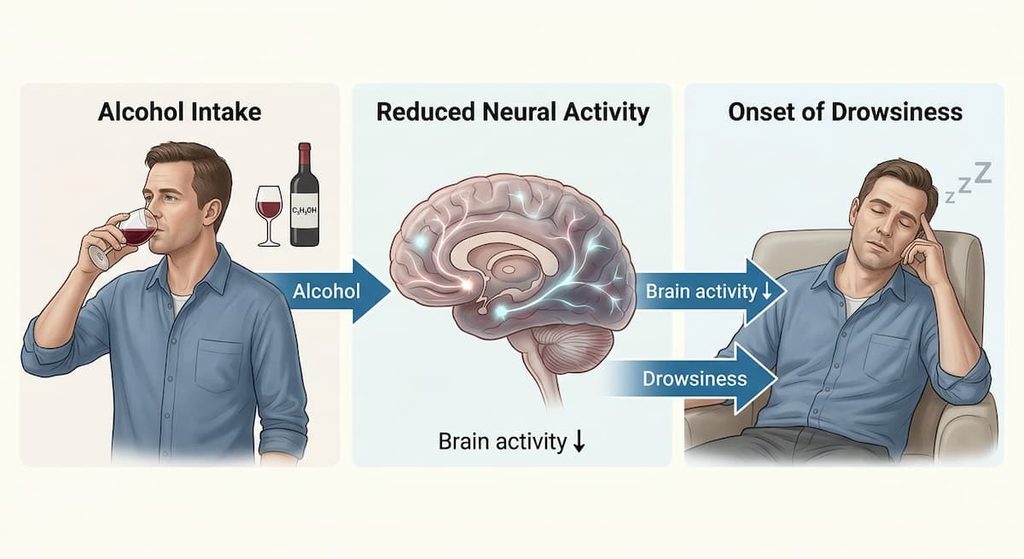
Alcohol has a depressant effect on the central nervous system, which can reduce alertness and make you feel relaxed and sleepy. At sufficiently high doses, this effect can also shorten the amount of time it takes to fall asleep.
A recent systematic review and meta-analysis looked at 27 studies examining alcohol and subsequent sleep. The researchers found that higher doses of alcohol could reduce sleep-onset time, meaning people tended to fall asleep faster.
But there is an important detail.
The effect was not equally strong at every dose. The analysis found the clearest reduction in the time needed to fall asleep at relatively high doses, while lower doses did not consistently produce the same effect.
So the common idea that alcohol simply acts as a sleeping aid is already too simple.
More importantly, falling asleep is only the first event in a much longer process.
Once you are asleep, your brain does not simply remain switched off. It moves through different stages of sleep, and the balance between those stages changes throughout the night.
Alcohol can affect those stages in ways that are very different from the initial feeling of sedation.
Sleep is not one single state
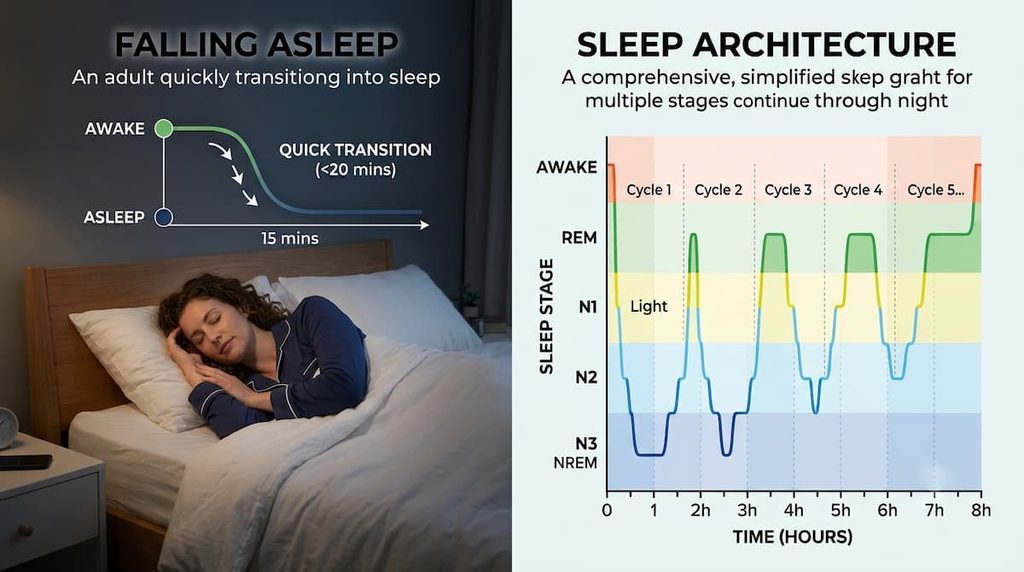
During a normal night, the brain cycles through non-REM and REM sleep.
Non-REM sleep includes several stages, ranging from lighter sleep to slow-wave sleep, often called deep sleep. REM sleep is the stage in which vivid dreaming commonly occurs, but its role is broader than dreaming. It is a normal and recurring part of the organization of sleep.
These stages do not appear randomly.
The brain follows a changing pattern across the night, with different stages becoming more or less prominent at different times.
That pattern matters because good sleep is not simply about spending as many hours as possible unconscious. The timing and balance of the stages are also part of what makes sleep normal.
This is where alcohol becomes interesting.
It can make the transition into sleep easier while simultaneously changing what happens after that transition.
Alcohol has a particularly strong effect on REM sleep
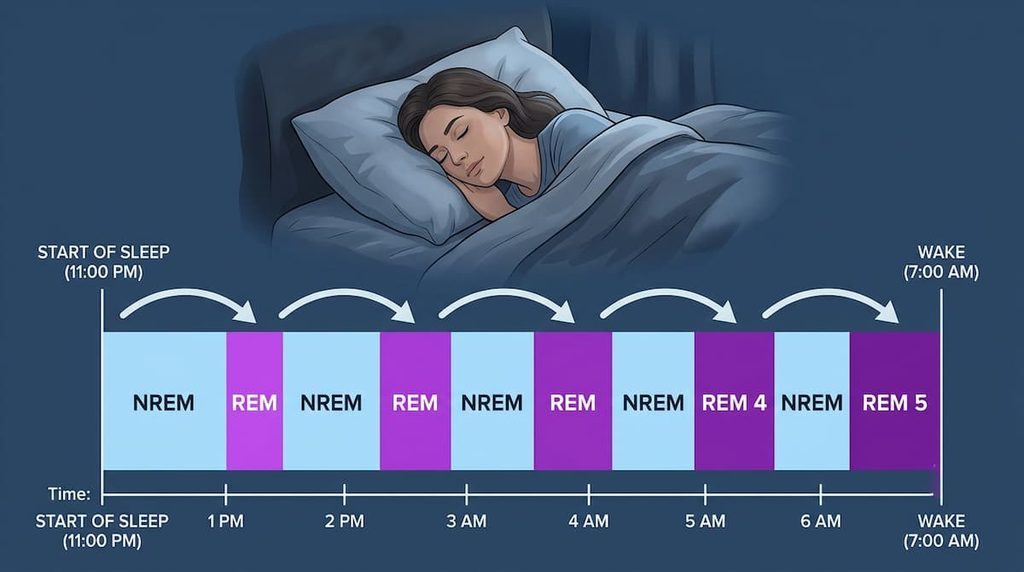
One of the most consistent findings in research on alcohol and sleep involves REM sleep.
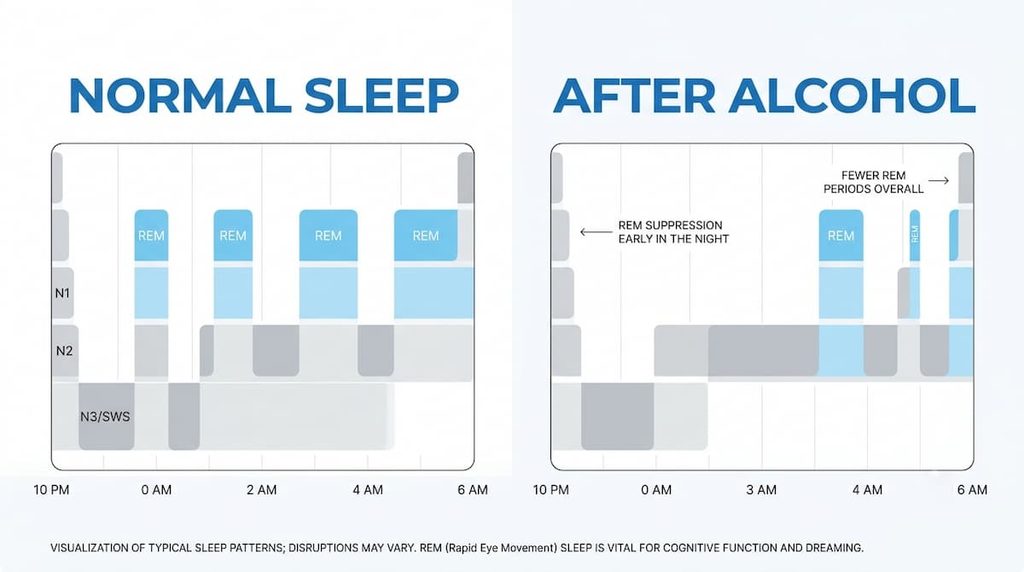
The 2025 systematic review and meta-analysis found that alcohol delayed the onset of REM sleep and reduced the amount of time people spent in REM sleep. The reduction was not limited to very high doses. Changes in REM sleep were also observed at relatively low doses, and the effect generally became stronger as alcohol exposure increased.
This creates an important distinction.
Alcohol does not simply make sleep disappear.
Instead, it changes the structure of the sleep that follows.
Imagine falling asleep quickly after drinking. From your perspective, everything may seem to have worked exactly as expected. You felt sleepy, your body relaxed, and you were asleep sooner than usual.
But your brain continues moving through its sleep cycles without you being aware of them.
REM sleep can be delayed and reduced during that process.
So the question is not simply whether alcohol helps you fall asleep.
The more interesting question is what happens to sleep after you have fallen asleep.
The first part of the night can be different from the second
Alcohol’s effects do not necessarily remain the same throughout the night.
This is one of the reasons the experience can be confusing.
Experimental studies have found that alcohol can produce stronger sedating effects during the earlier part of the night. In some studies, people fell asleep more quickly and spent more time in slow-wave sleep during the first part of the night.
That sounds beneficial at first.
After all, if someone falls asleep quickly and appears to enter deeper sleep, why would alcohol be considered disruptive?
The answer becomes clearer when the rest of the night is included.
As time passes, alcohol is gradually metabolized and its concentration in the body falls. The effects seen shortly after drinking therefore do not necessarily remain unchanged until morning.
Research has found that sleep organization can change later in the night, including increases in lighter sleep and alterations in sleep continuity.
The result is a night that can have two very different phases.
The beginning may be dominated by alcohol’s sedating effect.
Later, the pattern of sleep can become less like the normal progression seen without alcohol.
That is why judging alcohol’s effect on sleep by the first few hours can be misleading.
Why does deeper sleep not solve the problem?
There is an especially interesting detail here.
Some studies have found that alcohol can increase slow-wave sleep during the early part of the night. Slow-wave sleep is often described as deep sleep, so it might seem that alcohol is actually improving one of the most important parts of sleep.
But sleep does not work like a competition in which more of one stage automatically means better sleep.
The brain normally moves through a coordinated sequence of stages. Increasing one part while suppressing or delaying another changes the overall architecture of sleep.
This is why a person can experience strong sedation and still have altered sleep.
Think about the difference between being unconscious and experiencing normal sleep. They may look similar from the outside, but the brain is doing very different things in each state.
Alcohol can push the brain toward sleepiness, but that does not mean it reproduces the normal sequence of sleep.
The research on REM sleep makes this particularly clear. Alcohol can increase some forms of sleep early in the night while reducing or delaying REM sleep.
So simply asking, “Did I sleep deeply?” does not give us enough information to understand what alcohol did to the entire night.
What happens as alcohol levels fall?
There is another piece of the puzzle.
Alcohol does not remain at the same concentration after you drink it. The body gradually breaks down ethanol, mainly through the liver, and blood alcohol levels fall over time.
This means the brain is exposed to a changing level of alcohol rather than one constant dose throughout the night.
That matters because the effects of alcohol on sleep depend partly on when the alcohol was consumed and how much was consumed.
If someone drinks shortly before going to bed, the early part of sleep may occur while alcohol levels are still relatively high. Several hours later, the alcohol concentration may be much lower.
The sleep system, meanwhile, is continuing through its normal cycles.
This does not mean that everyone who drinks before bed will wake up at a particular time or experience exactly the same sleep disturbance. Studies differ in their findings for total sleep time, sleep efficiency, and nighttime wakefulness.
Those outcomes are much less consistent than the effect on REM sleep.
That distinction is important because it keeps the science from turning into an exaggerated claim.
Alcohol does not affect every person in exactly the same way, and researchers cannot use the evidence to predict one identical pattern for everyone.
What the evidence does show more consistently is that alcohol can alter the organization of sleep, especially REM sleep.
So why can alcohol feel like it helps?
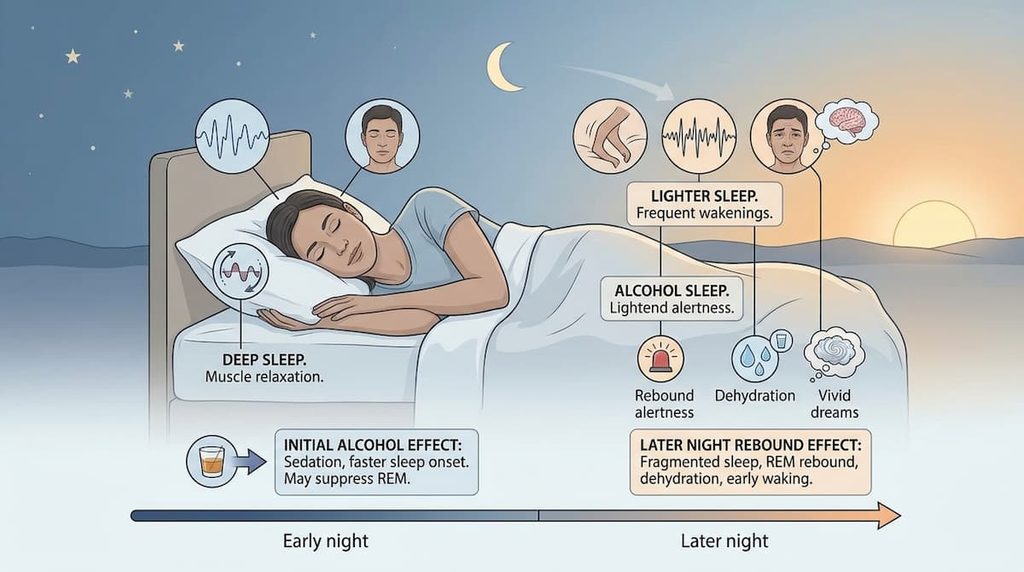
Because the first effect is the one you can actually feel.
You notice relaxation.
You notice sleepiness.
You notice that you fell asleep quickly.
You do not consciously notice your REM sleep being delayed or reduced while it is happening.
This creates a natural misunderstanding.
If the experience immediately before sleep feels better, it is easy to assume that the entire night of sleep must also be better.
But those are two different measurements.
One asks how quickly you fall asleep.
The other asks what happens to your brain during the hours that follow.
Alcohol can improve the first measurement under some conditions while changing the second.
That is why people can honestly describe alcohol as something that “helps them sleep” even though controlled studies show measurable changes in their sleep architecture.
The two observations are not necessarily contradictory.
They are describing different parts of the same night.
Does this mean alcohol always ruins sleep?
No. The evidence is more nuanced than that.
The strongest findings concern changes in REM sleep and the effects of alcohol on the organization of sleep. Other outcomes, such as total sleep time and sleep efficiency, vary more between studies.
Individual responses can also differ depending on the amount of alcohol consumed, timing, body characteristics, and other factors that affect sleep.
So it would be too strong to say that anyone who drinks will definitely sleep badly or wake repeatedly during the night.
The better-supported conclusion is more specific.
Alcohol can make falling asleep easier at sufficiently high doses, but that sedating effect does not mean the brain is producing a normal night of sleep. Alcohol can alter sleep architecture, with REM sleep particularly sensitive to its effects.
That difference is easy to overlook because falling asleep is something we experience directly, while changes in sleep architecture happen outside our awareness.
Falling asleep and sleeping well are not the same thing
This is what makes alcohol and sleep more interesting than the familiar advice to avoid drinking before bed.
The important distinction is between sleep initiation and sleep architecture.
Sleep initiation is about how quickly you move from being awake to being asleep.
Sleep architecture describes how your brain organizes the different stages once you are asleep.
Alcohol can influence both, but not in the same direction.
At higher doses, it can make the first transition easier. At the same time, it can delay REM sleep and reduce the amount of REM sleep that occurs.
That means the feeling of becoming sleepy after a drink is real, but it tells only part of the story.
Your brain does not simply go from “awake” to “asleep” and stay there. It spends the night moving through a carefully organized sequence of states.
Alcohol can change that sequence.
So the next time a drink makes you feel sleepy, there is a more interesting scientific question than simply asking whether it helped you fall asleep.
It is this:
What happened to your sleep after you stopped noticing it?
The answer is that alcohol may make the beginning of sleep easier while changing the biological pattern that follows. And that is why feeling sleepy is not the same thing as getting normal sleep.
Scientific Sources
1. Gardiner C, Weakley J, Burke LM, Roach GD, Sargent C, Maniar N, Huynh M, Miller DJ, Townshend A, Halson SL. “The effect of alcohol on subsequent sleep in healthy adults: A systematic review and meta-analysis.” Sleep Medicine Reviews. 2025;80:102030. PMID: 39631226. DOI: 10.1016/j.smrv.2024.102030. Read the study on PubMed
2.McCullar KS, Barker DH, McGeary JE, Saletin JM, Gredvig-Ardito C, Swift RM, Carskadon MA. “Altered sleep architecture following consecutive nights of presleep alcohol.” Sleep. 2024;47(4):zsae003. PMID: 38205895. DOI: 10.1093/sleep/zsae003. Read the study on PubMed
3. Feige B, Gann H, Brueck R, Hornyak M, Litsch S, Hohagen F, Riemann D. “Effects of alcohol on polysomnographically recorded sleep in healthy subjects.” Alcoholism: Clinical and Experimental Research. 2006;30(9):1527-1537. PMID: 16930215. DOI: 10.1111/j.1530-0277.2006.00184.x. Read the study on PubMe