[Bit#88] Saliva Secrets: Predict Your Health with DTC Genes
Introduction
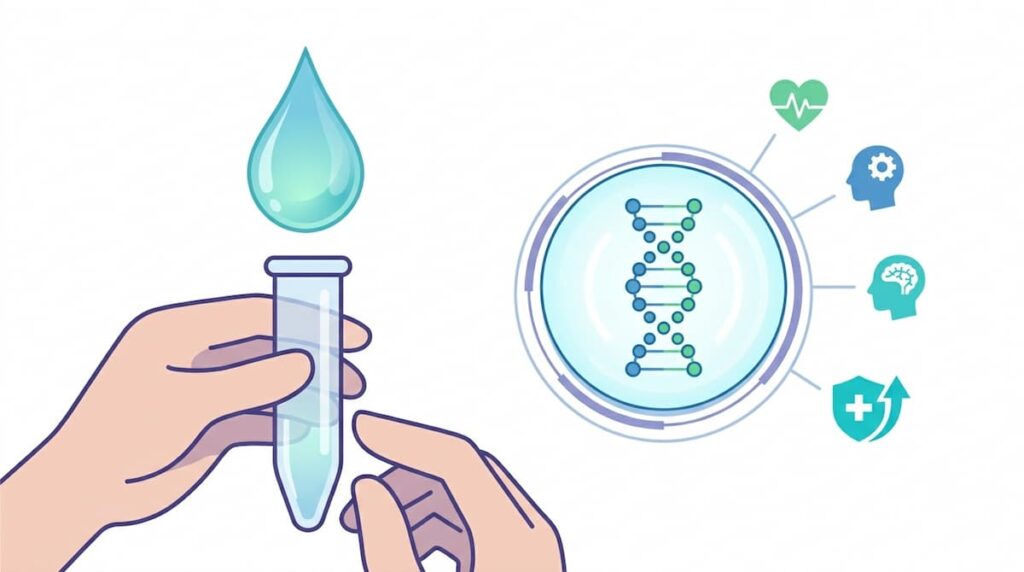
The era of peering into future illnesses with a single drop of saliva has arrived. Direct-to-Consumer (DTC) genetic testing, which allows individuals to check genetic vulnerabilities at home without visiting a hospital, is becoming a mainstream trend. This technology offers incredible convenience to humanity, but it simultaneously presents a massive question. Can genes truly dictate our lifespan and health in absolute terms? This article delves deeply into the scientific reality of saliva-based genetic testing and uncovers the critical ethical controversies hidden behind it.
1. The Code Hidden in Saliva Definition and Principles of DTC Genetic Testing

We swallow saliva every single day without a second thought. However, would you believe it if you were told that this ordinary fluid contains your entire biological history? This intriguing premise is the starting point of the recently spotlighted DTC genetic testing. DTC stands for Direct-to-Consumer services, where individuals directly request genetic analysis from private corporations without passing through medical institutions.
The entire testing process is surprisingly simple. You collect your saliva in a kit delivered to your home and send it back via courier. There is no need to schedule appointments at a hospital, nor do you have to endure scary needles to draw blood.
Then, how exactly does this tiny drop of saliva predict future diseases? The hidden secret lies within the oral epithelial cells shed into your saliva. Testing laboratories separate nucleic acids from these collected cells. They then meticulously scan billions of base pairs that constitute your DNA.
The core objective here is identifying regions called Single Nucleotide Polymorphisms (SNPs). Human beings share an identical genetic makeup of 99.9 percent. A microscopic difference of merely 0.1 percent determines our varying physical appearances and unique constitutions. This method works by locating these tiny variant regions, where just a single letter of the genetic code differs, and comparing them with vast demographic data to forecast future disease vulnerabilities.
Why do we specifically utilize saliva among numerous biological samples? DNA exists identically in every single cell throughout our bodies. Therefore, using hair strands or blood samples yields the exact same results. However, saliva offers the lowest difficulty in collection. Anyone from infants to the elderly can provide samples safely without experiencing any pain.
Furthermore, saliva has the distinct advantage of being extremely easy to store and transport at room temperature. Recent exponential leaps in biotechnology have dramatically lowered testing costs compared to the past. Today, we live in a world where you can receive your personal genetic blueprint for just a few dozen dollars. Saliva-based testing is moving beyond the era of merely treating illnesses, transforming into a powerful tool for autonomous disease prevention.
2. Preventing Cancer with a Drop of Saliva The Actual Efficacy of Disease Vulnerability Analysis
Receiving genetic test results for the first time can make your heart sink instantly. How would you feel if your results stated that your risk of developing a specific cancer is three times higher than the average person? Fear strikes immediately. You become consumed by anxiety, feeling as though a major illness will manifest tomorrow.
Then, is this numerical figure an unchangeable, absolute death sentence? The conclusion is an absolute no. Genetic vulnerability is merely a statistical index indicating that you were born with slightly more risk factors than others.
Why do these differences in probability occur? It is because diseases are never determined by a single gene alone. Chronic illnesses we dread, such as cancer, diabetes, and high blood pressure, do not result from a single genetic defect. Instead, they are the complex product of interactions between numerous genetic variations and acquired environmental factors.
A genetic test operates much like a high-performance weather forecast. Just because the forecast says there is an 80 percent chance of rain tomorrow does not mean a torrential downpour is guaranteed to happen. It is a strong warning signal advising you to prepare an umbrella in advance.
The true efficacy lies not in feeling terror, but in the power to reshape your future. Knowing your vulnerabilities beforehand allows you to manage your health much more systematically than others. For instance, what if your results indicate a high vulnerability to colorectal cancer? You can proactively reduce greasy foods and strictly adjust your diet by avoiding charred portions. You can also actively defend your genetic weaknesses by advancing the intervals of your colonoscopy screenings rather than waiting around for routine national checkups.
Ultimately, this test hands you a weapon to detect signs of disease much faster than anyone else. Most critical diseases, including cancer, achieve exponentially higher cure rates when discovered in their early stages. Data uncovered through a single drop of saliva is not an object of dread. Rather, it is the most scientific preventative measure that blocks a negative future and helps design a healthy life. Knowing your weak points is equivalent to gaining an opportunity to overcome them.
3. The Trap of Blind Faith in Genes The Twist of Environmental Factors and Epigenetics
Many people place absolute, blind faith in their genetic test results. They fall into despair when facing high disease risks, yet they become careless when seeing low risk factors, assuming they can live recklessly. Do genes truly determine everything regarding our health and longevity?
The definitive answer is absolutely not. Genes are merely a blueprint that records possibilities. Within our bodies, another system operates with equal importance to this genetic blueprint. This is the fascinating world of epigenetics, a field currently capturing the intense focus of the biomedical community.
To put it simply, epigenetics is the switch system of our genes. The DNA base pairs inherited from our parents never change throughout our entire lives. However, whether those specific genes actually express themselves inside our bodies is determined by post-natal factors.
Why is this the case? The food we consume daily, our sleep duration, exercise amounts, and even stress levels act to flip these genetic switches on and off. Even if you were born with a cancer-related gene, if you maintain rigorous health management, that switch can remain turned off and asleep for your entire life. The safety pin of the disease bomb is never pulled.
The reverse scenario is equally true. No matter how clean and healthy your genetic makeup is, post-natal indulgence remains highly dangerous. What happens if you eat late-night snacks daily, smoke cigarettes, and suffer from chronic stress? The quietly sleeping disease switches are forced to turn on.
In the end, what is far more terrifying than inherited genetic variations is your post-natal lifestyle and environment. A genetic test is merely a navigation system that identifies your body’s weaknesses in advance. Holding the steering wheel and deciding which path to take is ultimately your choice. What transforms a crisis into an opportunity is not your genes, but your daily routines right now.
4. Is My Genetic Information Safe Privacy and Ethics of Biological Data

An era where health can be predicted with a single drop of saliva is incredibly convenient. However, a massive shadow lurks behind this convenience. This is the critical danger of personal data leaks. We often view genetic testing lightly, equating it to signing up for a smartphone application. You can easily change your name or phone number if needed. However, your DNA data is absolute, unique information that can never be altered throughout your lifetime.
The problem begins the moment this information is stored on the servers of private corporations. What happens if that company suffers a cyberattack? Your most intimate biological weaknesses will be exposed to the world. In fact, a major overseas genetic testing firm was hacked, resulting in the leak of millions of individuals’ genetic data onto the dark web. No one can guarantee where or how your genes might be circulating.
Even more frightening is the scenario where genetic information is commercially exploited. What if insurance companies acquire this data? They could reject coverage for individuals with high genetic cancer vulnerabilities or raise premiums to exorbitant levels. In the hiring market, a future might arrive where corporations demand genetic blueprints from job applicants. Genetic discrimination, where individuals are excluded from society simply because they possess a higher probability of developing a certain disease, could become a reality.
Technology always runs faster than law and ethics. Legal safeguards to protect genetic data remain severely insufficient. Before spitting into a kit and sending it away, we must ask ourselves a vital question. Are we surrendering our biological sovereignty too easily just to satisfy immediate curiosity? Your DNA left behind in digital spaces can become a far more dangerous weapon than you think.
Conclusion
Genetic testing initiated by a single drop of saliva instills a powerful illusion that we can fully control our health. Knowing risks in advance to prepare is undoubtedly a blessing. However, the belief that genes dictate our entire future merely reduces human beings to slaves of a DNA blueprint. Science only informs us of probabilities; it never decides how we should live our lives today.
We must collectively contemplate the ethical values hidden beneath technological convenience. Is your body, quantified into numerical data, your true self? Or is it merely one of numerous changeable possibilities? When a future arrives where the secrets of genes are completely controlled, we must ask ourselves whether we can still prove our human dignity and free will.
![[Bit#18] From a Badge of Survival to the Root of Disease: The Cruel Paradox of Obesity](https://hiddenbitknowledge.com/wp-content/uploads/2026/05/48843f2b382a-768x512.jpg)
![[Bit#87] Why Cavities Are the Price of Human Evolution](https://hiddenbitknowledge.com/wp-content/uploads/2026/07/main.Cavities-768x512.jpg)
![[Bit#9] Why We Must Die: The ‘Expiration Date’ Chosen by Evolution](https://hiddenbitknowledge.com/wp-content/uploads/2026/04/0348b8923730-768x585.jpg)
![[Bit#141] Why 98 Percent of DNA in My Body Remains Silent](https://hiddenbitknowledge.com/wp-content/uploads/2026/09/DNA-768x419.jpg)
![[Bit#63] Why Did Life That Once Hatched From Eggs Choose the Placenta?](https://hiddenbitknowledge.com/wp-content/uploads/2026/06/main.Eggs-and-chickens-768x512.jpg)
![[Bit#108] The Mitochondrial Twist: The Evolutionary Secret of Maternal Cellular Energy](https://hiddenbitknowledge.com/wp-content/uploads/2026/07/main.human-mitochondria-768x538.jpg)