[Bit#163] Plant Nyctinasty: The Secret Cellular Science Behind How Plants Sleep

When night falls, leaves that once reached toward the sun fold up silently in the dark. How can a plant detect the arrival of night and move its body without eyes or muscles? This column explores the remarkable biological mechanisms hidden behind plant sleep movement. Beyond simple responses to stimuli, we look into how plants calculate time and deploy sophisticated survival strategies. Understanding the night life of plants provides a fresh perspective on the life cycles of all living beings and the overall order of nature.
1. The Hidden Nighttime Behavior of Leaves Folding

As daylight fades and darkness sets in, take a close look at a silk tree or clover in the garden. Leaves that were widely expanded during the day drop downward or fold against each other as if following a strict agreement. It resembles a plant settling into bed after a long, exhausting day. Scientists refer to this phenomenon as sleep movement or nyctinasty.
Plants do not possess eyes or ears like animals. They naturally lack both a nervous system and muscular structures. How then do they realize night has arrived and execute such precise movements?
The secret resides in a specialized tissue called the pulvinus, located at the base of the leaf stalk. Inside the pulvinus, water-filled cells are densely packed together. When night comes, the plant regulates the ion concentration inside these cells. As ions move, water flows out of or into the cells accordingly.
The side where water exits experiences a drop in turgor pressure, much like a balloon losing air. Conversely, the side where water accumulates swells up tightly. This difference in volume and water pressure creates a smooth bending motion. Consequently, the plant achieves remarkable folding and unfolding movements without relying on a single muscle.
This process is not a passive wilting caused merely by the absence of light. It is the direct result of a physical mechanism responding to external stimuli. Plants do not stand idly without function. Every night, they stay remarkably busy adjusting cellular pressure within their bodies. Even while humans sleep, plants complete their preparations for the night in their own sophisticated manner.
2. Plant Biological Rhythms Formed by Light and Internal Clocks
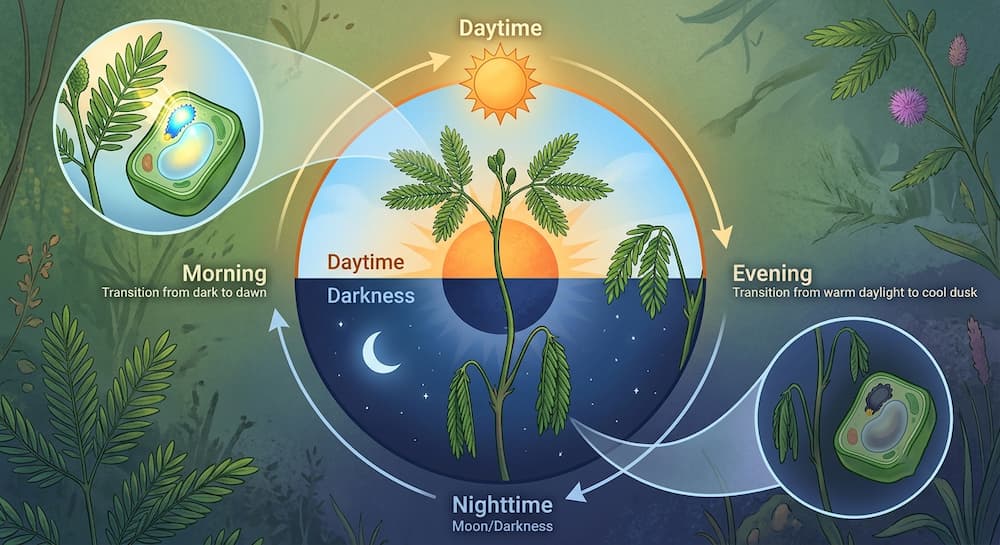
Plants do not fold their leaves simply because light disappears. If you place a plant inside a completely dark box, its leaves still fold on schedule at the time night normally arrives. This indicates that plants accurately calculate their own time even in the total absence of external light. How can a plant without eyes keep track of time?
The secret lies in an internal biological clock operating within the plant cells. Plants possess a unique genetic circuit inside their cellular structure. This circuit repeats a cycle of synthesizing and breaking down specific proteins roughly every 24 hours. When protein concentrations peak or hit bottom, the cells distinguish between day and night. External light merely serves as a calibration tool to correct daily drift in this internal clock.
Plants feature specialized photoreceptors called phytochromes and cryptochromes. These receptors detect not only the intensity of light but also its specific color spectrum. As the sun sets and the ratio of red light changes, these receptors recognize the shift instantly. The detected signal travels directly to the internal biological clock, signaling the cells to begin night preparations.
Ultimately, sleep movement is far from a passive reaction. It represents an active life process created through the seamless cooperation of an intricate genetic clock and external light receptors. Plants never face the night unprepared. Well before sunset, they thoroughly adjust their internal chemical balance to gear up for the darkness.
3. Critical Survival Advantages of Sleep Movement in Plants

Expending energy to move leaves is by no means an easy task for a plant. Why do plants repeat this demanding exercise every single night? What compelling reasons force them to fold their leaves night after night?
The primary reason involves maintaining body temperature and preventing moisture loss. During the day, leaves absorb sunlight and heat up. Once the sun drops, however, heat escapes rapidly into the night sky, causing leaves to cool down drastically. Keeping leaves fully expanded leaves them vulnerable to frost and cold damage. Folding the leaves reduces the surface area exposed to the cool air. This acts as a reliable shield, preserving internal temperature and guarding against water loss caused by dew.
It also serves as a vital survival strategy to avoid predators. Herbivorous animals and insects often identify plants by their leaf shapes at night. If a plant pulls its leaves tightly downward to look wilted, animals perceive it as dead or unappetizing. Folding the leaves functions as an effective camouflage to protect the plant from nocturnal visitors.
In short, sleep movement is not simple rest. It is a highly developed survival formula chosen to endure a harsh natural environment. Every time night falls, plants erect their best defensive barrier to protect their lives. Inside a quiet night garden, plants are actively engaged in a life-or-death survival game at this very moment.
4. Questions Plant Nighttime Behaviors Pose to Modern Science

The precise movement of plants folding their leaves each night is more than a simple natural spectacle. Scientists are finding crucial hints within this nocturnal rhythm to transform future technologies. How can an organism without a neural network or a brain compute time and move so accurately?
Robotic engineers have recently focused on the structural mechanics of the plant pulvinus. Traditional robots rely on heavy metal components, rigid parts, and noisy motors. Plants, however, fold and unfold smoothly without any motor by regulating internal cellular water pressure.
Applying this mechanism led to the development of next-generation soft robotics. This field replaces hard metals with flexible materials, operating machines by controlling internal fluid or gas pressure. What benefits do soft, plant-like movements offer? They can be applied to surgical robots handling delicate human organs or industrial grippers handling fragile items like eggs without damage. Such systems operate without motor noise and drastically reduce the risk of structural failure.
Plant sleep movement also provides deep insights into agriculture and human health. Controlling plant biological clocks can accelerate crop growth rates or offer key clues to treating human sleep disorders. The roadside weed we pass by without a second thought is actually a concentration of advanced technology developed over hundreds of millions of years.
Conclusion
Plant sleep movement is not just a natural display. It is a grand art of survival practiced by living organisms in harmony with their surroundings. Observing a plant with no brain and no muscles set its internal clock and move its body every night leaves a deep impression.
Do we truly understand nature as a whole? Or are we merely looking at a tiny fraction of what nature reveals? The night life of plants, hidden in quiet darkness, urges us to move beyond human-centric thinking and reflect on the sophisticated intelligence of all living things.
![[Bit#137] The Science of 36.5°C: The Secret of Cellular Thermodynamics Optimized for Survival](https://hiddenbitknowledge.com/wp-content/uploads/2026/08/main.36.5-767x428.jpg)
![[Bit#160] Why Do You Feel Extreme Thirst the Day After Drinking?](https://hiddenbitknowledge.com/wp-content/uploads/2026/09/main.drink-Thirst-768x419.jpg)
![[Bit#74] The Warning from Siberia: Ancient Viruses Awakening from the Permafrost](https://hiddenbitknowledge.com/wp-content/uploads/2026/06/main.virus-and-ice-768x432.jpg)
![[Bit#85] Is a Virus Alive? The Shocking Truth Behind the Ultimate Biological Mystery](https://hiddenbitknowledge.com/wp-content/uploads/2026/07/main.virus_-768x512.jpg)
![[Bit#130] Stop Ignoring Your Arteries: The Secret Power of Bioflavonoids](https://hiddenbitknowledge.com/wp-content/uploads/2026/08/main.bioflavonoids-767x428.jpg)
![[Bit #156] The Real Reason It Hurts Less When You Rub Where You Hit](https://hiddenbitknowledge.com/wp-content/uploads/2026/09/main.pain-reduce-768x419.jpg)