Why Do Some Plankton Glow in the Dark? [Bit#197]
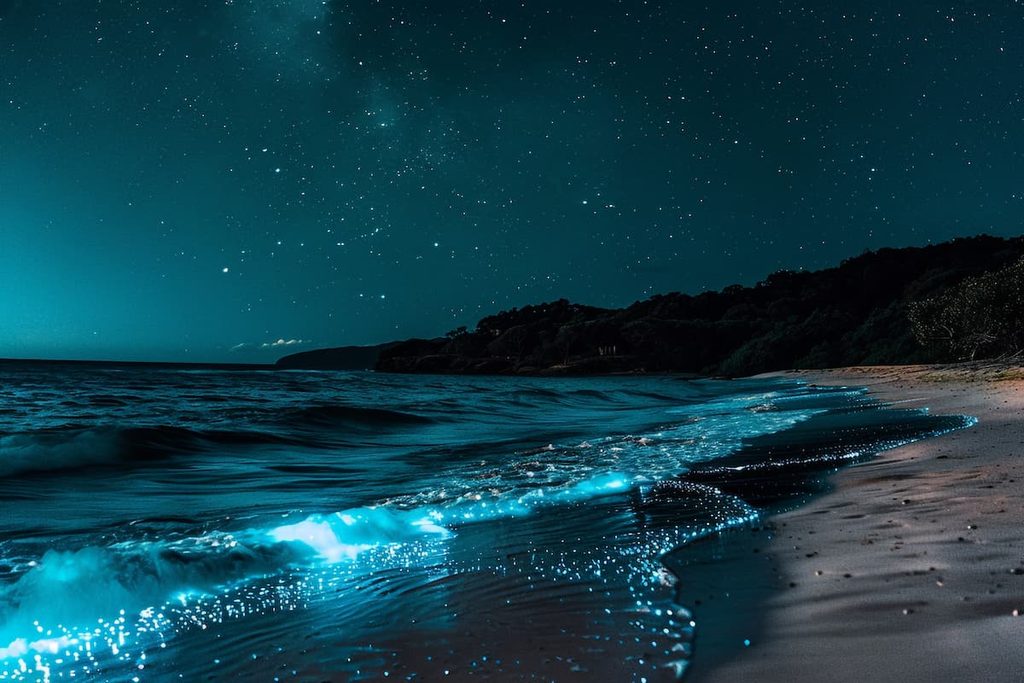
Imagine standing beside the ocean at night. A wave rolls toward the shore, and suddenly the water glows blue. For a moment, the moving sea looks as if it contains tiny stars.
The light may seem magical, but it comes from living organisms in the water. Some of them are plankton, tiny organisms that drift with ocean currents. When the water moves around them, certain plankton can produce brief flashes of light.
What makes this especially interesting is that the light may do more than create a beautiful sight. For some plankton, it can help them survive an encounter with a hungry predator.
What Makes the Ocean Glow?
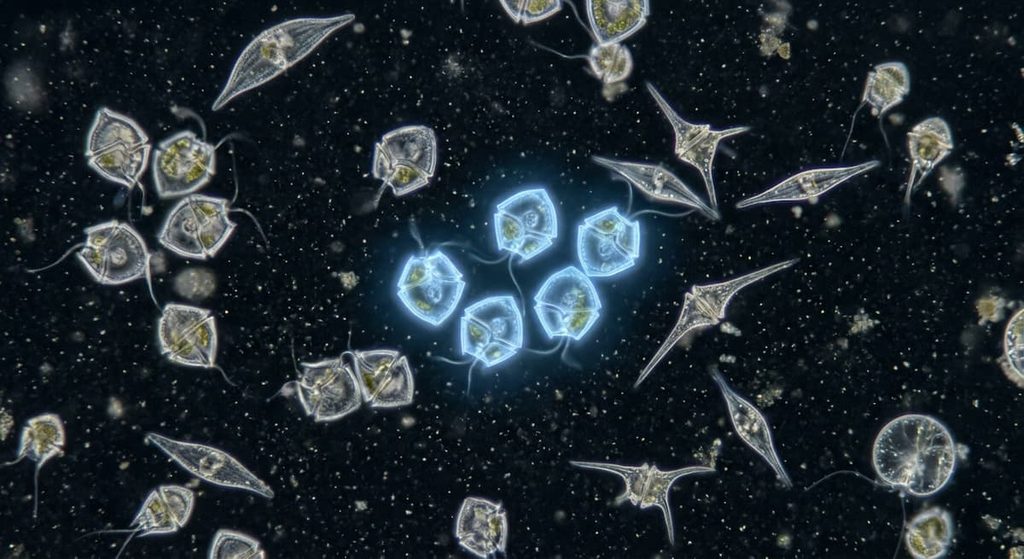
Plankton is not one particular kind of organism. The word describes a wide range of living things that drift in water rather than swimming strongly enough to control their movement against currents.
Some plankton are tiny animals. Others are bacteria, algae, or other microscopic organisms. They differ greatly in size, shape, and how they get their food.
The light-producing plankton in this story belong to a group called dinoflagellates. These mostly single-celled organisms are found in marine environments, and some species can produce their own light.
This ability is called bioluminescence. In simple terms, it means that a living organism produces light through a chemical reaction inside its body.
Dinoflagellates are not the only glowing organisms in the ocean. Certain jellyfish, squid, fish, and marine bacteria can also produce light. However, the glow that appears when waves disturb the surface can often come from light-producing plankton.
The important detail is that not all plankton glow. Even among dinoflagellates, the ability varies by species.
How Can a Single Cell Make Light?
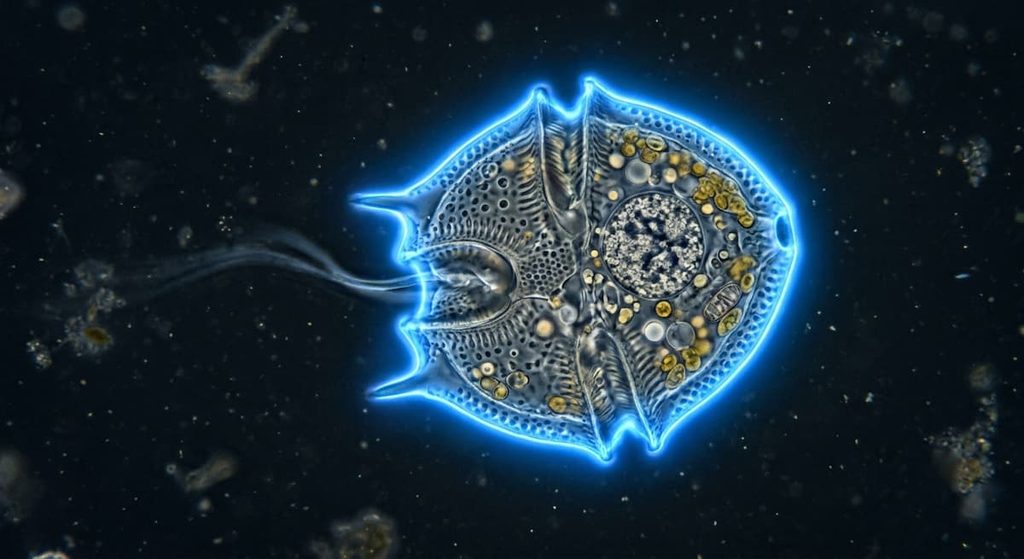
A dinoflagellate is made of just one cell, yet that cell can produce a visible flash under the right conditions. It does not need eyes, a brain, or a complicated lighting system.
Instead, it uses chemistry.
Inside light-producing dinoflagellates are tiny structures called scintillons. These contain components needed for the light-producing reaction, including a substance called luciferin and an enzyme called luciferase.
An enzyme is a molecule that helps a chemical reaction happen. In this case, luciferase helps drive the reaction involving luciferin and oxygen, releasing energy as light.
But the reaction does not simply run all the time. The cell must activate its light-producing system.
When the cell experiences mechanical stimulation, such as movement caused by a breaking wave or contact with another organism, changes inside the cell can trigger a flash. The process involves changes in acidity within the light-producing structures, which help activate the chemical reaction.
The result is a brief burst of light, often blue.
Why blue? Blue light travels relatively well through seawater compared with many longer wavelengths, making it a useful color in the marine environment. The exact color depends on the organism and its light-producing system.
Although scientists understand many parts of this process, some details of the chemistry remain under investigation. That does not change the central finding: certain dinoflagellates can turn physical disturbance into a flash of light.
A Predator Approaches
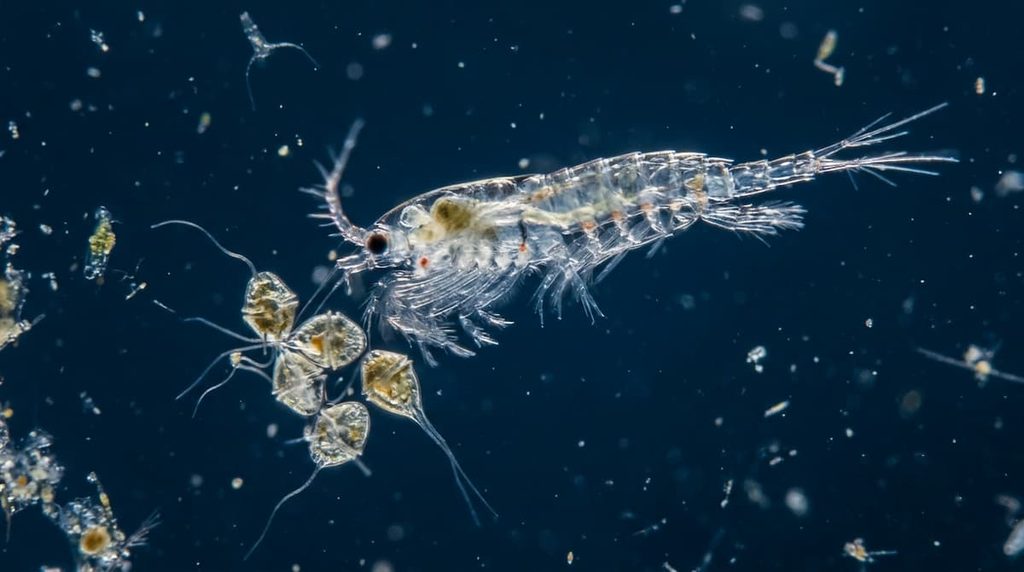
Producing light takes energy and requires specialized cellular machinery. So why would a tiny organism use this ability?
One important clue comes from its interactions with predators.
Small crustaceans called copepods are common animals in marine plankton communities. Many feed on microscopic organisms, including dinoflagellates. Because copepods are so small, these encounters can happen at a scale that is difficult to see without a microscope.
Researchers have investigated what happens when copepods encounter light-producing dinoflagellates.
In one experiment, scientists studied a dinoflagellate species called Lingulodinium polyedra. They exposed the cells to chemical signals associated with copepods. These signals indicated that potential grazers were nearby, even before the organisms necessarily came into direct contact.
The dinoflagellates responded by increasing their capacity to produce light.
The researchers then examined how copepods behaved when feeding on the stimulated cells. The results showed a striking change: copepods that had readily eaten the dinoflagellates under one condition strongly rejected them after their light-producing capacity had been increased.
High-speed, low-light-sensitive video also showed cells flashing when copepods came into contact with them, followed by the copepods rejecting the cells.
This is important because the researchers observed a change in feeding behavior, not simply a beautiful flash under laboratory conditions.
The findings support the idea that bioluminescence can help certain dinoflagellates defend themselves against being eaten.
How Does a Flash Help?
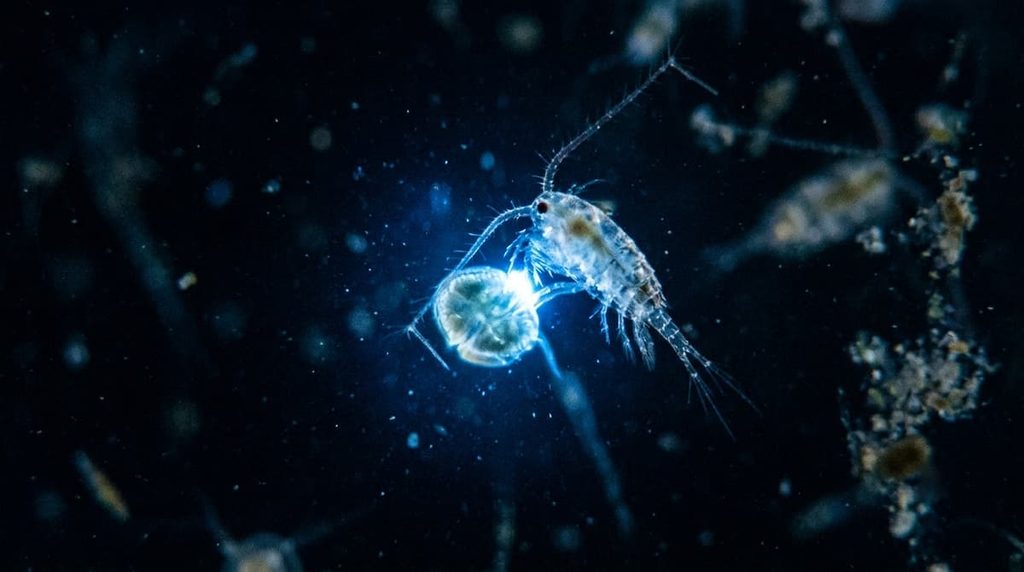
The flash does not physically block the predator. It is not a shield, and the dinoflagellate cannot fight back in the way a larger animal might.
Instead, the light may change what happens during the encounter.
One possibility is that the sudden flash startles the predator or triggers an escape response. A copepod may release a cell it has captured, allowing that cell to survive the encounter.
Another possibility is that the light acts as a warning. Some light-producing dinoflagellates can also produce toxins, so a flash might be associated with prey that is unpleasant or dangerous to eat.
Scientists are still investigating how much each explanation contributes. The effect may differ between species, and the flash alone does not prove that a predator has recognized a warning signal.
There is also a broader idea called the burglar alarm hypothesis. Under certain conditions, a flash could make a feeding predator easier for its own predators to detect. In theory, attracting the attention of a larger animal could indirectly help the plankton being eaten.
This explanation is more complicated than the direct defensive effect, and it should not be treated as a universal explanation for bioluminescence. Different experiments have tested different parts of this idea, and the result depends on the organisms involved.
The clearest lesson is that a flash can change the behavior of other organisms. In some cases, that change gives a tiny cell a better chance of surviving.
Do Plankton Know They Are in Danger?
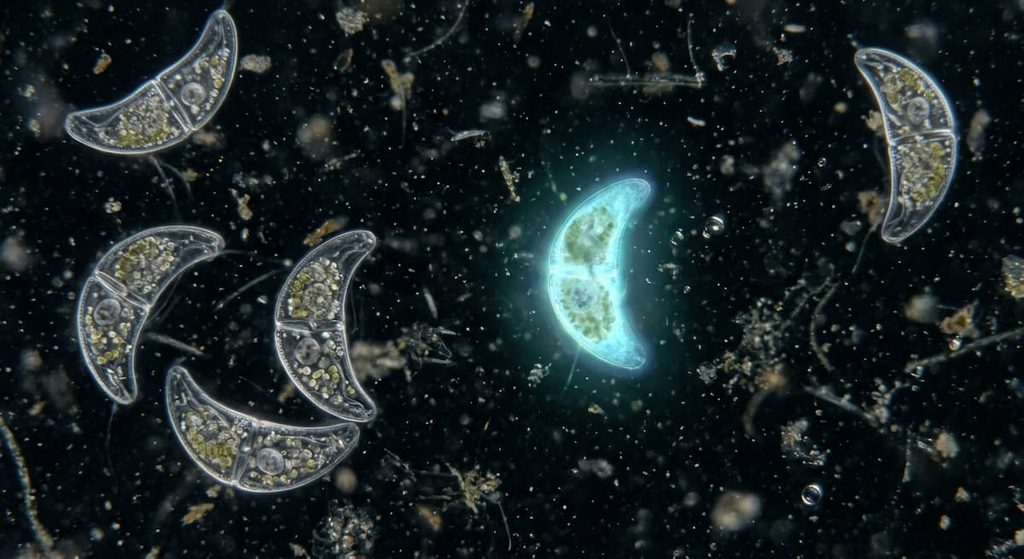
It is tempting to imagine a dinoflagellate sensing danger and deciding to switch on its light. But that description would give the organism abilities that have not been demonstrated.
A dinoflagellate does not need a brain to respond to its surroundings. Cells can detect chemical and physical changes and react through biological processes.
In the experiments, chemical signals associated with copepods increased the light-producing capacity of certain dinoflagellates. Physical contact could then trigger a flash.
This is a biological response, not evidence that the cell consciously understands danger.
The distinction matters. Living organisms can respond to their environments in surprisingly complex ways without having thoughts or intentions like ours.
A single cell can carry out chemical reactions, detect changes, move, and alter its behavior. These abilities are enough to create interactions that affect survival.
Why Doesn’t Every Plankton Produce Light?
If light can help a plankton cell escape a predator, it may seem that every species should evolve the same ability.
But evolution does not give every organism the same solution to the same problem.
Producing light requires specialized biological machinery and energy. Whether it provides a useful advantage depends on the organism, its predators, the conditions in its environment, and the other ways it can survive.
Some plankton rely on different defenses. Certain species produce toxins, while others can change their shape, swimming behavior, or growth patterns. Still others may be eaten without having any specialized defense against a particular predator.
Even among bioluminescent dinoflagellates, researchers have found differences in how the light-producing system responds to environmental signals.
The advantage of glowing may also depend on how many light-producing cells are present and which animals are nearby. A strategy that works in one setting may have little benefit in another.
That is why scientists study individual species and specific interactions instead of assuming that all plankton behave alike.
A Tiny Flash With a Wider Effect
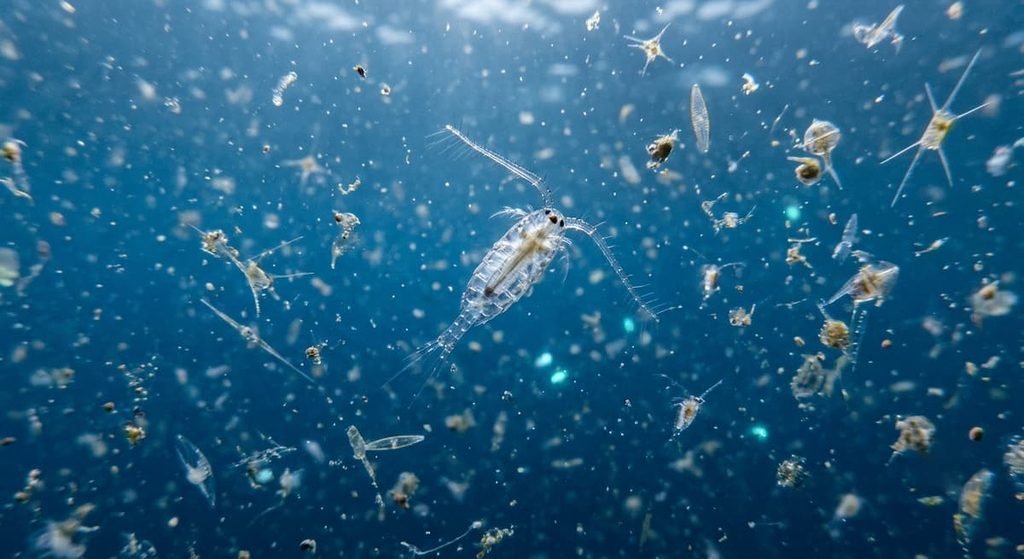
The story of glowing plankton shows how much can happen at a scale invisible to the naked eye.
A single cell produces a flash. A tiny crustacean reacts. That reaction can change whether the cell is eaten, and the effects may extend to other organisms in the food web.
Scientists have even investigated whether the escape movements of copepods after encountering flashing dinoflagellates make the copepods more vulnerable to their own predators. Laboratory experiments published in 2024 provided evidence for such a chain of behavioral effects in a simplified plankton food web.
These results do not mean that every flash changes an entire ocean ecosystem. They show that interactions among very small organisms can have consequences beyond the individual encounter.
The ocean is full of processes that are easy to overlook because the organisms involved are so small. Yet their feeding, movement, chemical signals, and defenses help shape marine communities.
The next time seawater glows blue at night, remember that the light is more than a beautiful effect. In some cases, it is part of a struggle to survive, taking place one microscopic encounter at a time.
Scientific Sources
1. Lindström J, Grebner W, Rigby K, Selander E. “Effects of predator lipids on dinoflagellate defence mechanisms: increased bioluminescence capacity.” Scientific Reports. 2017;7:13104. PMID: 29026130. DOI: 10.1038/s41598-017-13293-4. Read the study on PubMed
2. Prevett A, Lindström J, Xu J, Karlson B, Selander E. “Grazer-induced bioluminescence gives dinoflagellates a competitive edge.” Current Biology. 2019;29(12):R564-R565. PMID: 31211972. DOI: 10.1016/j.cub.2019.05.019. Read the study on PubMed
3. Valiadi M, Iglesias-Rodriguez D. “Understanding Bioluminescence in Dinoflagellates: How Far Have We Come?” Microorganisms. 2013;1(1):3-25. PMID: 27694761. DOI: 10.3390/microorganisms1010003. Read the study on PubMed