How Do Crows Think Ahead? [Bit#206]
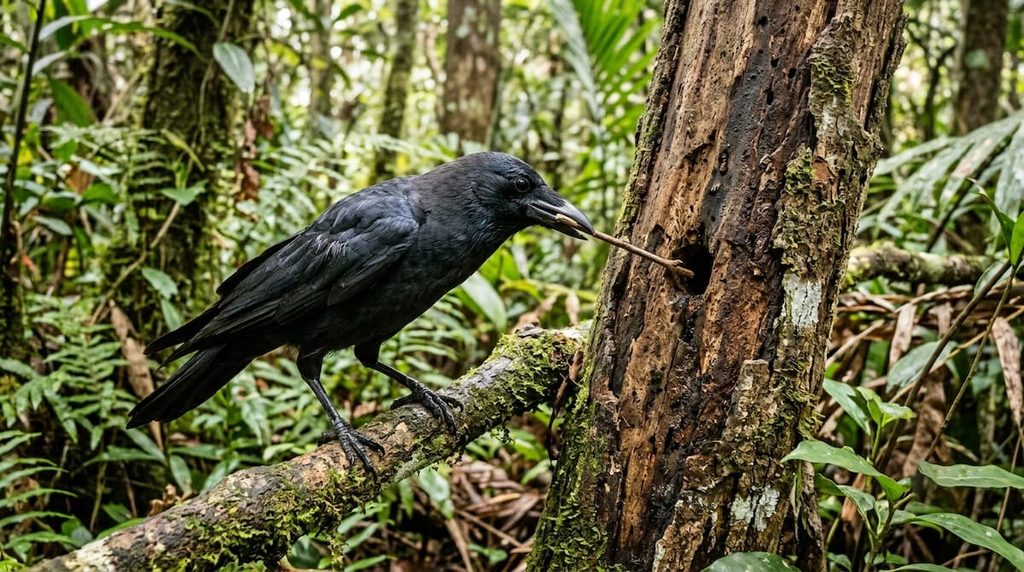
A crow picks up a stick and flies away with it. At first, this might look like an ordinary example of a bird using whatever object happens to be nearby.
But some crows do something much more complicated.
They can make tools, use one tool to obtain another, and solve problems in which the useful object is not immediately obvious. In one experiment, New Caledonian crows even selected a particular tool before they could use it, because that tool would become useful later.
That raises a fascinating question. Are crows actually planning ahead?
The answer is more interesting than a simple yes or no.
A Bird That Makes Its Own Tools
New Caledonian crows (Corvus moneduloides) are among the most remarkable tool-using birds known to science.
In the wild, they use sticks, leaves, and other materials to extract food from places their beaks cannot easily reach. But their ability goes beyond picking up a convenient object.
Researchers have found that these crows can manufacture tools by modifying materials.
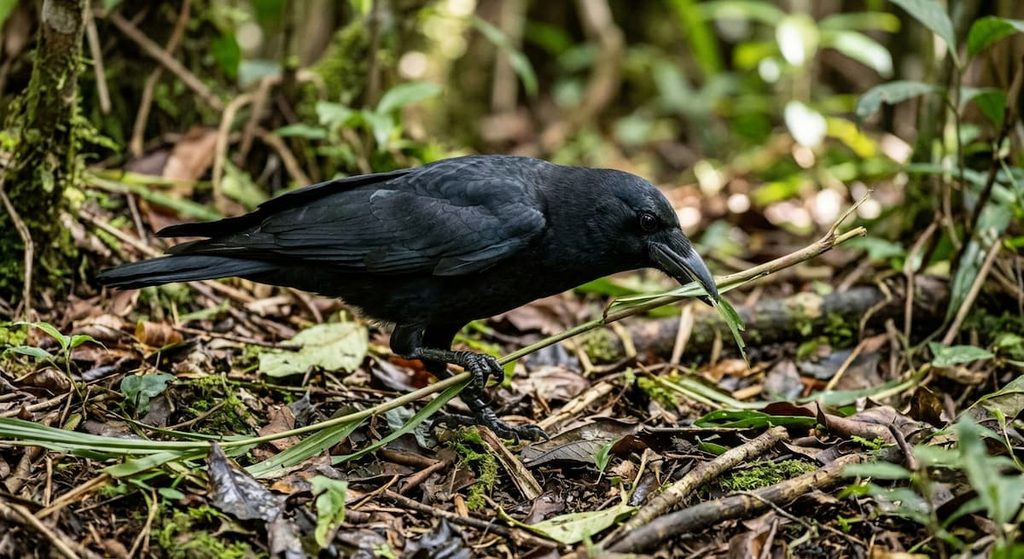
One particularly revealing study looked at young crows that had been raised without contact with adult members of their species and without seeing humans demonstrate tool-making. Even so, the young birds spontaneously manufactured and used tools.
This does not mean that every detail of their tool-making ability is completely independent of learning. Young crows still develop in a social and ecological environment that can influence their behavior.
But the finding shows that tool manufacture does not require a bird to simply copy an adult demonstrating the exact behavior.
The ability is already built into the behavioral and cognitive system of the species.
Sometimes One Tool Is Not Enough
The real test of problem-solving ability comes when a single tool cannot solve the problem.
Imagine a crow facing a piece of food that it cannot reach directly. A short tool is available, but the short tool cannot reach the food.
Instead, the crow has to use the short tool to pull out a longer tool.
Then it must use the longer tool to obtain the food.
This is called metatool use, because one tool is being used to obtain another tool.
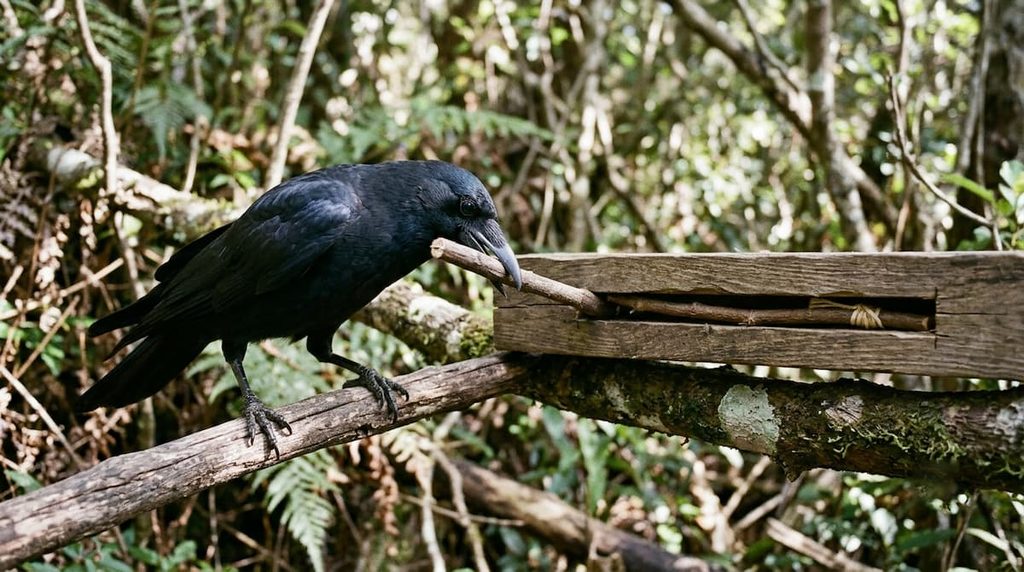
New Caledonian crows have successfully solved this type of problem.
In one experiment, six of seven crows initially attempted to use the short tool to retrieve the longer tool, and four obtained the food on their first trial.
That is important because the bird is not simply using an object to reach food. It is using an object to obtain another object that will become useful afterward.
This kind of behavior is one reason scientists have become interested in whether crow intelligence includes something resembling planning.
But there is an important distinction.
Solving a multi-step problem does not automatically prove that the animal is consciously imagining every step before acting.
Behavior can sometimes be produced by learned rules, associations, or simpler decision processes.
So researchers have to design experiments that separate these possibilities.
The Experiment That Looked Into the Future
One of the most interesting tests came from a 2020 study of New Caledonian crows.
Researchers trained the birds to understand a sequence of events.
First, a crow saw a particular apparatus containing food.
Five minutes later, it was given several objects to choose from.
Ten minutes after that, it was allowed to return to the apparatus.
The important part was that different future apparatuses required different tools.
The crow therefore had to select a tool before it could actually use it.
And the results were striking.
When the researchers presented new combinations of apparatuses and tools, the crows tended to choose the tool that would be useful for the specific task waiting for them later.
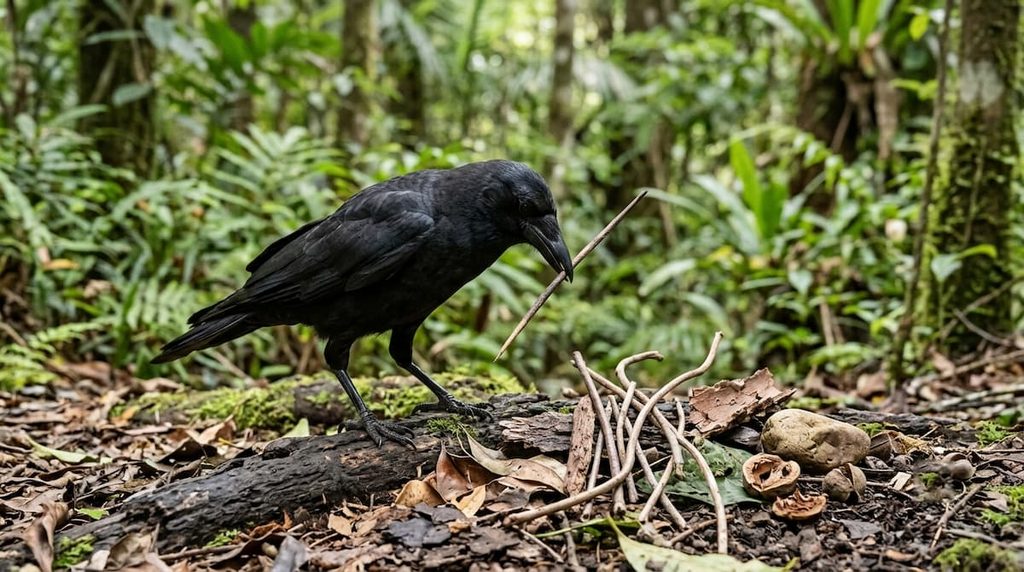
They did not simply choose a tool that had been useful before. They also ignored a low-value food item and other distracting objects.
In other words, the bird’s choice made more sense when the future problem was taken into account.
This is why the researchers described the behavior as planning for specific future tool use.
It is a remarkable result because the crow had to connect what it saw now with what it would need later.
That is very different from simply reacting to food that is immediately available.
Does That Mean Crows Imagine the Future?
Not necessarily.
This is where the science becomes more interesting.
Planning for the future is difficult to define in animals. If a crow chooses the correct tool, we can observe the behavior. But we cannot simply ask the bird what it was thinking while making the choice.
Scientists therefore have to distinguish between future-oriented behavior and the much stronger claim that an animal consciously imagines a future event in a human-like way.
The 2020 study itself noted that future planning in non-human animals remains a contentious question.
There was also a published critique of the study that raised concerns about how the experimental design could distinguish genuine planning from other explanations. The original researchers subsequently published a response defending their interpretation.
That scientific debate does not make the original experiment useless.
Instead, it tells us exactly how carefully the result should be interpreted.
We can say that the crows showed behavior consistent with planning for a specific future task.
We should not turn that into the claim that crows think about the future exactly as humans do.
Crows Can Also Solve Physical Problems
Planning is only part of the story.
Researchers have also tested whether New Caledonian crows can solve physical problems that require more than memorizing a simple rule.
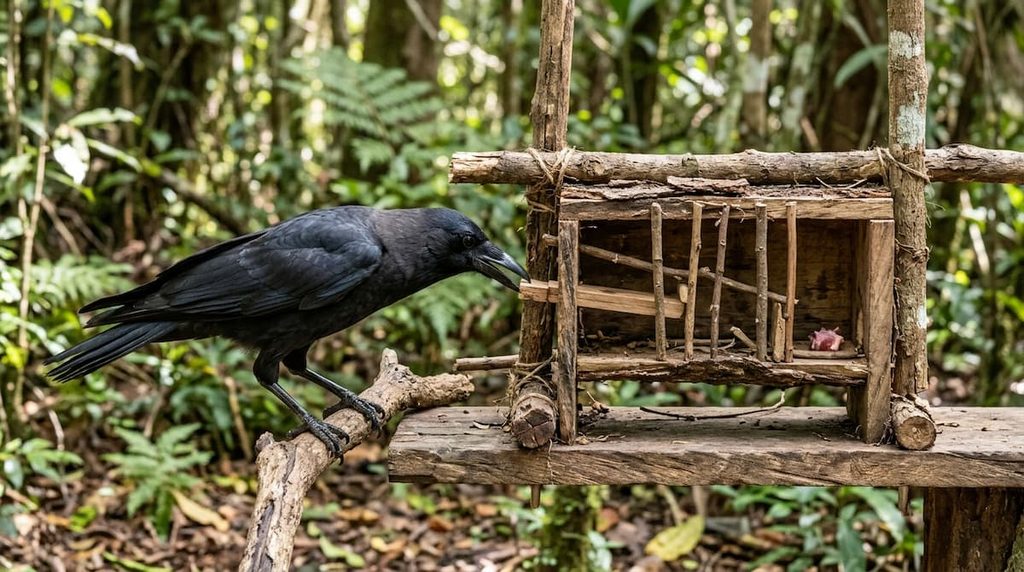
In a series of experiments, crows were presented with a trap-tube problem. Food had to be moved in a direction that avoided a functional trap.
Three of six crows solved the initial problem.
More interestingly, those successful birds were then tested with altered versions of the problem. Some of the visual features associated with the original solution were removed or changed.
The birds still avoided the functional trap.
They also solved a different problem, called the trap-table task, which was physically equivalent but visually different.
The researchers argued that the results were difficult to explain through chance, simple associative learning, or straightforward visual generalization. They suggested that the birds were reasoning about causal relationships and transferring that understanding to a new problem.
But again, the safest interpretation is not that crows possess human-style reasoning.
The experiment provides evidence for sophisticated physical problem solving. Whether the underlying mental process should be called causal reasoning in exactly the same sense used for humans remains a deeper question.
Their Intelligence Is Not Just About Tools
There is another reason crows are attracting attention.
Their remarkable abilities are not limited to manipulating objects.
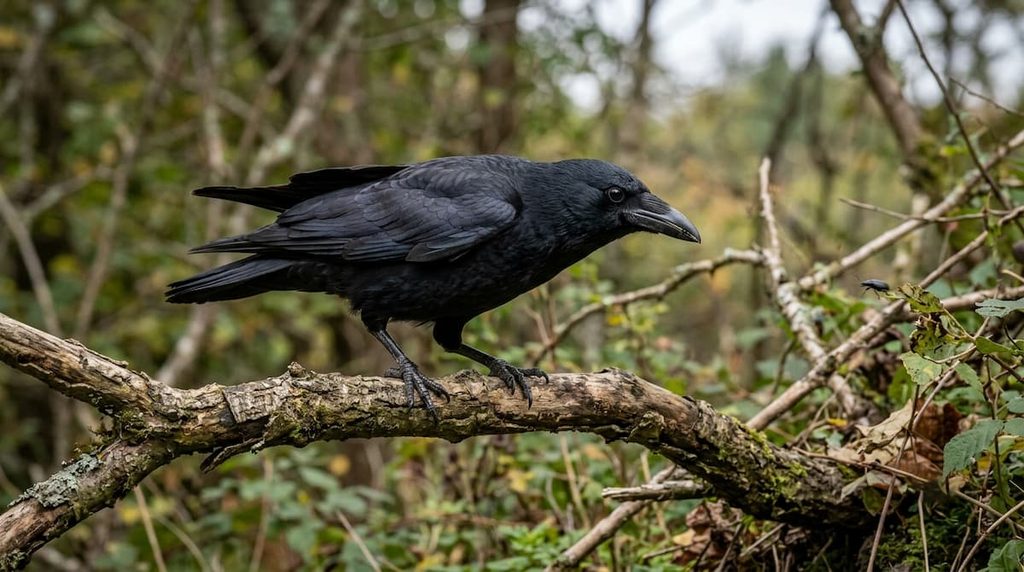
A 2026 study examined decision-making in carrion crows (Corvus corone) using a visual motion task.
The birds made decisions in about 235 milliseconds on average, while maintaining high accuracy. The researchers also recorded activity from the birds’ pallial endbrain, finding neural signals related to the upcoming choice as early as about 70 milliseconds after the visual stimulus appeared.
The researchers described this as exceptionally fast decision-making in an avian brain.
This does not prove that crows are generally “smarter” than humans.
It shows something more specific and scientifically useful.
Their brains can process certain visual information and produce accurate decisions extremely quickly.
That fits with the demands of an animal that may need to react rapidly while moving through a complex environment.
Why Would a Bird Need This Kind of Intelligence?
The abilities seen in crows make more sense when viewed through evolution.
Finding food is rarely a simple matter of seeing something edible and eating it.
A crow may have to remember where food is hidden, manipulate objects, avoid danger, choose between different options, and adjust its behavior when the environment changes.
For New Caledonian crows, tool use is especially valuable because their tools can reach food that would otherwise be inaccessible.
Over many generations, natural selection can favor individuals that are better at solving these recurring problems.
This does not mean evolution deliberately “designed” a bird to become intelligent.
Rather, behaviors that improve survival and reproduction can become more common over generations.
And once an animal has the cognitive machinery needed for one kind of problem, that machinery may sometimes be useful for other problems as well.
This may help explain why corvids, the bird family that includes crows and ravens, have become an important group for studying animal cognition.
But Not Every Crow Is the Same
It is also important to be precise about the word crow.
Most of the famous tool-use experiments discussed here involve the New Caledonian crow.
That does not mean every crow species possesses exactly the same abilities.
A 2026 systematic review examined 47 studies covering 16 corvid species and found evidence for sophisticated cognitive development across several areas, including tool use, object manipulation, caching, and gaze following.
But the review also identified major gaps in the evidence.
Many studies have small sample sizes. Much of the research has been conducted in captivity. Long-term developmental studies are limited, and some potentially important abilities, including executive function, causal reasoning, self-control, metacognition, and social learning, remain underrepresented.
That matters because an impressive experiment with a few birds cannot automatically tell us how an entire family of birds thinks.
Science becomes stronger when impressive results are combined with evidence about their limitations.
So, Are Crows Planning Ahead?
The evidence gives us a careful but fascinating answer.
Crows can manufacture tools without simply copying a demonstrated behavior. They can use one tool to obtain another. They can solve physical problems that require them to transfer what they have learned to new situations. And in a carefully designed experiment, New Caledonian crows selected tools that matched a task they would face later.
Those findings make future-oriented planning a reasonable interpretation of their behavior.
But they do not establish that a crow sits somewhere and consciously imagines tomorrow in the same way a human does.
That distinction is important.
Animal intelligence does not have to look human to be impressive.
A crow has a very different brain, body, evolutionary history, and way of experiencing the world. Yet evolution has produced a system capable of solving problems that once seemed to belong mainly to animals with much larger brains.
Perhaps the most interesting lesson is not that crows are secretly “little humans.”
It is that complex intelligence can evolve in a very different kind of brain.
The next time a crow picks up an ordinary piece of wood, it may be worth remembering that the object itself is only part of the story.
What matters is what the bird can do with it, and sometimes, what it can prepare to do with it later.
Scientific Sources
- Boeckle M, Schiestl M, Frohnwieser A, Gruber R, Miller R, Suddendorf T, Gray RD, Taylor AH, Clayton NS. “New Caledonian crows plan for specific future tool use.” Proceedings of the Royal Society B: Biological Sciences. 2020;287(1938):20201490. PMID: 33143583. DOI: 10.1098/rspb.2020.1490. Read the study on PubMed PubMed
- Taylor AH, Hunt GR, Holzhaider JC, Gray RD. “Spontaneous metatool use by New Caledonian crows.” Current Biology. 2007;17(17):1504-1507. PMID: 17702575. DOI: 10.1016/j.cub.2007.07.057. Read the study on PubMed PubMed
- Taylor AH, Hunt GR, Medina FS, Gray RD. “Do New Caledonian crows solve physical problems through causal reasoning?” Proceedings of the Royal Society B: Biological Sciences. 2009;276(1655):247-254. PMID: 18796393. DOI: 10.1098/rspb.2008.1107. Read the study on PubMed PubMed
- Kenward B, Weir AAS, Rutz C, Kacelnik A. “Behavioural ecology: tool manufacture by naive juvenile crows.” Nature. 2005;433(7022):121. PMID: 15650729. DOI: 10.1038/433121a. Read the study on PubMed PubMed
- de Mahy D, Esteve NA, Santariello A. “New test, old problems: comment on ‘New Caledonian crows plan for specific future tool use’.” Proceedings of the Royal Society B: Biological Sciences. 2021;288(1958):20210186. PMID: 34465238. DOI: 10.1098/rspb.2021.0186. Read the study on PubMed PubMed
- Miller R, Claisse E, Timulak A, Clayton NS. “Development of cognition in corvids.” Animal Cognition. 2026;29(1). PMID: 42961678. DOI: 10.1007/s10071-026-02088-8. Read the study on PubMed PubMed
- Schmidbauer P, Nieder A. “Ultrarapid decision-making in an avian brain.” Science. 2026;394(6822):445-449. PMID: 42912155. DOI: 10.1126/science.aed6459. Read the study on PubMed