What Happens to a Pill After You Swallow It? [Bit#207]
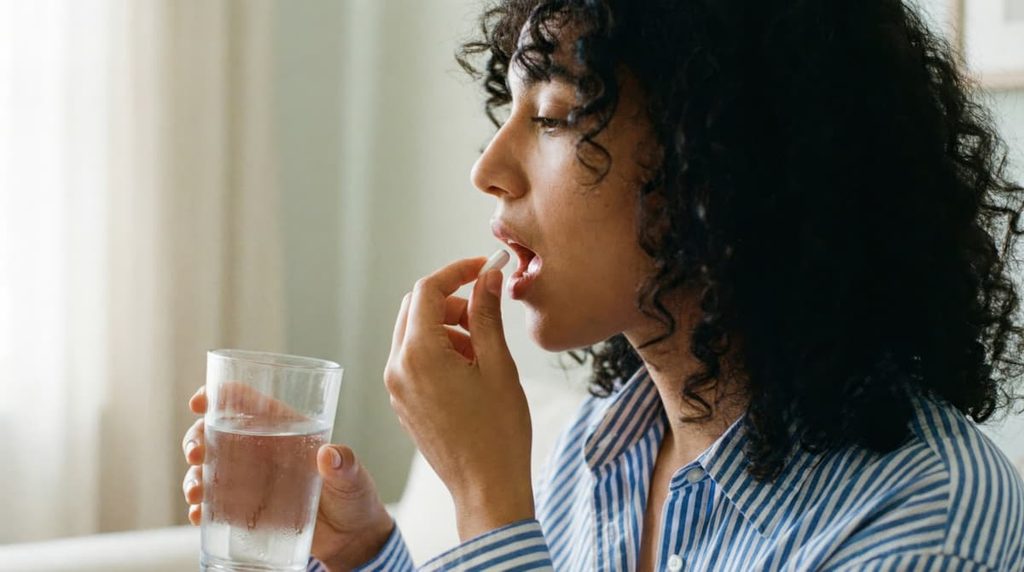
Most people think of taking medicine as a simple process. You swallow a pill, it goes into your stomach, and eventually it starts working.
But the drug inside that pill has a much harder journey.
Before it can produce an effect, the active ingredient has to escape from its dosage form, dissolve in the fluids of the gastrointestinal tract, cross the intestinal lining, survive chemical and enzymatic barriers, and reach the bloodstream in sufficient amounts.
In other words, swallowing a pill is only the beginning.
A pill is not the drug itself
A tablet or capsule is a delivery system. Its job is to carry an active pharmaceutical ingredient into the body and release it at the right place and rate.
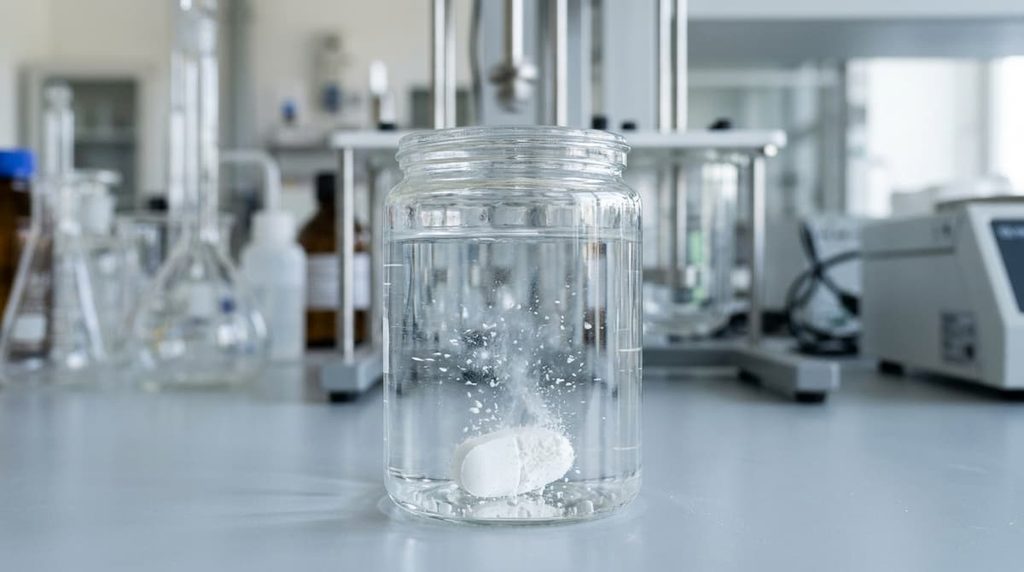
Once an oral solid dosage form enters the gastrointestinal tract, it must first break apart and release the active ingredient. The drug then needs to dissolve before it can be absorbed.
This distinction matters because a drug cannot simply pass through the intestinal wall as an intact tablet.
Dissolution can become a major limitation. A compound may have powerful biological activity but still be difficult to deliver orally if it does not dissolve well in gastrointestinal fluids. The chemical properties of the drug, the formulation of the tablet, and physiological conditions such as pH, bile salts, and gastrointestinal movement can all influence how quickly and how completely the drug becomes available for absorption.
The stomach is not simply a storage bag
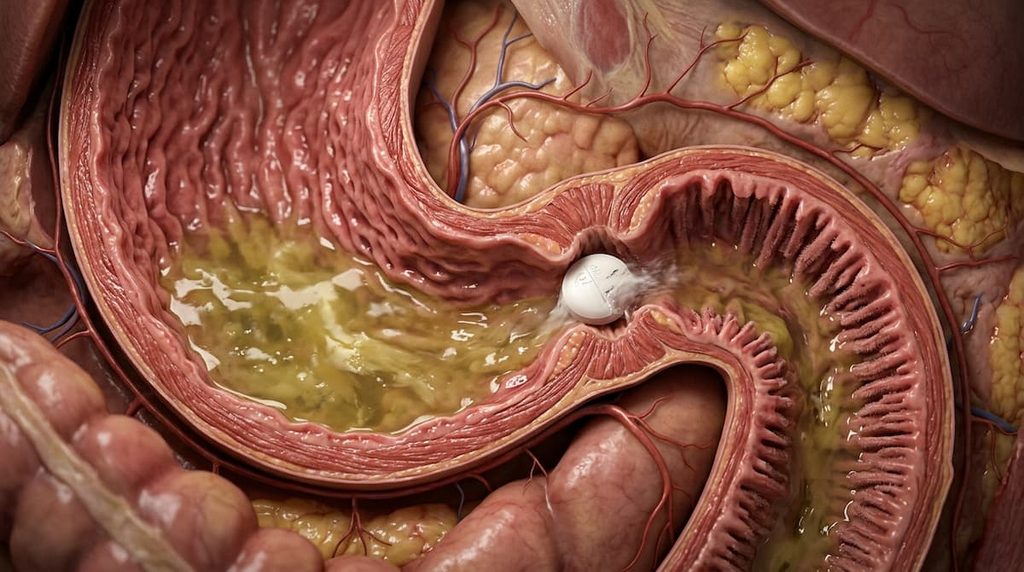
The stomach plays an important role in what happens to an oral medicine, but it is not necessarily the main place where the drug enters the bloodstream.
Stomach acidity can affect the chemical state and dissolution of some drugs. At the same time, the stomach controls when the dissolved drug and remaining dosage form move into the small intestine.
That timing matters.
The gastrointestinal tract is a changing environment rather than a uniform tube. Its pH, fluid volume, bile concentration, movement, and transit time vary from one region to another. These conditions can change how a drug dissolves and becomes available for absorption.
This is also one reason that food can matter.
Eating changes the environment inside the gastrointestinal tract. Food can alter stomach and intestinal pH, bile secretion, fluid volume, gastrointestinal movement, and the time a dosage form spends in different parts of the digestive system.
As a result, food can increase, decrease, or have little effect on the absorption of a particular drug.
So the instruction to take a medicine with food or on an empty stomach is not simply about protecting the stomach. It can also be about controlling how the drug behaves during its journey through the gastrointestinal tract.
The real gateway is the intestinal wall
After the drug has dissolved, it faces one of its biggest challenges.
It has to cross the intestinal barrier.
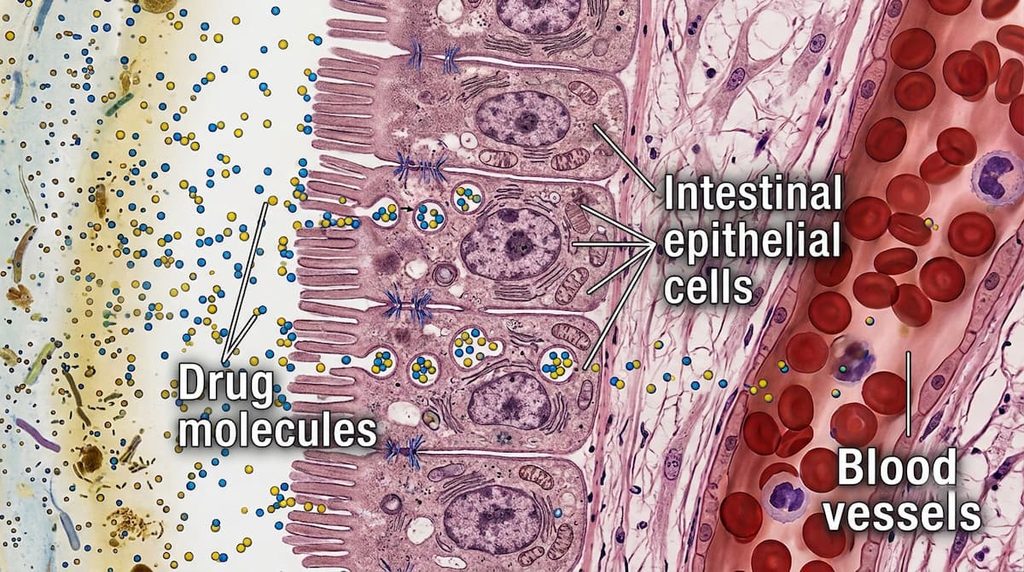
The lining of the small intestine contains epithelial cells that separate the contents of the gut from the internal environment of the body. A drug reaching this surface cannot automatically pass through.
Some drug molecules can move across cell membranes because of their chemical properties. Others rely partly on transport proteins that move particular molecules across cell membranes.
This creates an important difference between drugs.
A molecule may dissolve well in intestinal fluid but still have difficulty crossing the intestinal barrier. Another molecule may cross biological membranes efficiently but have poor water solubility.
That is why scientists often consider both solubility and permeability when thinking about oral drug absorption.
The journey is not simply about getting a drug to dissolve.
It is about getting the dissolved drug across the right biological barrier.
Some proteins help drugs get in. Others push them back out
The intestinal lining is more than a passive wall.
It contains transport proteins that can influence how much of a drug enters the body.
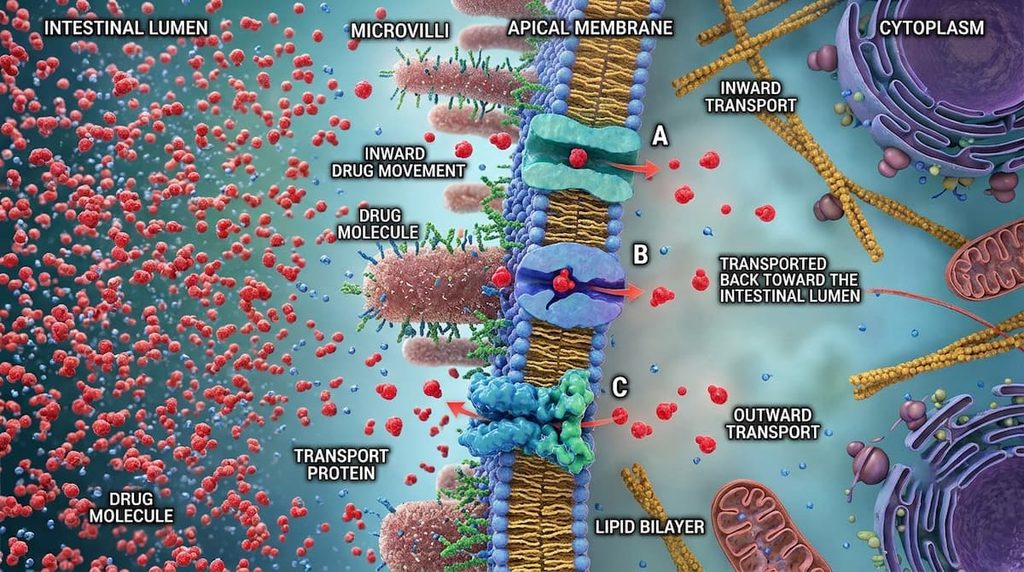
Some transporters can help move substances into cells or across them. Others work in the opposite direction.
One well-known example is P-glycoprotein, also called P-gp. It can transport certain drugs from intestinal cells back toward the intestinal lumen.
For a drug that is a P-gp substrate, this can reduce the amount that successfully crosses the intestinal barrier.
The result is a biological tug-of-war.
A drug may be moving toward the bloodstream while transport systems are simultaneously limiting how much of it gets through.
This is one reason why two molecules with apparently similar properties can behave very differently after being swallowed.
Getting through the intestine does not mean the drug has reached the bloodstream
Suppose the drug successfully crosses the intestinal lining.
It might seem that the hardest part is over.
But there is another checkpoint.
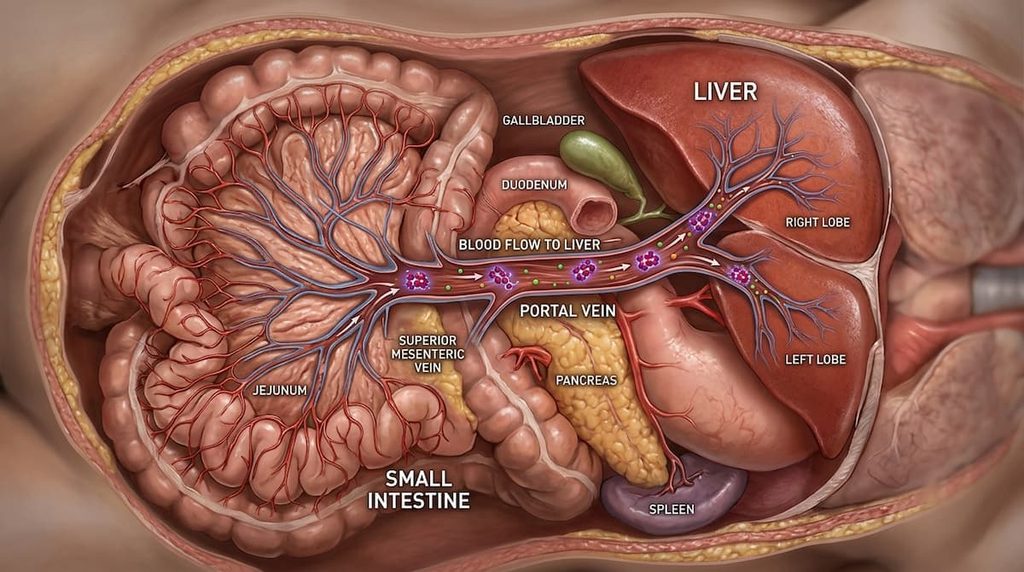
Blood draining much of the gastrointestinal tract does not immediately enter the general circulation. It travels through the portal circulation toward the liver.
This creates an important phenomenon known as first-pass metabolism.
Before an orally absorbed drug reaches the systemic circulation, some of it can be metabolized in the intestinal wall and in the liver.
As a result, only a fraction of the swallowed dose may ultimately reach the systemic bloodstream in its original form.
This is one reason pharmacologists distinguish between the amount of drug administered and its bioavailability, the fraction that reaches systemic circulation in an available form.
For an orally administered drug, bioavailability can be affected by several stages of the journey. The fraction absorbed, the fraction that escapes intestinal metabolism, and the fraction that escapes hepatic first-pass elimination all contribute.
So if you swallow 100 milligrams of a drug, it would be wrong to assume that 100 milligrams will simply appear in your bloodstream.
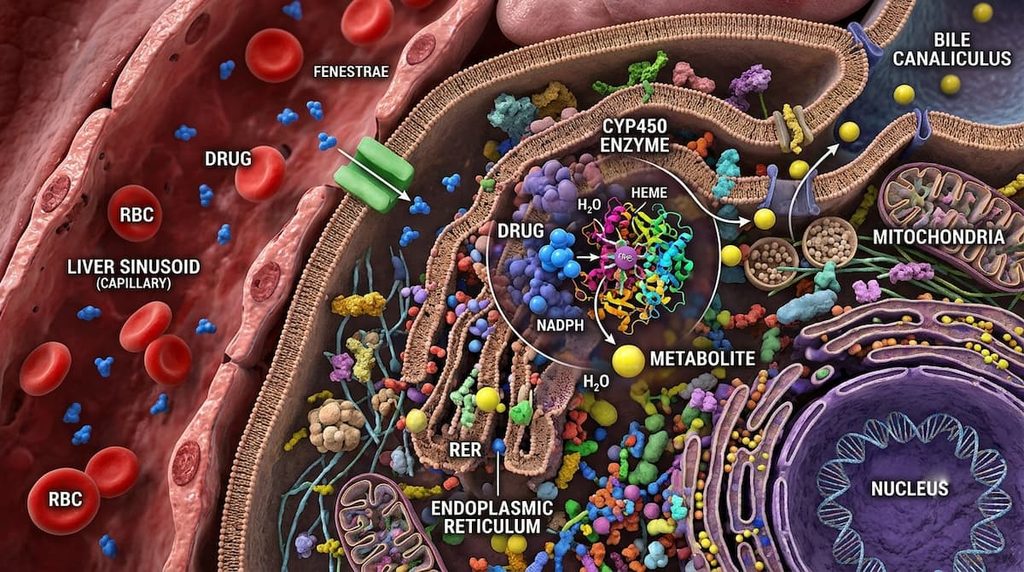
The liver can change the drug before it works
The liver is famous for processing substances that enter the body, and drugs are no exception.
Enzymes in the liver can chemically modify drug molecules. This can make them easier to eliminate, but metabolism does not always simply switch a drug off.
Some drugs are administered in a form that becomes more active after metabolism. These are called prodrugs.
Other drugs are converted into metabolites that may retain biological activity or have different properties from the original compound.
Therefore, saying that the liver “destroys” a drug would be too simplistic.
The liver is better thought of as a chemical processing site.
It can change the molecules that arrive there, sometimes reducing their activity, sometimes contributing to their activity, and sometimes creating metabolites with their own biological effects.
Now the drug can travel through the body
Once enough drug survives absorption and first-pass processes, it enters the systemic circulation.
Now another stage begins: distribution.
The bloodstream carries the drug throughout the body, but that does not mean every tissue receives the same amount.
Drug distribution depends on factors such as blood flow, tissue properties, molecular characteristics, protein binding, and the ability of the drug to cross biological barriers.
Some drugs remain mainly in the bloodstream. Others distribute extensively into tissues.
Some can cross the blood-brain barrier, while others cannot readily do so.
The drug is therefore not simply moving from the stomach to one specific destination.
It is being distributed through a constantly moving biological system.
Then comes the part we actually notice: the effect
Eventually, the drug reaches tissues where it can interact with its biological targets.
Those targets can include receptors, enzymes, ion channels, transport proteins, and other molecular structures.
This is where pharmacology becomes especially interesting.
The drug does not need to “know” where it is going in the way a person follows a map. Instead, its concentration, distribution, chemical properties, and interactions with biological molecules determine where it can act.
A drug may bind to a target and change its activity. That molecular interaction can then alter cellular signaling or physiological processes.
The effect we notice, such as reduced pain, lower blood pressure, or suppression of inflammation, is therefore several biological steps removed from the moment the pill was swallowed.
Swallowing starts the process.
The effect comes later.
The journey can change from one person to another
Even when two people take the same dose of the same medicine, their drug exposure does not have to be identical.
Gastric emptying, intestinal conditions, food intake, age, disease, gastrointestinal physiology, drug formulation, and other factors can contribute to variability in oral drug absorption and exposure.
This does not mean that medicines are unreliable. It means that the human body is not a perfectly standardized chemical container.
It is a living system.
The environment through which a drug travels is constantly changing, and the drug itself can interact with that environment at multiple stages.
That is also why pharmaceutical scientists spend so much effort designing formulations that improve dissolution, permeability, stability, and controlled release.
The next time you swallow a tablet, it is worth thinking about what is actually happening.
The pill does not simply dissolve and disappear.
A pill is really a delivery system
It has to release its active ingredient.
The ingredient has to dissolve.
The dissolved molecules have to cross the intestinal barrier.
Transporters and metabolic enzymes can influence how much survives.
The portal circulation carries much of the absorbed drug toward the liver, where first-pass metabolism can further change its fate.
Only after these barriers have been passed can enough drug reach the systemic circulation to distribute through the body and interact with its targets.
That makes an ordinary pill a surprisingly sophisticated delivery system.
The science of medicine is not only about discovering molecules that can change biology. It is also about figuring out how to get those molecules through the body’s own defenses, in the right amount, at the right place, and at the right time.
A pill may look simple from the outside.
Getting its active ingredient to where it needs to work is anything but simple.
Scientific Sources
1. Wilson CG, et al. “Impact of regional differences along the gastrointestinal tract of healthy adults on oral drug absorption: An UNGAP review.” Advanced Drug Delivery Reviews. 2019;142:12-24. PMID: 30991092. Read the study on PubMed.
2. Dahan A, et al. “Understanding peroral absorption: regulatory aspects and contemporary approaches to tackling solubility and permeability hurdles.” European Journal of Pharmaceutical Sciences. 2017;105:1-11. PMID: 28540164. Read the study on PubMed.
3. Jambhekar SS, Breen PJ. “Drug dissolution: significance of physicochemical properties and physiological conditions.” Drug Discovery Today. 2013;18(23-24):1173-1184. PMID: 24042023. DOI: 10.1016/j.drudis.2013.08.013. Read the study on PubMed.
4. Müller J, Keiser M, Droździk M, Oswald S. “Expression, regulation and function of intestinal drug transporters: an update.” Biological Chemistry. 2017;398(2):175-192. PMID: 27611766. DOI: 10.1515/hsz-2016-0259. Read the study on PubMed.
5. Kambayashi A, Shirasaka Y. “Food effects on gastrointestinal physiology and drug absorption.” Drug Metabolism and Pharmacokinetics. 2023;48:100488. PMID: 36737277. DOI: 10.1016/j.dmpk.2022.100488. Read the study on PubMed.
6. Varma MVS, et al. “Physicochemical space for optimum oral bioavailability: contribution of human intestinal absorption and first-pass elimination.” Journal of Medicinal Chemistry. 2010. PMID: 20070106. DOI: 10.1021/jm901371v. Read the study on PubMed.