[Bit#73] The Martian Farmer’s Dream: Can Plants Truly Grow on the Red Planet?
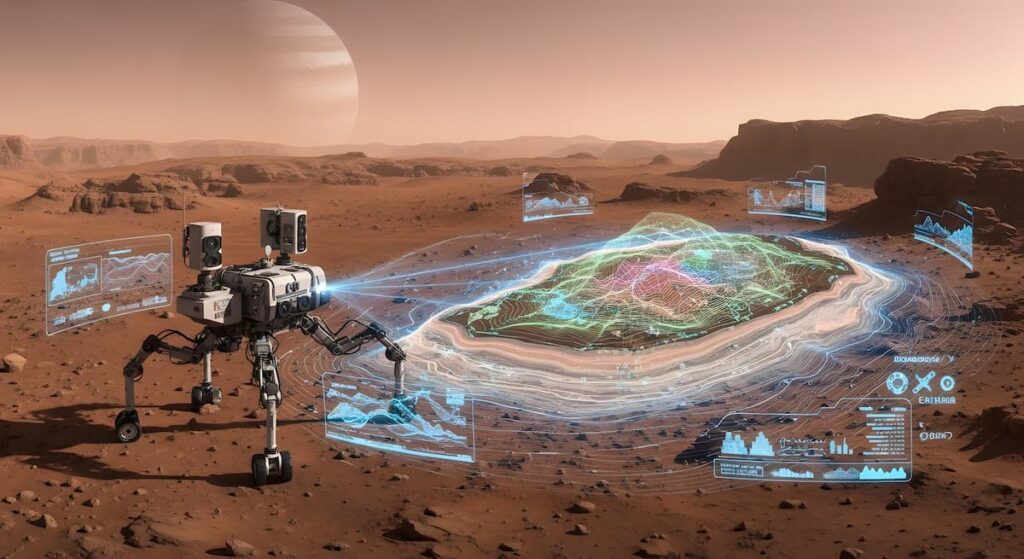
1. The Deadly Secret of Martian Soil: Toxic Perchlorates
Do you remember the movie The Martian? There is a highly romanticized scene where the protagonist survives by planting potatoes directly into the Martian soil. However, the reality awaiting us on Mars is fundamentally different. What would actually happen if you were to plant a seed directly into the raw Martian ground? It would perish almost instantly. Why is that? It is because a dark, hidden secret slumbers within the soil of Mars.
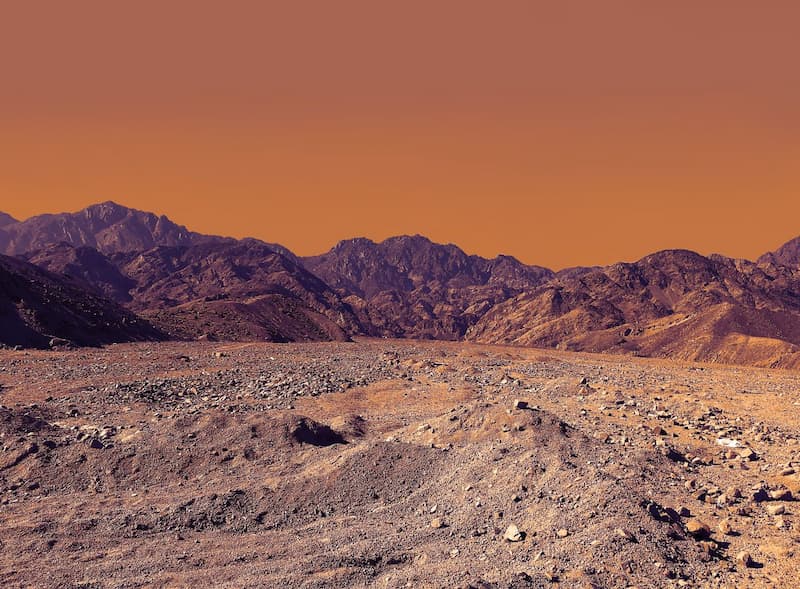
The loose dirt covering the surface of Mars contains an incredibly high concentration of a substance called perchlorate. The name sounds somewhat complex and technical, but it can be easily understood as a highly potent, toxic salt. On Earth, this specific chemical compound is primarily utilized as a major ingredient in rocket fuel and industrial explosives. It possesses an extraordinarily powerful oxidizing capability. What do you think happens when fragile plant roots come into direct contact with dirt saturated with such a volatile component? The roots will literally dissolve within moments, or their cellular structures will be completely destroyed.
To make matters worse, this toxic chemical is highly soluble in water. If you were to water the Martian soil in an attempt to nourish a plant, the perchlorates would dissolve into the moisture and be rapidly absorbed by the root system. Consequently, the entire plant would become thoroughly saturated with deadly poison. What would happen if a human being were to consume a crop grown in this manner? Their thyroid function would be completely devastated, leading to a life-threatening medical emergency. Therefore, before anyone can even dream of farming on Mars, this terrifying toxic substance must be completely and flawlessly eradicated from the soil.
How can scientists eliminate this lethal poison? Researchers are currently studying specialized microorganisms capable of neutralizing the threat. These unique microbes actually consume perchlorates, breaking them down into entirely harmless chlorine and oxygen molecules. Alternatively, the soil could be subjected to continuous, intensive washing using massive volumes of water. However, on a desert planet where water is an incredibly scarce and precious commodity, washing vast amounts of soil is an immensely difficult logistical challenge. The journey to becoming a Martian farmer is firmly blocked by a monumental barrier right from the very beginning.
2. A Rarefied Atmosphere and Subzero Temperatures: An Environment That Freezes Plants to Death
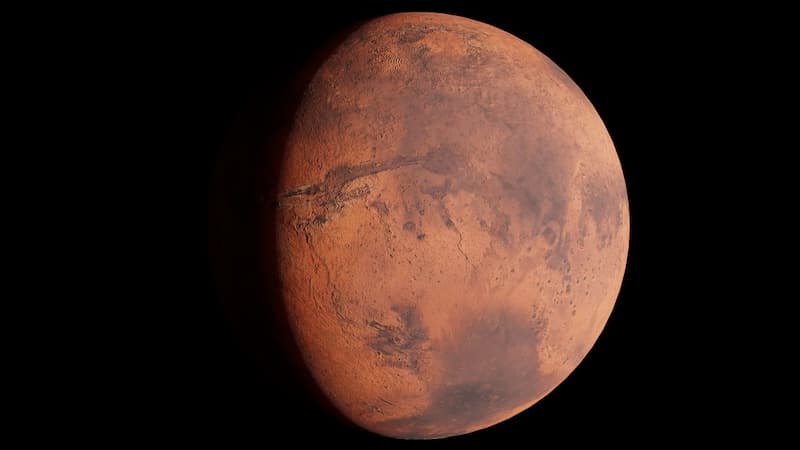
Let us assume for a moment that we have somehow managed to eliminate the toxic chemicals from the soil. Can we now safely plant our seeds with peace of mind? Unfortunately, the true nightmare begins right after that hurdle. Looking up at the Martian sky is enough to make anyone choke with anxiety, primarily because there is almost no atmosphere to speak of. The atmospheric pressure on Mars is a mere one-hundredth of the atmospheric pressure found on Earth. It is significantly lower than the pressure experienced at the absolute summit of Mount Everest. What happens when the ambient pressure is that low? Liquid water begins to boil and vaporize at incredibly low temperatures. This means that the vital moisture contained within the cellular walls of a plant would instantly evaporate into the thin air. In simple terms, the plant would completely dry up and die in seconds.
Furthermore, Mars is an unimaginably freezing world. The average global temperature hovers around a staggering minus 60 degrees Celsius. During the peak of winter, temperatures can plummet even further to a bone-chilling minus 140 degrees Celsius. This represents an environment far more hostile and unforgiving than the coldest depths of Antarctica on Earth. Rather than growing, every single cell within a plant would freeze instantly and burst open due to the expansion of internal fluids. While the temperature rises slightly during the peak of the daytime, it reverts right back into a brutal, frozen wasteland the moment night falls. There is not a single plant species anywhere on Earth capable of enduring such an extreme diurnal temperature swing.
How then can we possibly cultivate vegetation in a place with such a thin atmosphere and deadly cold? Scientists propose giant, transparent dome-shaped greenhouses as the ultimate alternative solution. Inside these specialized structures, the internal atmospheric pressure can be artificially regulated to mirror the conditions found on Earth. Additionally, artificial heat must be constantly applied to raise the subzero temperatures well above the freezing point. However, constructing these advanced greenhouses is by no means an easy feat. It requires highly specialized, state-of-the-art materials capable of withstanding the terrifying kinetic force of Martian dust storms and the relentless thermal stress of the cold.
Ultimately, planting crops directly into the open terrain of Mars remains an impossibility. Humanity must first construct a massive, flawlessly controlled artificial cradle. Sustaining that cradle demands a continuous, enormous supply of energy. The true cost of obtaining a single plate of fresh salad on Mars is far more punishing and complicated than anyone could ever imagine.
3. A Different Gravitational Pull and Lighter Sunlight: Conditions That Disrupt Photosynthesis
Even if we successfully purge the toxic soil and construct a warm, pressurized greenhouse, our checklist is far from complete. There are other fundamental elements absolutely essential for plant growth that cannot be overlooked: gravity and sunlight. Let us first examine the factor of gravity. The gravitational pull on Mars is only about 38 percent of what we experience on Earth. While weighing significantly less might sound like a wonderful advantage for human astronauts, it introduces absolute chaos to vegetation. Why is that? It is because plants rely on gravity to orient themselves, sending their roots downward into the earth and pushing their stalks upward toward the sky.
When the gravitational force is too weak, plants completely lose their sense of direction. Their roots may start growing randomly in all directions, and their stems can become severely twisted and distorted. Furthermore, the internal transport mechanism that moves water and vital nutrients upward and downward through the plant slows down drastically. Consequently, the overall growth rate of the vegetation is severely stunted, and the probability of structural mutations increases dramatically. To flora that has spent hundreds of millions of years adapting perfectly to Earth’s specific gravity, the weak gravity of Mars represents a source of immense physiological stress.
An even more critical issue is the lack of quality sunlight. Mars is positioned much further away from the Sun than Earth is. Because of this vast orbital distance, the amount of solar radiation reaching the surface of Mars is less than half of what Earth receives. This means that photosynthesis, which serves as the absolute lifeblood and primary food source for plants, cannot occur efficiently. When light is profoundly insufficient, plants tend to become weak, spindly, and structurally unstable instead of growing healthy and strong. How can we overcome this solar deficit?
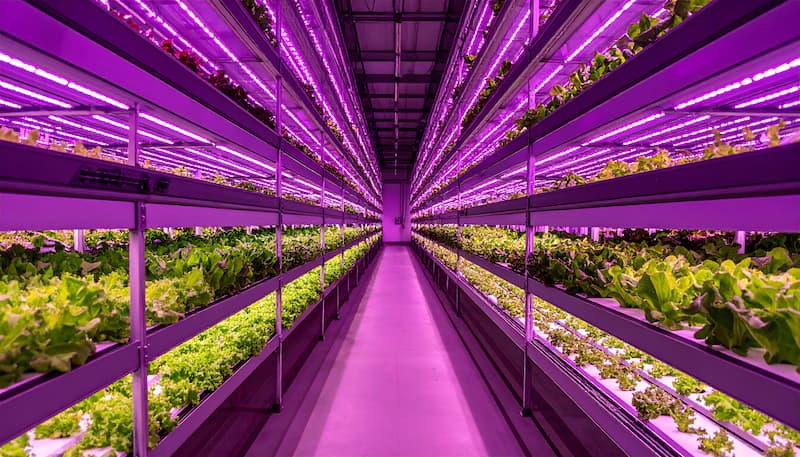
In the end, we have no choice but to install a massive array of artificial lighting systems inside the greenhouses. We must bathe the crops day and night in specialized LED lights tuned to the exact wavelengths that plants prefer for optimal growth. Unlike Earth, where life-giving sunlight is completely free, light on Mars becomes a highly expensive resource that must be manufactured using immense amounts of electrical energy. Since we cannot alter the gravity of a planet, we must perfectly control the light instead. Farming in the deep reaches of space is an ongoing, brutal war against the laws of nature.
4. Humanity’s Survival Solutions: Terraforming and Smart Farm Technology
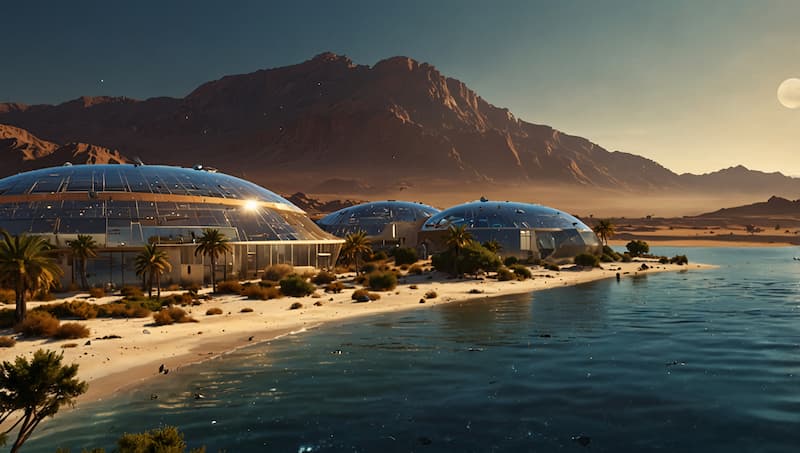
Despite the existence of these numerous, seemingly insurmountable barriers, humanity refuses to surrender. Scientists are actively drawing up grand, generational blueprints to transform Mars into a second Earth. This monumental concept is known as terraforming, the process of intentionally altering an entire planet’s environment. The primary phase involves raising the global temperature of Mars. Ideas include deliberately releasing potent greenhouse gases into the atmosphere or melting the massive ice caps situated at the Martian south pole. If those ice caps melt, vast amounts of trapped carbon dioxide will be released, significantly thickening the atmosphere. A thicker atmosphere naturally raises the global air pressure and warms the temperature.
However, altering the environment of an entire planet is a distant dream that will require centuries of continuous effort. What will the immediate astronauts traveling to Mars eat in the meantime? To answer this urgent need, a highly practical and immediate alternative has emerged: smart farm technology. This system involves a completely sealed, automated container where advanced computers flawlessly regulate every single environmental variable. No natural soil is used whatsoever. Instead, they utilize hydroponic cultivation techniques, where the plant roots are immersed entirely in nutrient-rich liquid solutions. This approach solves the toxic Martian soil problem in a single stroke.
Within these high-tech smart farms, specialized light-emitting diodes completely replace natural sunlight. These LEDs supply artificial light 24 hours a day, focusing strictly on the precise wavelengths that maximize plant growth efficiency. Artificial intelligence autonomously monitors and adjusts the temperature, humidity, and carbon dioxide levels in real time. Furthermore, engineering techniques are implemented to force the continuous circulation of nutrients, ensuring that the weak gravitational pull does not cause the plants to grow in erratic directions. In essence, Earth’s most advanced agricultural technologies will serve as the absolute baseline for the survival of Martian colonists.
Ultimately, the successful cultivation of plants on Mars will first manifest inside these perfectly insulated, artificial cradles. It is a profound process of overcoming a harsh, barren cosmic environment through the sheer force of human ingenuity. The day may well come when astronauts inside a Martian outpost can sit down and enjoy a fresh salad made from lettuce they cultivated with their own hands. The first definitive step for humanity to prove its self-sufficiency beyond Earth will begin inside the quiet confines of these small, high-tech greenhouses.
![Cut a Planarian, and It Can Regrow Its Body. How? [Bit#178]](https://hiddenbitknowledge.com/wp-content/uploads/2026/10/main-image-2-767x428.jpg)
![[Bit#118] Hydroponics: The Science of Growing Plants Without Soil](https://hiddenbitknowledge.com/wp-content/uploads/2026/08/main.Hydroponics-768x512.jpg)
![[Bit#12] The Golden Death: Why Scorpion Venom Costs $39 Million Per Gallon](https://hiddenbitknowledge.com/wp-content/uploads/2026/04/5fbca9cf7008-768x561.jpg)
![[Bit#25] The Future Where Brain and Computer Become One: The Essence of BCI Technology](https://hiddenbitknowledge.com/wp-content/uploads/2026/05/0cff846367c9-768x431.jpg)
![[Bit#28] Messages from the Deep: How Extreme Survival Strategies Shape the Future of Humanity](https://hiddenbitknowledge.com/wp-content/uploads/2026/05/351f921afc8f-768x419.jpg)
![[Bit#76] Leaf Quantum Code: 100% Light to Energy Secret](https://hiddenbitknowledge.com/wp-content/uploads/2026/06/main.plant-converting-light-into-electricity-768x419.jpg)