[Bit#174] Electromagnetic Waves in Biotechnology: How Light Spectrum Powers Modern Medicine
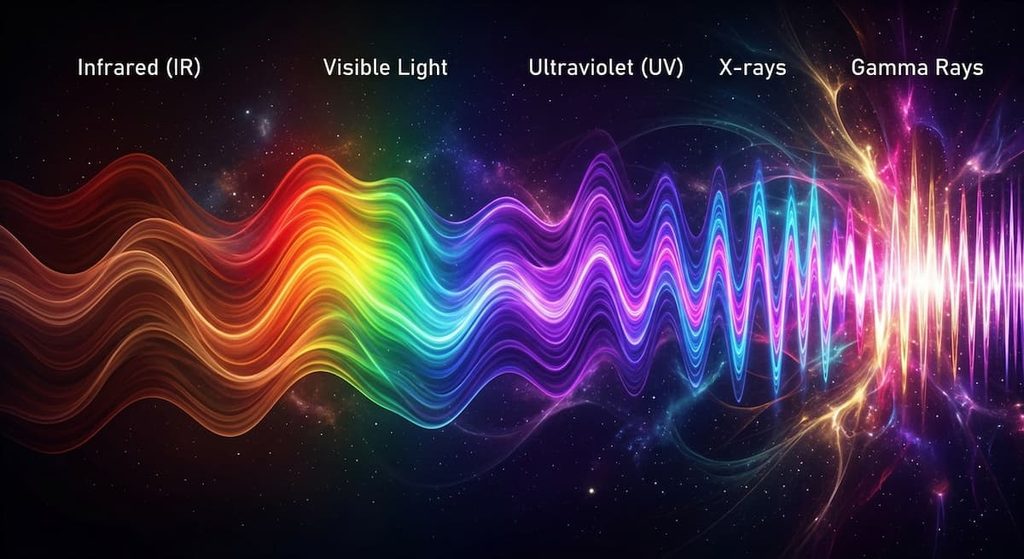
Electromagnetic waves are more than just natural light; they serve as critical tools in biotechnology and medical science. From thermal imaging using infrared radiation to optogenetics driven by visible light, ultraviolet sterilization, and precise radiation oncology via X-rays and gamma rays, wavelength-based applications are advancing rapidly. We explore how invisible waves became the ultimate weaponry in biotechnology and examine the future possibilities that electromagnetic spectrum technology holds for human medicine.
1. Biological Applications of Infrared and Visible Light: Thermal Imaging and High-Precision Optogenetics
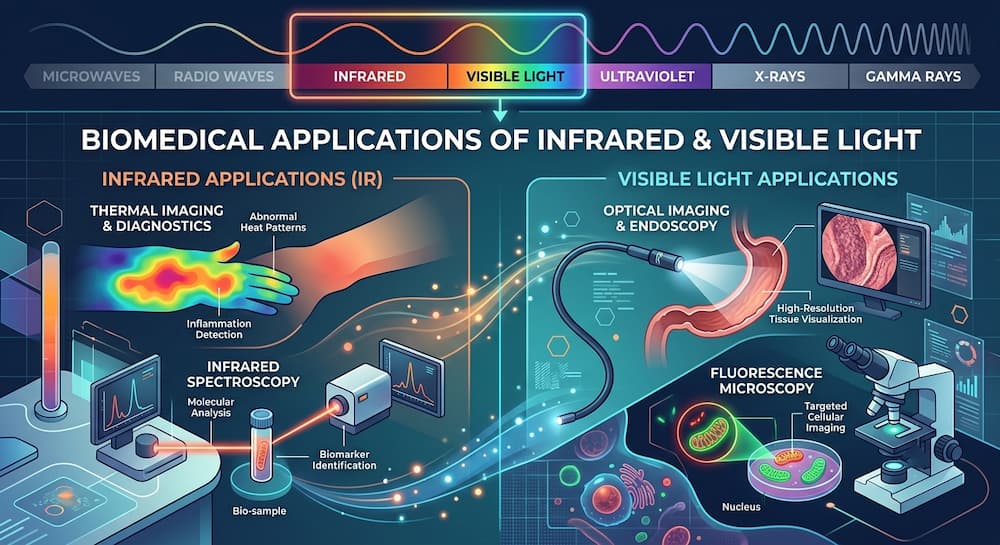
Light is no longer merely a tool to illuminate our surroundings. In modern biotechnology, light acts as a precision instrument to control living cells. The first band to capture scientific attention is infrared radiation. Infrared waves have wavelengths invisible to the human eye, yet they possess strong energy that induces molecular vibration. Biotechnology researchers have aggressively leveraged this phenomenon for precision diagnostics.
Consider the infrared thermal cameras used in daily life. Cancer cells exhibit metabolic processes entirely distinct from those of normal cells. As they proliferate exponentially, they consume massive quantities of nutrients and release thermal energy. Infrared sensors capture these minute temperature differentials with high precision. Without surgical incisions or invasive procedures, clinicians can rapidly identify subcutaneous tumors or circulatory anomalies.
How is visible light deployed within biotechnological fields? Visible light forms the foundational pillar of optogenetics, an innovative branch of life sciences. Scientists introduce specific channelrhodopsin genes into target cells, enabling protein channels to open and close upon light exposure. When targeted with microscopic visible light lasers, a remarkable phenomenon occurs: specific neurons can be activated or deactivated within a single millisecond.
This capability unlocks an era where complex neural circuits in the brain can be controlled at will. Active research is underway to stimulate malfunctioning neurons to halt tremors in Parkinson’s disease or disrupt deep depressive neural pathways. Penetration depth varies depending on the specific wavelength applied through biological tissues. By engineering exact wavelengths, researchers can target specific deep-seated cells with extreme accuracy. This precision of light is fundamentally altering the paradigm of incurable disease treatment.
2. Biotechnological Applications of Ultraviolet Radiation: DNA Modification and Viral Photo-Sterilization
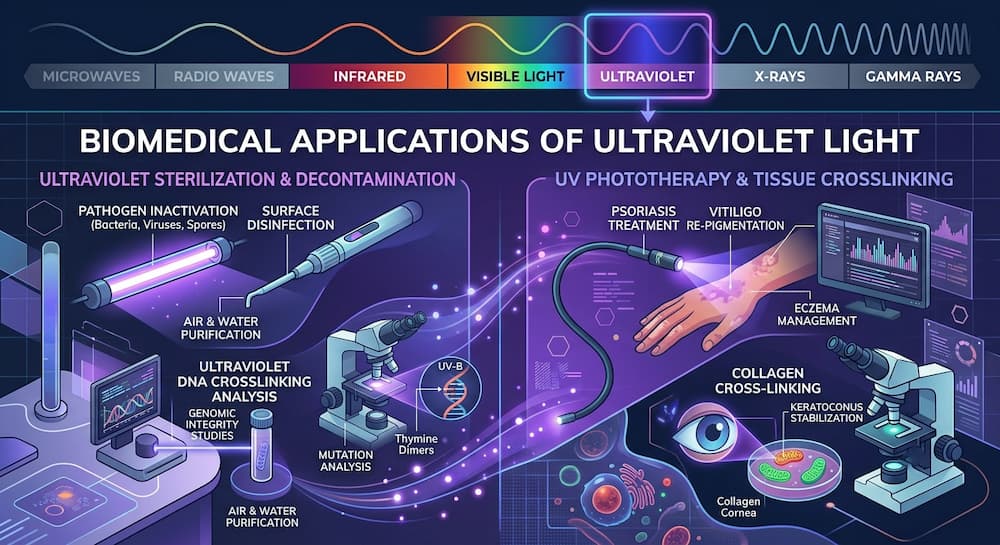
Ultraviolet (UV) radiation is commonly recognized as the cause of skin tanning. However, in biotechnology, UV light transforms into an intelligent molecular weapon. UV radiation possesses significantly shorter wavelengths than visible light, allowing it to penetrate deep into cellular interiors and directly strike molecular structures. How have scientists harnessed this high-energy wave?
The core mechanism lies in DNA disruption. When UV light irradiates microorganisms, adjacent thymine bases within the DNA strand form abnormal covalent bonds, creating thymine dimers. Once this structural distortion occurs, viruses and bacteria completely lose their replication capability. This process neutralizes pathogens within seconds without relying on chemical reagents. This mechanism is critical for inactivating toxicity during vaccine manufacturing and developing high-precision hospital sterilization systems.
The utility of UV radiation extends further into genetic engineering. Scientists apply UV light when inducing random mutations to screen for high-yield industrial microorganisms. Among countless strains, researchers isolate mutant variants that either withstand UV stress or produce targeted industrial compounds in large quantities.
How do human cells respond to UV exposure? Human cells maintain sophisticated enzymatic repair systems that autonomously fix light-induced DNA lesions. Biotechnology researchers are working to reverse-engineer this UV repair mechanism to inhibit the self-healing capacity of cancer cells, leading to novel oncology therapeutics. Converting dangerous invisible light into life-saving technology, UV radiation has firmly established itself as a core control mechanism in modern biotechnology.
3. The Medical Evolution of X-rays: Structural Biology Protein Analysis and High-Precision CT Scanning
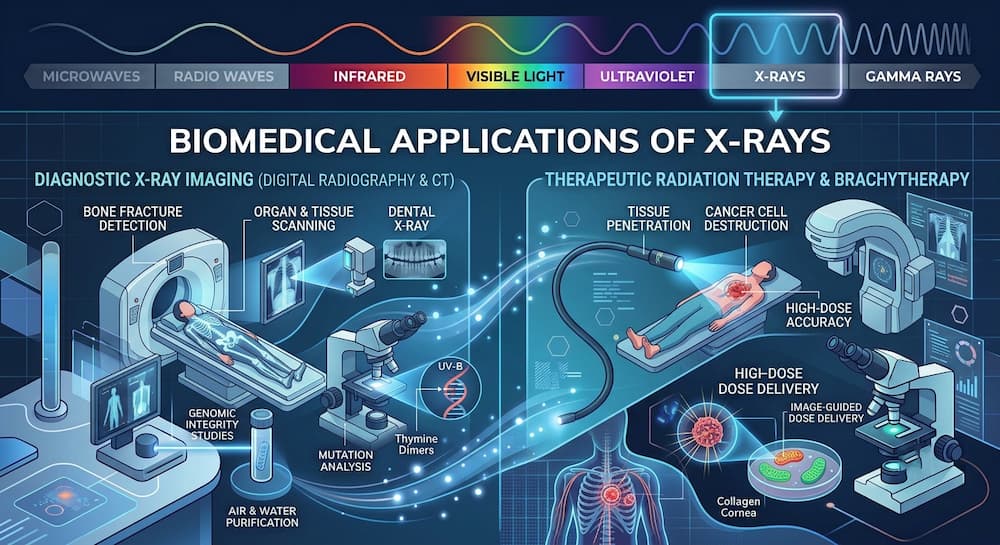
X-rays are far more than a tool for capturing bone fractures. In modern biotechnology laboratories, X-rays function as high-powered microscopes that reveal the fundamental structures of life. X-rays carry much shorter wavelengths than UV radiation. This ultra-short wavelength allows X-rays to penetrate deep into matter and resolve structures down to the molecular and atomic levels.
A primary application in biotechnology is X-ray crystallography. How do scientists determine the exact three-dimensional structures of proteins or DNA? Target proteins are crystallized and irradiated with X-rays. As light collides with electrons inside the crystal matrix, it scatters in predictable diffraction patterns. Computers analyze these diffraction patterns to reconstruct the 3D structures of macromolecules down to angstrom-level precision. The double-helix structure of DNA was historically unraveled using this technique. Pharmaceutical researchers utilize these structural insights to design targeted therapies that bind exclusively to cancer proteins.
How are X-rays applied in clinical settings? Computed Tomography (CT) advances traditional 2D radiography into multi-angle cross-sectional imaging. An X-ray emitter rotates 360 degrees around the patient, collecting continuous attenuation data. X-ray absorption varies depending on tissue density, enabling advanced algorithms to synthesize detailed 3D cross-sectional views of internal organs, bones, and blood vessels.
This technology allows clinicians to pinpoint micro-hemorrhages or early-stage tumors instantly. By rendering visible the microscopic architectural features of living systems, X-rays continue to expand the horizons of molecular biology, serving as a pillar for drug discovery and precision diagnostics.
4. Precision Targeted Therapy via Gamma Rays: Radiation Oncology and Biomaterial Sterilization
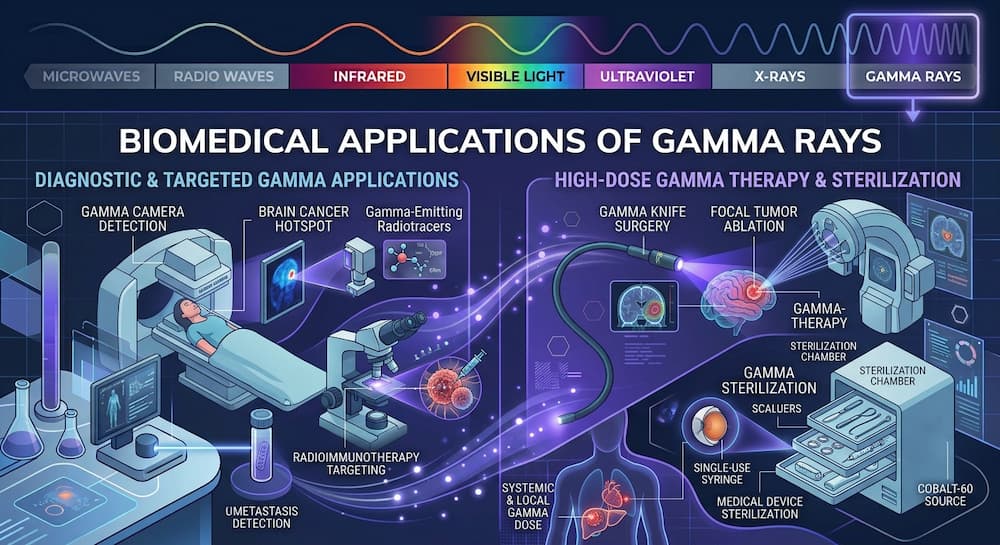
Positioned at the extreme end of the electromagnetic spectrum, gamma rays possess the shortest wavelengths and highest energy density. Capable of penetrating cell membranes and thick tissues, this destructive radiation unexpectedly serves as an essential tool in modern medicine and biotechnology.
A prominent clinical application is Gamma Knife radiosurgery. How do surgeons eliminate brain tumors without opening the skull? Waves emitting from roughly 200 microscopic gamma radiation sources are focused precisely onto the tumor site. While each individual beam is weak enough to spare healthy tissue, converging beams at the focal point deliver concentrated energy, fracturing the double-stranded DNA of cancer cells and inducing apoptosis.
Gamma rays also play an essential role in biomaterials and medical device manufacturing. Products such as artificial joints, organ scaffolds, and advanced drug delivery containers risk structural deformation or toxic residue contamination when sterilized with high heat or chemical agents.
Researchers solve this issue through gamma irradiation sterilization. When gamma rays irradiate fully sealed packaging, high penetrative power destroys the genetic material of all viruses and bacterial spores within the product. Because no chemical residue remains post-sterilization, this technique yields safe and sterile biomaterials. By controlling high-energy radiation, gamma rays serve as a precision instrument in modern oncology and biotechnology.
Conclusion
Electromagnetic waves extend beyond simple physical phenomena to serve as transformative tools expanding the boundaries of biotechnology and medicine. By controlling invisible wavelengths, science enables precision diagnostics and targeted cellular therapy. As light-based techniques continue to advance, electromagnetic waves will remain central to unlocking biological mechanisms and shaping the future of therapeutic medicine.
![[Bit#43] Animal’s Instinctive Weather Radar You Didn’t Know About](https://hiddenbitknowledge.com/wp-content/uploads/2026/05/8bf6811cafc2-768x512.jpg)
![[Bit#123] Miracle Substance in Sweet Wormwood Defeats Malaria](https://hiddenbitknowledge.com/wp-content/uploads/2026/08/main.Sweet-Wormwood-768x419.jpg)
![[Bit#12] The Golden Death: Why Scorpion Venom Costs $39 Million Per Gallon](https://hiddenbitknowledge.com/wp-content/uploads/2026/04/5fbca9cf7008-768x561.jpg)
![[Bit#127] Salt-Tolerant Crops: Future Food Growing in Salty Soil](https://hiddenbitknowledge.com/wp-content/uploads/2026/08/main.saline-grow-area-768x419.jpg)
![[Bit#23] The Dining Revolution: Cultured Meat and the Dilemma of Carnivory](https://hiddenbitknowledge.com/wp-content/uploads/2026/05/7b4b7585b7de-768x538.jpg)
![[Bit#15] Cryonics: A Scientific Gamble Toward Life After Death](https://hiddenbitknowledge.com/wp-content/uploads/2026/04/ab12b1d4e7ff-768x513.jpg)