[Bit#161] The Secret of 400 Year Longevity: How Greenland Sharks Rewrote Aging Science
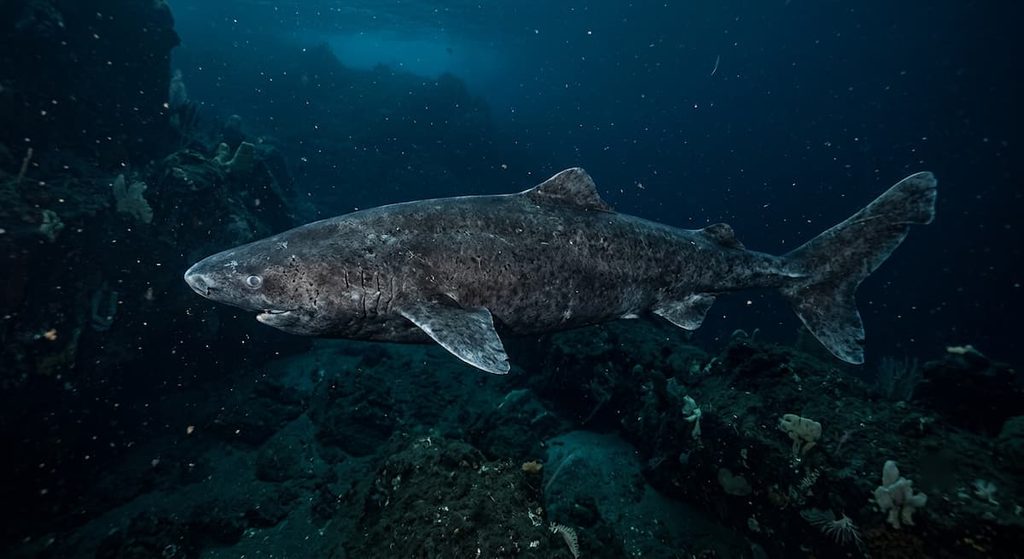
Deep in the freezing waters of the Arctic, a massive creature swims silently through the darkness. Remaining calmly in place like a living ghost, this is the Greenland shark. Long before the United States was founded, this shark was already swimming through the chilly deep seas. What is the secret that allows it to endure hundreds of years? It goes beyond a simple biological mystery. The key to extending human lifespan and overcoming aging lies inside their genes. We explore the secrets of this astonishing creature of longevity and examine what implications it holds for the future of humanity.
1. The Phantom of the Ocean Swimming for 400 Years
Deep in the frigid, near-freezing waters of the Arctic, a massive creature cuts through the darkness. Quietly maintaining its presence like a living ghost, this is the Greenland shark. Just how long has this animal roamed these icy oceans? Recent scientific analysis of eye lens proteins reveals that this shark can live for an astonishing 400 years.
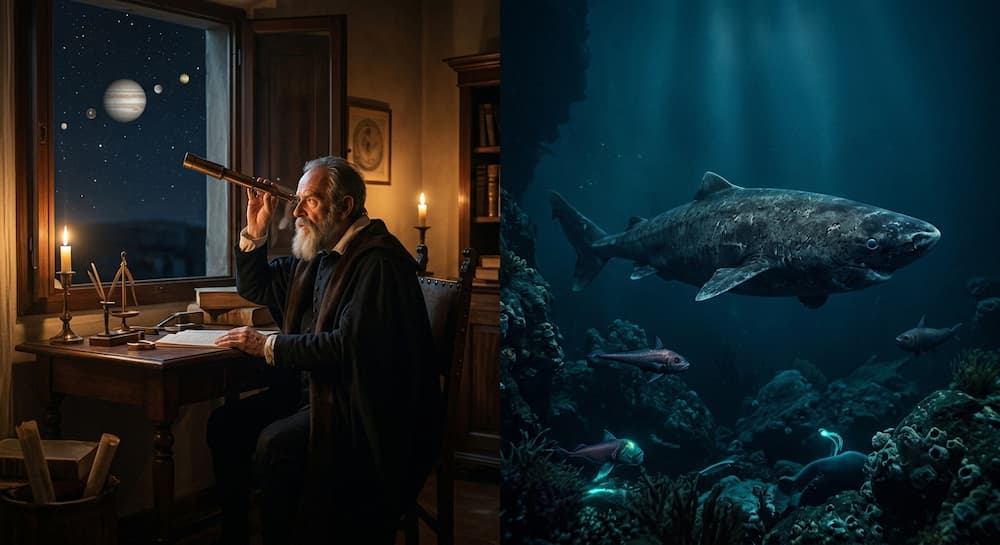
Is it difficult to grasp the weight of four centuries? Four hundred years ago, Galileo Galilei was raising his telescope for the very first time to observe Jupiter in the night sky. Long before the United States was even established as a nation, a creature born in that era was swimming through the sea and continues to do so at this very moment. As the undisputed oldest living vertebrate on Earth, how has it managed to endure such an immense span of time?
The secret lies in an extraordinarily slow biological clock coupled with a unique survival strategy. Adapted to near-freezing deep-sea conditions, the Greenland shark reduces all metabolic functions to the absolute minimum. Its swimming speed tops out at roughly one kilometer per hour, significantly slower than a human walking pace. Its growth rate is equally astonishing, expanding by a mere single centimeter per year. Remarkably, it takes a female shark at least 150 years just to reach sexual maturity and reproduce. It spends a century and a half maturing before it is even ready to become a parent.
Why adopt such a sluggish lifestyle in the cold, dark depths? The answer is extremely simple. Extreme efficiency designed to conserve energy. In a food-scarce abyss, spending minimal energy is the ultimate key to surviving across centuries. The existence of the Greenland shark goes far beyond a biological novelty. It is living proof that completely redefines the absolute limits of vertebrate longevity.
2. The Mechanism of Immortality Created by Extremely Slow Metabolism
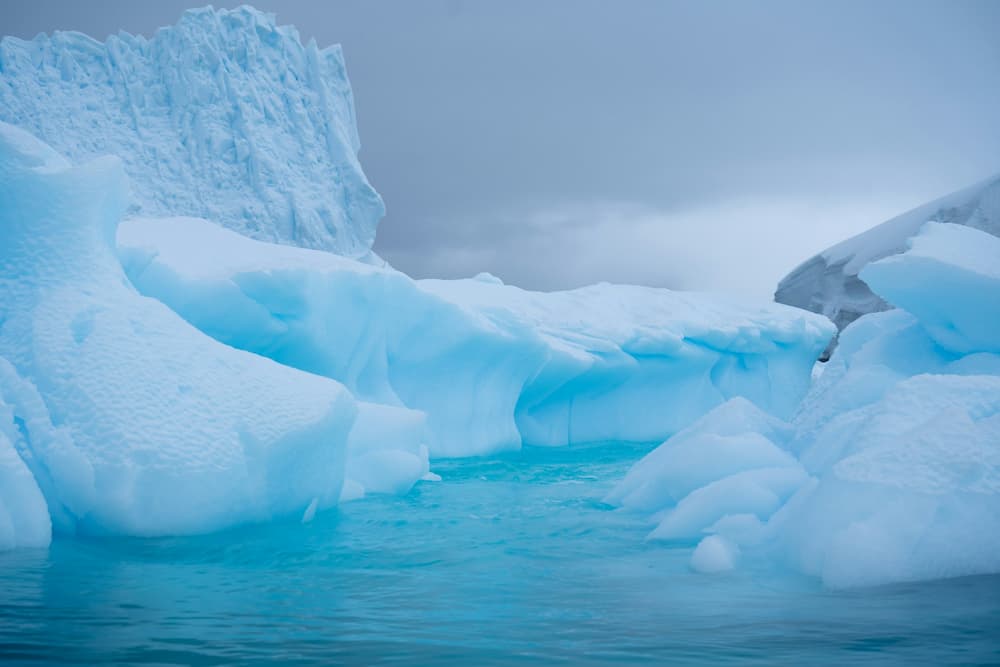
Why do living organisms age and decay? The core issue rests within cellular division and metabolic processing. Every single second spent breathing and converting food into energy exerts wear and tear on cells. Higher metabolic rates accumulate elevated levels of oxidative stress, eventually leading to cumulative cellular damage and aging. Where does the metabolic rate of the Greenland shark stand?
Surprisingly, the metabolic rate of this shark drops far below typical biological boundaries. Subzero deep-sea temperatures keep its body temperature extremely low. Low temperatures slow down cellular enzymes and chemical reactions dramatically. Even its heart beats only once every 12 seconds, existing in a state close to total stillness with long pauses of silence between beats.
Why is this extreme metabolic delay so crucial? It drastically reduces oxidative stress. Reactive oxygen species are the primary culprits that attack tissues and DNA. By minimizing metabolism, the Greenland shark prevents the creation of reactive oxygen species at the source, offering no opportunity for cells to sustain damage. It builds the foundation of longevity internally.
Furthermore, enzyme activity within its muscle cells remains completely stable over centuries. Most organisms experience a sharp drop in enzyme performance with age. Yet whether a Greenland shark is 100 or 300 years old, its physical capability shows virtually no decline. Cells simply do not degrade or lose functionality over time. A slow-burning engine ultimately runs the longest distance.
3. The Harsh Deep-Sea Environment and DNA Repair Capability
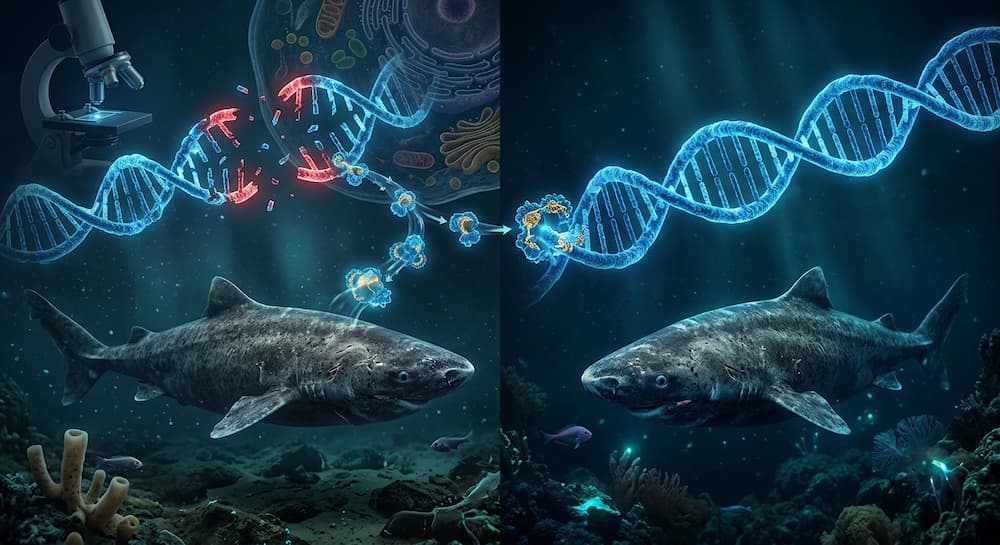
Enduring centuries requires more than just a low metabolic rate. The true secret rests inside a highly sophisticated DNA repair system within its cells. The Arctic deep sea inhabited by the Greenland shark is a harsh realm ruled by immense water pressure and frigid temperatures. Such extreme conditions constantly damage genetic material. How do they overcome this constant cellular degradation?
The secret lies in a specialized cluster of DNA repair genes. Recent genomic sequencing revealed exceptionally developed TP53 and XRCC family genes inside the Greenland shark. The TP53 gene monitors damaged cells and halts malignant transformation into cancer. The XRCC gene group immediately reconnects double-stranded DNA breaks caused by environmental stressors. Supported by the BCL2 gene, which regulates cell death, the shark fundamentally blocks cumulative damage.
Why is this gene repair machinery so significant? It provides near-total protection against fatal diseases such as cancer. Typical organisms collect DNA repair errors over time, causing cellular mutations. In contrast, the robust DNA repair genes of the Greenland shark preserve genetic stability over centuries, leaving zero room for mutated cells to proliferate.
Ultimately, the Greenland shark evolved an internal survival kit to safeguard its genome rather than succumb to harsh environments. It transformed extreme pressure and freezing cold into drivers of longevity. This precise genomic blueprint offers profound inspiration for human chronic disease treatment and anti-aging research.
4. Scientific Questions Posed to Human Aging Research
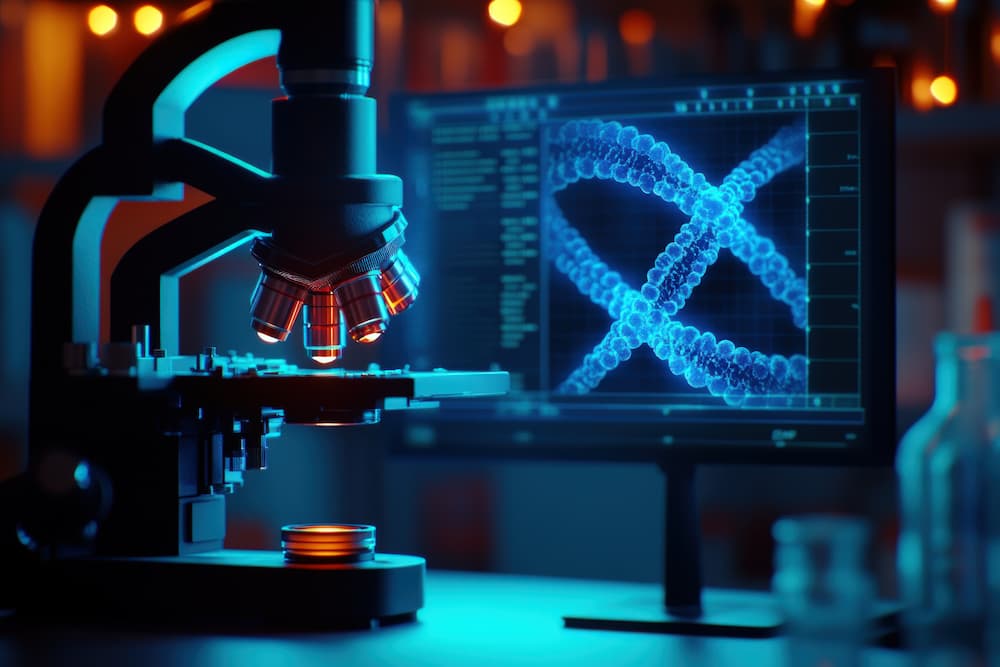
The incredible survival strategy of the Greenland shark extends beyond marine biology. It poses unprecedented questions to modern medicine and longevity science. Can humans slow down aging as dramatically as the Greenland shark? Scientists are actively decoding its genome to find actionable answers.
The long-held human dream of extending lifespan is no longer mere science fiction. Researchers are analyzing ways to apply the TP53 and XRCC repair mechanisms of the Greenland shark to human cellular biology. The goal is developing therapies that prevent cellular senescence and suppress cancer early. The biological clock that enabled 400 years of life has become a key to transforming human medicine.
Naturally, one cannot apply the exact habitat conditions of the Greenland shark to humans. We cannot reside in freezing oceans or drop our body temperature. However, cellular damage repair and reactive oxygen species suppression mechanisms are fully adaptable. Leading research groups worldwide are testing shark cell mechanisms to explore anti-aging breakthroughs.
Swimming through four centuries, the Greenland shark proves that the boundary of lifespan is not fixed. Once known as a ghost of the deep ocean, this creature now serves as a guiding light for human healthspan extension. Science remains focused on how far the secrets hidden in its DNA will reshape the future of human life.
Conclusion
The Greenland shark perfected an internal biological system that resists aging while enduring 400 years in the dark depths. Its continuous DNA repair capacity and extreme metabolic slowdown present practical answers to human longevity research.
What questions should we ask ourselves next? If humanity unlocks the secrets of this shark and extends human lifespan twofold or threefold, will we truly be happier? What matters more: surviving for centuries, or maintaining a high quality of life filled with deep meaning? The vast lifespan of the Greenland shark invites us to reflect deeply on the true value of time and existence beyond technological possibilities.
![[Bit#21] Cockroaches: The Ultimate Biological Design Surpassing Nuclear Survival](https://hiddenbitknowledge.com/wp-content/uploads/2026/05/015d9c51b899-768x512.jpg)
![[Bit#143] Why Cats Land Safely When Falling from High Places](https://hiddenbitknowledge.com/wp-content/uploads/2026/09/main.cat_-768x439.jpg)
![[Bit#138] How Mudskippers Breathe on Land: The Secrets of Cutaneous Respiration](https://hiddenbitknowledge.com/wp-content/uploads/2026/08/main.Mudskipper-767x428.jpg)
![[Bit#57] Wildfires and Ecosystems: The Bio-Mechanism of Destruction and Rebirth](https://hiddenbitknowledge.com/wp-content/uploads/2026/06/8b81363e2c58-768x512.jpg)
![[Bit#51] Locusts: The Time Bomb Transformation of Peaceful Vegetarians](https://hiddenbitknowledge.com/wp-content/uploads/2026/06/0288773009e8-768x433.jpg)
![[Bit#150] How Chimpanzees Self-Medicate in the Wild](https://hiddenbitknowledge.com/wp-content/uploads/2026/09/main.Wild-chimpanzee-in-forest-767x624.jpg)