[Bit#115] The Hidden Secrets of Seahorses: Nature’s Most Unusual Marine Creatures
Introduction
Seahorses are mysterious creatures swimming through the deep ocean. They feature a unique appearance and a fascinating ecological background. They are the only animals in the world where males undergo pregnancy and give birth. They live by fluttering their tiny fins in a truly distinct way. However, destruction of coastal ecosystems and overfishing leave them with no place to stand. This article explores the biological traits of seahorses, the quiet guardians of marine life, and the environmental messages they send. How does this tiny sea creature survive in the harsh ocean?
1. The Unique Wanderer of the Sea: Biological Traits and Swimming Style of Seahorses
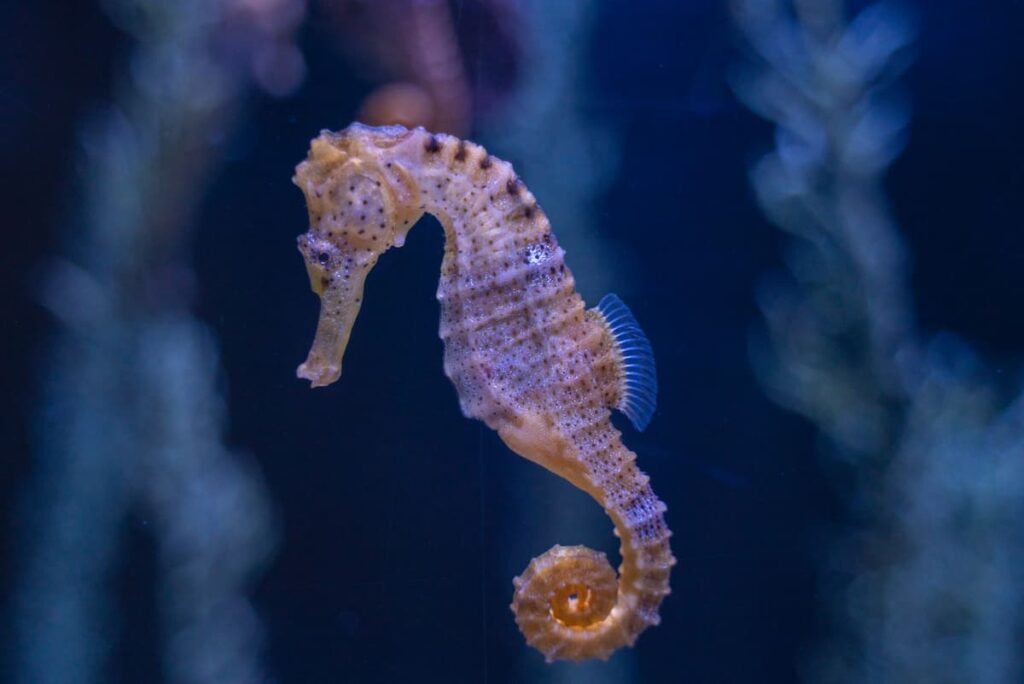
An odd creature that is hard to believe as a fish lives underwater. It is the seahorse. It has a face resembling a horse and a body like a dragon. Where are its fins located?
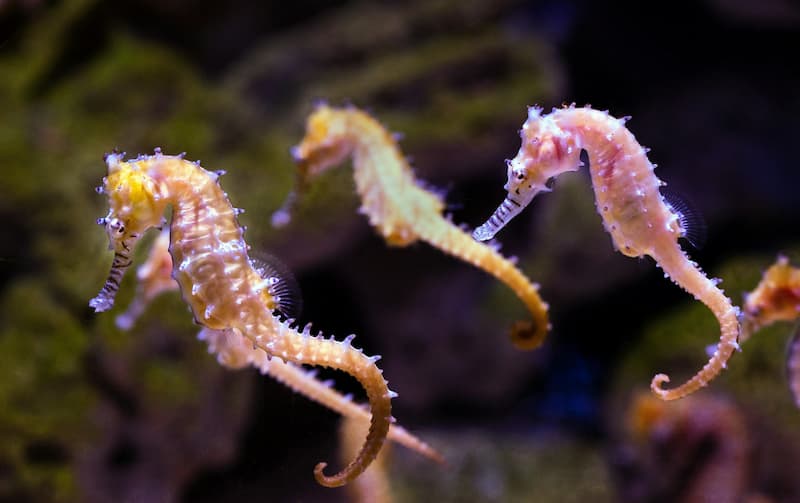
Seahorses swim using a single dorsal fin and pectoral fins. They flutter their dorsal fin 30 to 40 times per second to move forward. Yet, their swimming ability ranks at the very bottom among marine life. Strong waves easily knock them off balance and sweep them away. Why did they evolve to swim so poorly?
The secret lies in their bones and tail. Seahorses do not have scales like regular fish. Instead, bony armor plates cover their entire body. This bone armor protects them from predator attacks, but it makes their body heavy and stiff. Furthermore, seahorses lack a caudal fin. Instead, they gained a flexible tail like a monkey. Seahorses wrap this tail tightly around seaweed or coral to withstand strong ocean currents. They chose a survival strategy of anchoring in one place instead of swimming fast.
Even more interesting are their eyes. Both eyes move independently. One eye targets small prey like shrimp, while the other monitors approaching predators. It serves as an ultimate defense mechanism to scan 360 degrees around without turning the head. This small, slow creature continues its survival race in the rough sea using its unique body structure.
2. Nature’s Unique Twist: Pregnancy and Birth in Male Seahorses
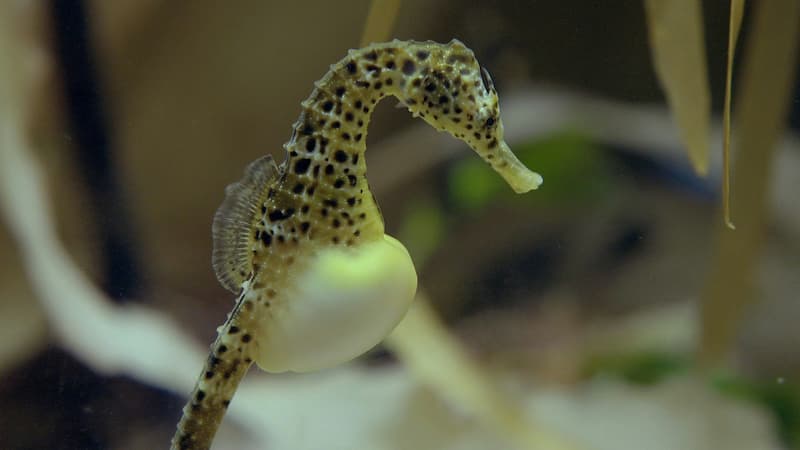
A creature where the father gets pregnant and gives birth exists in the ocean. It is the male seahorse. They are the only male animals on Earth that become pregnant. When the female produces eggs and transfers them, the true pregnancy process begins. The female deposits eggs into a pouch called a brood pouch located on the male’s belly. The male fertilizes the eggs inside this brood pouch. Then, amazing changes occur inside the father’s body.
The male seahorse’s brood pouch is not just a simple pocket. It plays a role remarkably similar to a mammal’s uterus. Blood vessels fill the inside of the pouch. The male directly supplies oxygen and nutrients to the eggs. He even transfers immune substances to protect the offspring. Prolactin, a hormone found in female mammals, is also secreted. A hormone that aids lactation appears in male seahorses. He automatically adjusts the salinity inside the pouch so the offspring adapt to ocean water. Why did they adopt such a unique method?
The ocean is a dangerous environment filled with predators. Eggs left on rocks get eaten immediately. When the male raises them safely inside his body, the survival rate of the offspring rises significantly. Moreover, this division of labor maximizes reproductive efficiency. While the male handles pregnancy, the female replenishes nutrients to create the next batch of eggs. Right after birth, the female can transfer eggs to the male again.
After a pregnancy period of two to four weeks, labor begins. The male seahorse experiences severe labor pains. He twists his body intensely and squeezes his belly. Hundreds to as many as two thousand baby seahorses burst out from the father’s belly at once. Tiny seahorses shooting into the sea form a true wonder of nature. The father seahorse enduring severe pain to bring forth life leaves a deep impression on us.
3. Hiding from Large Predators: Seahorse Camouflage and Survival Strategies
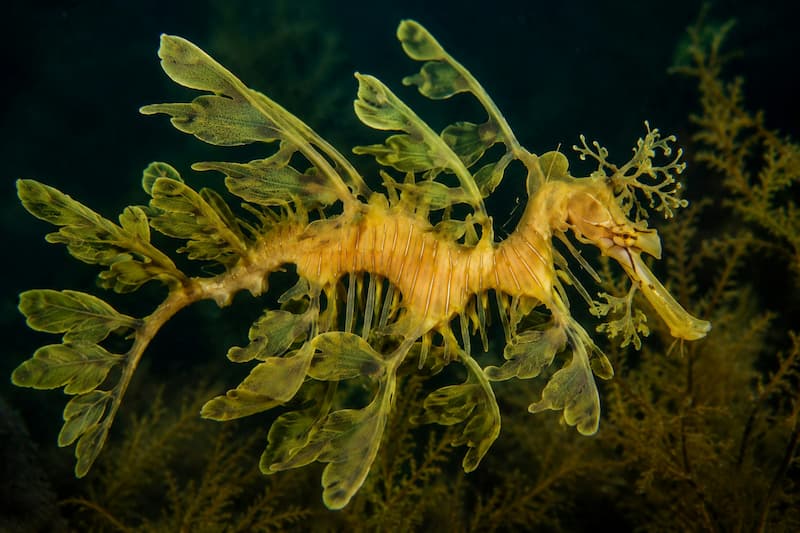
How does the slow seahorse survive in an ocean full of predators? The secret weapon of the seahorse is perfect transformation. It changes body color freely and hides completely into the background. Why is this transformation possible? Special cells called chromatophores sit densely under the seahorse’s skin. Expanding or contracting these cells creates the exact same color as the surrounding environment. When resting among yellow corals, it turns bright yellow. When entering a black seaweed forest, it changes into dark brown immediately.
It goes beyond changing colors. Seahorses grow skin filaments shaped like bumps or twigs on their body surface. They replicate the texture of nearby seaweed or coral. They even allow real moss or algae to grow on top of their bumps. This is why sharks or large fish fail to notice seahorses even when passing right beside them. They completed a perfect camouflage to deceive the eyes of predators.
This perfect camouflage is not used only for defense. It serves as the ultimate hunting tool to capture prey. A slow swimming speed never catches fast prey. So the seahorse wraps its tail around coral and waits quietly in hiding. It targets the moment when small mysid shrimp lower their guard and approach. What happens when prey enters range? The seahorse powerfully suctions the prey along with seawater using its long snout. This whole process occurs in just a few milliseconds. The slowest swimmer in the ocean transforms into the fastest hunter in an instant. The seahorse chose complete harmony with its surroundings over superior physical ability. It is a wise strategy for a weak creature to survive in harsh nature.
4. Alarm Bell of the Coastal Ecosystem: The Crisis and Preservation Needs of Seahorses
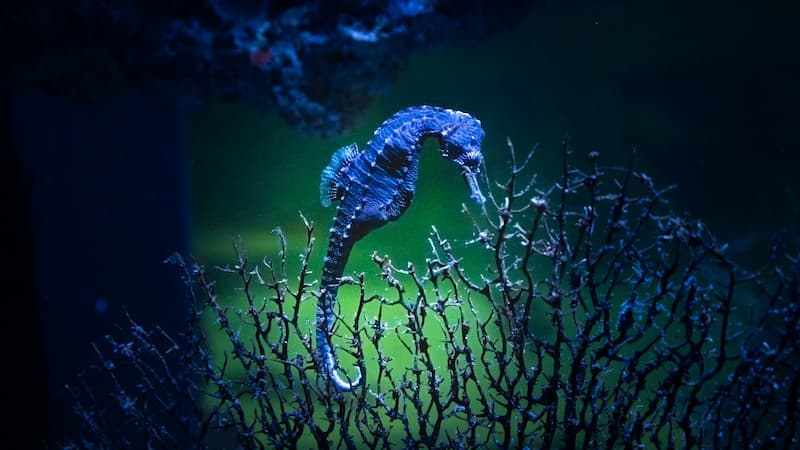
The quiet guardian of the sea, the seahorse, faces a severe crisis today. Why is this happening? It stems from human greed and coastal development. Seahorses live mainly in coastal seaweed forests and seagrass beds. However, coastal development and pollution destroy their habitats rapidly. Seahorses losing their homes get pushed into the open ocean and lose their lives.
A more serious problem is indiscriminate overfishing. Seahorses are highly popular as traditional medicine ingredients and ornamental pets. Tens of millions of seahorses get caught mercilessly from the sea every year. Seahorses swimming slowly with weak fins have no way to avoid human nets. The unique ecological structure where males handle pregnancy makes population recovery harder. Catching one father seahorse means losing hundreds or thousands of babies inside his belly together.
The decline of seahorses does not end with the extinction of a single species. Seahorses serve as an indicator species representing the health of coastal ecosystems. The disappearance of seahorses signifies that the ocean is already sick. This small, helpless creature warns us of the ocean crisis with its entire existence. We must take active steps to designate marine protected areas and prohibit illegal trade to safeguard these mysterious sea knights.
Conclusion
Seahorses chose their own survival methods using camouflage and strong bonding rather than fast swimming in the rough ocean. The sacrificial pregnancy of father seahorses and their wisdom in adapting to environments show the great harmony of nature. What kind of future are humans dreaming of while taking away the homes of these small creatures? It is time to reflect on the value of living together with nature.
![[Bit#165] Green Sea Slug: The Secret of an Animal Powered by Sunlight Like a Plant](https://hiddenbitknowledge.com/wp-content/uploads/2026/09/main.Elysia-chlorotica-767x428.jpg)
![[Bit#78] The Perfect Predator: The 300 Million Years Secret Hidden by Dragonflies](https://hiddenbitknowledge.com/wp-content/uploads/2026/06/main.dragonfly-768x512.jpg)
![[Bit#134] Ultralight Flight of the Albatross : The Secret of Endless Energy Free Flight](https://hiddenbitknowledge.com/wp-content/uploads/2026/08/main.Albatross-flying-ocean-768x439.jpg)
![[Bit#45] The Impact of Whales on the Earth](https://hiddenbitknowledge.com/wp-content/uploads/2026/05/00bced9565e0-768x512.jpg)
![[Bit#91] The Secret of the Immortal Jellyfish’s Rejuvenation](https://hiddenbitknowledge.com/wp-content/uploads/2026/07/main.Immortal-Jellyfish-1-768x512.jpg)
![[Bit#109] Aspirin: How Science Turned Toxic Willow Bark into Medicine?](https://hiddenbitknowledge.com/wp-content/uploads/2026/07/main.Aspirin-768x432.jpg)