[Bit#116] The Secret to Longevity: How Naked Mole-Rats Defy Aging and Cancer
Introduction
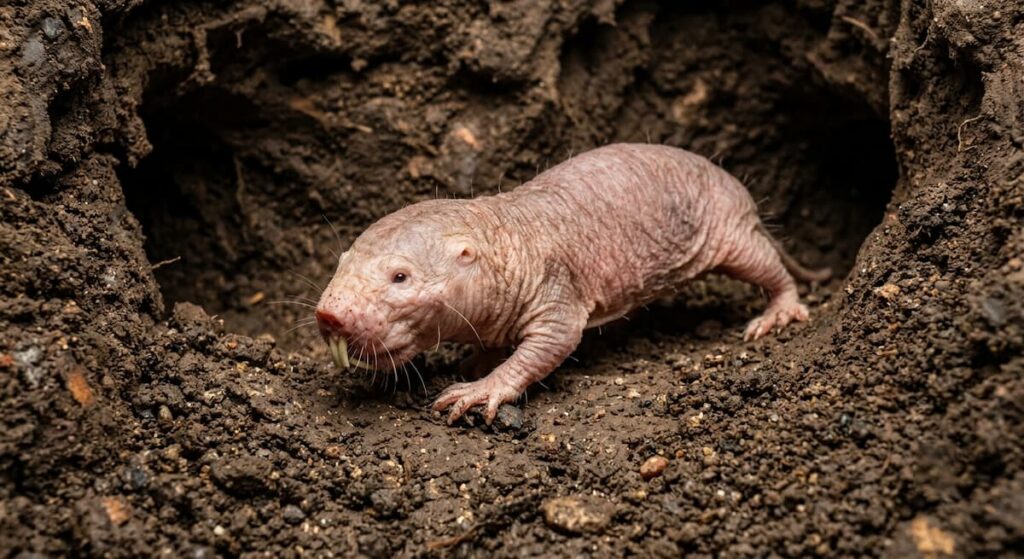
Deep underground, the naked mole-rat commands immense scientific interest despite its wrinkled appearance. This is because it lives over ten times longer than other rodents and almost never develops cancer. How does this tiny creature endure pain and resist aging? In this column, we examine the unique physiological characteristics of the naked mole-rat and consider the profound questions it raises for human longevity and disease prevention.
1. Living 30 Years: The Secret to a Lifespan 10 Times Longer Than Ordinary Mice

An ordinary mouse lives up to three years at most. In stark contrast, the naked mole-rat can live for more than 30 years. Compared to rodents of similar size, it survives ten times longer. How is such monstrous vitality possible? The secret lies in its anti-aging mechanisms operating at the cellular level.
Generally, animals accumulate DNA damage as they age. When damaged DNA builds up, cellular function declines, eventually leading to death. However, this small subterranean creature functions differently. It operates an extraordinary gene repair system that instantly fixes damaged DNA. It simply leaves no time for cells to grow old and deteriorate.
Its ability to prevent protein damage is equally remarkable. Inside every cell, there is a facility responsible for managing proteins. If this factory breaks down, altered proteins accumulate and turn the cell into a trash bin. Neurodegenerative conditions like Alzheimer’s and Parkinson’s diseases in humans stem from these damaged proteins. On the other hand, the naked mole-rat rapidly discards damaged proteins and replaces them with new ones. It maintains a clean, pristine cellular environment at all times.
Why did this creature evolve such unique capabilities? The answer lies in its dark, crowded subterranean tunnels. To survive an extreme environment lacking oxygen and filled with carbon dioxide, it pushed its cellular resilience to the ultimate limit. Their mysterious cells, which maintain full bodily function despite advanced age, offer powerful insights for humanity seeking to conquer aging.
2. A Body Immune to Cancer: The Powerful Barrier of High-Molecular-Mass Hyaluronan
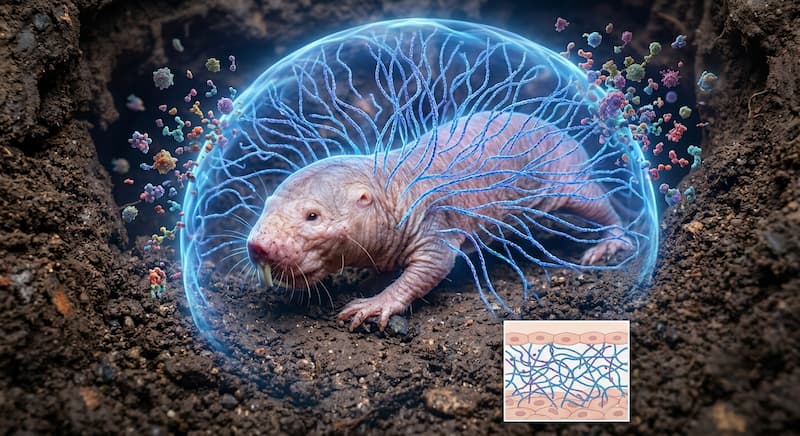
Naked mole-rats afford cancer cells no room to take root. Even after observing thousands of individuals over several decades, virtually no cases of cancer have been found. What shields them so completely from cancer? The answer rests in a substance filling the spaces between their skin and organs.
Their bodies contain an enormous amount of high-molecular-mass hyaluronan. Its molecular weight is vastly larger and denser than that found in humans or other mice. It fills the intercellular spaces tightly. This substance acts as a tough, gel-like protective barrier.
What is the most dangerous characteristic of cancer cells? It is their ability to proliferate indefinitely and invade surrounding tissues. However, inside the naked mole-rat, cancer cells find no room to expand even if they do appear. High-molecular-mass hyaluronan blocks the surrounding environment, forcing cells to stop growing the moment they reach a certain density.
What happens if this barrier is broken? Researchers introduced an enzyme that degrades high-molecular-mass hyaluronan. Remarkably, once the shield dissolved, the naked mole-rat cells began transforming into cancerous cells just like those of other animals. In essence, high-molecular-mass hyaluronan itself acts as a natural anti-cancer agent.
Human bodies produce this substance as well. However, it does not last long due to degrading enzymes. Naked mole-rats suppress the activity of these degrading enzymes, preserving this strong gel for a lifetime. This perfect self-defense mechanism against cancer opens new pathways for cancer researchers.
3. Surviving Without Oxygen: The Bizarre Ability to Metabolize Like Plants
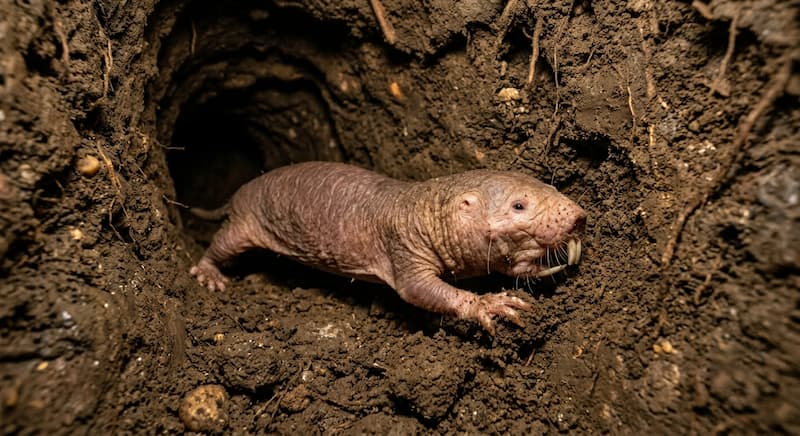
Naked mole-rats spend their entire lives in densely packed underground tunnels. Because hundreds of individuals huddle together and breathe in these enclosed spaces, oxygen is perpetually scarce. Carbon dioxide levels are exceptionally high. If an ordinary animal enters this environment, it suffers brain damage and dies within minutes.
Yet, these creatures endure more than 18 minutes without oxygen without suffocating. They even resume normal movement afterward without any lingering side effects. How is such miraculous survival possible?
The secret lies in their capability to fundamentally alter their energy metabolism. In humans, oxygen deprivation rapidly destroys brain cells because oxygen is strictly required to convert glucose into energy. Conversely, when oxygen vanishes, naked mole-rats immediately stop glucose metabolism. Instead, they activate a metabolic pathway that uses fructose as an energy source.
Generating energy from fructose resembles a plant mechanism rather than an animal process. They possess a system that transcends typical animal limitations. Until oxygen becomes available again, fructose metabolism maintains brain and heart function at a minimum baseline level.
What happens when oxygen returns? They instantly switch back to glucose metabolism. Not a single trace of damage remains in their internal organs or brain cells. This is why scientists studying strokes and myocardial infarctions caused by oxygen deprivation focus heavily on this unique metabolic pathway.
4. Skin Intolerant to Pain: A Nervous System Unresponsive to Acid and Capsaicin
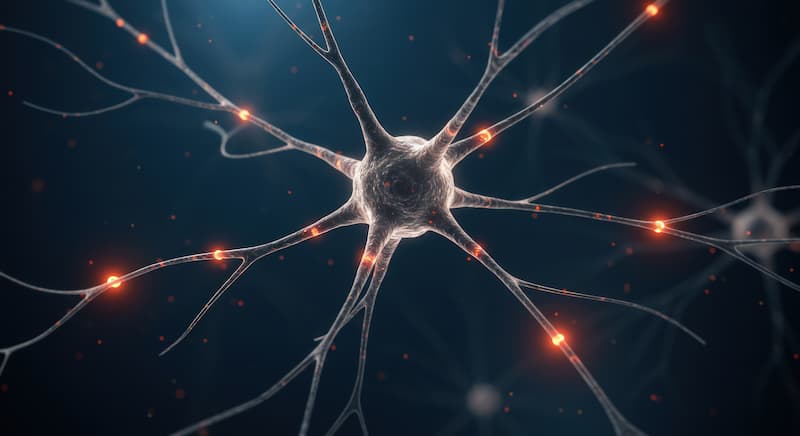
What happens if you apply acetic acid to skin? Other animals writhe in extreme pain. Yet, the naked mole-rat remains entirely unfazed, as if nothing happened. The outcome is identical even when applying capsaicin, the compound responsible for spiciness. Remarkably, they feel no pain whatsoever from acidity or spiciness.
Why are they unable to feel this pain? Specific alterations occurred within their pain-transmitting neural network. Pain nerves in typical animals open ion channels on their cell membranes when exposed to acidic substances. Once opened, signals travel to the brain, producing the sensation of pain. However, the pain nerves of the naked mole-rat lock these channels tightly when encountering acid. They completely shut down signal transmission.
This pain-blocking mechanism is a survival strategy dictated by their subterranean environment. Living in burrows filled with high concentrations of carbon dioxide causes acidic substances to accumulate in the body. Feeling pain constantly in an acidic environment would make normal life impossible. Ultimately, they evolved to turn off their own pain switches.
This insensitivity to pain holds massive medical potential. It provides the key to developing chronic pain treatments without side effects. This small rodent offers critical clues for techniques that selectively block specific pain signals without paralyzing nerves altogether.
Conclusion
The naked mole-rat is a creature that has effectively solved four of humanity’s greatest challenges: aging, cancer, oxygen deprivation, and chronic pain. The harsh subterranean tunnel environment gifted them immense vitality.
We often consider extended lifespans an exclusive privilege of humanity. Yet, in the history of evolution, nature created a creature that defies aging and disease long ago. If humanity unlocks the secrets of this small animal to double our lifespan and eliminate disease, will we truly be happier? Does the value of life lie merely in living longer, or in the meaning we create within our limited time?
![[Bit#138] How Mudskippers Breathe on Land: The Secrets of Cutaneous Respiration](https://hiddenbitknowledge.com/wp-content/uploads/2026/08/main.Mudskipper-767x428.jpg)
![[Bit#107] Extreme Survivors of the Arid Land: The Hidden Scientific Secrets of Cacti](https://hiddenbitknowledge.com/wp-content/uploads/2026/07/main.Cactus-Desert-768x512.jpg)
![[Bit #152] How Cat Purrs Heal Bones and Tissue](https://hiddenbitknowledge.com/wp-content/uploads/2026/09/main.cat-purring-close-up-768x512.jpg)
![[Bit#43] Animal’s Instinctive Weather Radar You Didn’t Know About](https://hiddenbitknowledge.com/wp-content/uploads/2026/05/8bf6811cafc2-768x512.jpg)
![[Bit#69] The Secret to the Longevity of Trees That Endure for Thousands of Years](https://hiddenbitknowledge.com/wp-content/uploads/2026/06/main.oldest-tree-768x512.jpg)
![[Bit#21] Cockroaches: The Ultimate Biological Design Surpassing Nuclear Survival](https://hiddenbitknowledge.com/wp-content/uploads/2026/05/015d9c51b899-768x512.jpg)