[Bit #153] Why Does Your Breath Turn White in the Cold? The Hidden Biology of Human Vapor
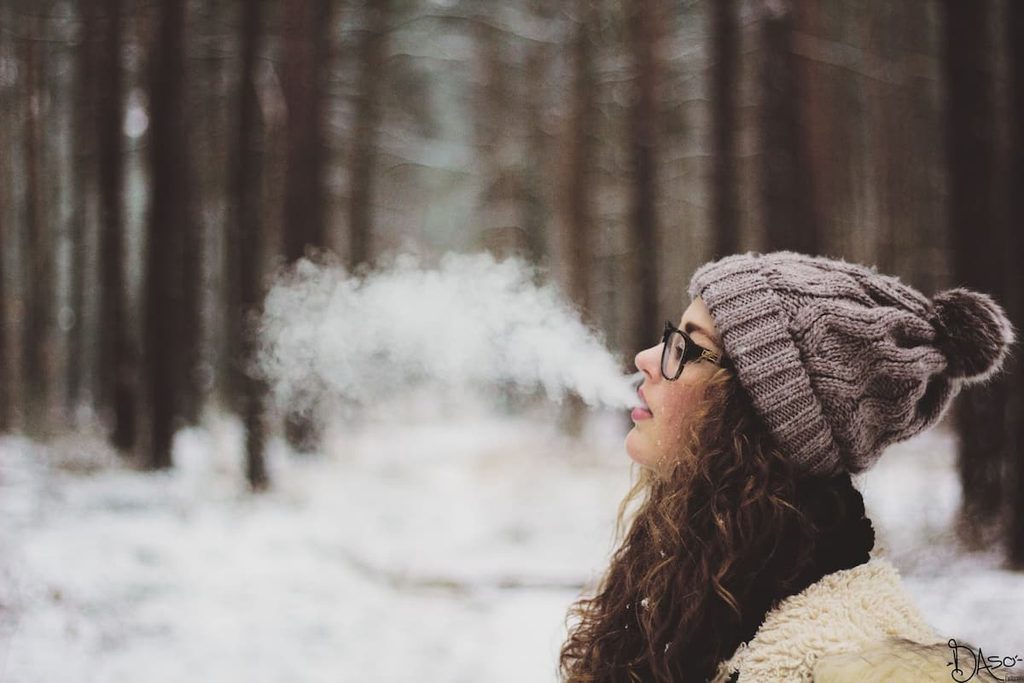
The white vapor released from your mouth on a freezing winter day is not simply a reaction to cold temperatures. It is a precise bio-thermodynamic process that occurs when warm internal body temperature, high moisture levels within the lungs, and cold external air meet. Why does this fog only become clearly visible below specific temperatures? This column explores the scientific mechanisms of condensation, temperature, and relative humidity as moisture from the lungs expands into the air. We also examine the biological significance of how the human body exchanges heat with its surrounding environment.
1. Body Temperature and the Internal Lung Environment: Why Water Vapor Is Created During Respiration
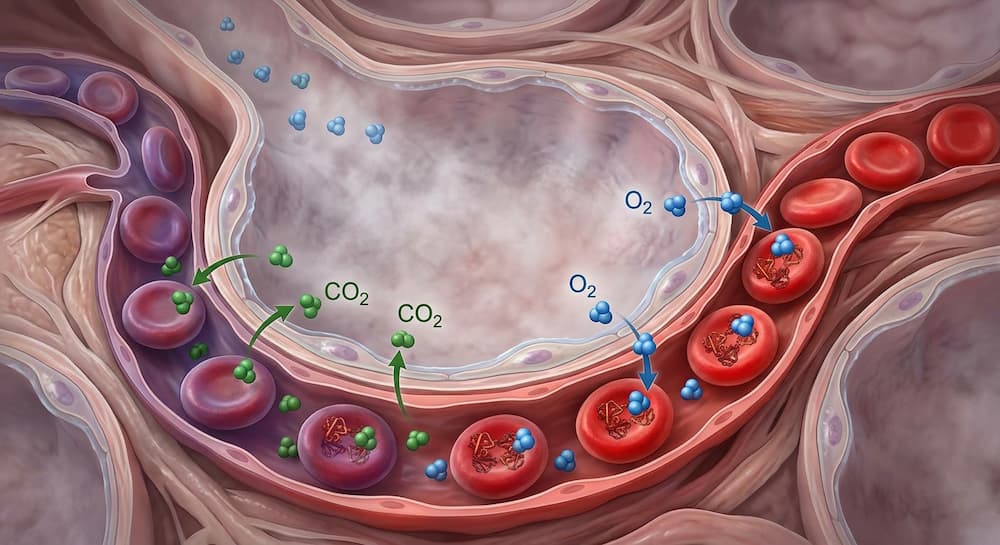
What happens inside our bodies when we inhale freezing winter air? The human lungs are not mere flexible air bags that draw in and expel atmosphere. They function more like a high-performance biological climate control system. It does not matter if the ambient air is cold and dry like polar winds. The time it takes for air to pass through the nasal passages and airways into the deep recesses of the lungs is less than 0.1 seconds. Yet, in that split second, the properties of the air are completely transformed.
Internal lung temperature is strictly regulated at approximately 37 degrees Celsius by the homeostatic system. At the same time, the relative humidity inside the lungs is maintained near 100 percent. Why does the human body expend such vast amounts of energy to saturate incoming air? The secret lies in the biological structure of the alveoli. For alveoli to transport oxygen into the bloodstream and receive carbon dioxide, their cellular membranes must remain continuously moist with a thin film of water. If dry air were to contact the alveoli directly, these delicate cells would be destroyed immediately, causing the gas exchange mechanism to fail.
Consequently, every time we inhale, the body pours out internal heat and moisture to warm and hydrate the incoming air like a hot thermal bath. The volume of water consumed through this process daily equals several full glasses. From a bio-thermodynamic perspective, respiration is a continuous heat exchange process that evaporates water and expels thermal energy. As a result, the air we exhale is constantly filled with invisible microscopic water vapor. As long as we are alive, warm vapor travels out with every breath. Why then does this transparent vapor, completely invisible under normal conditions, suddenly turn into white mist the moment it leaves our mouths?
2. Dew Point and Condensation: The Moment Cold Air Transforms Vapor into White Mist
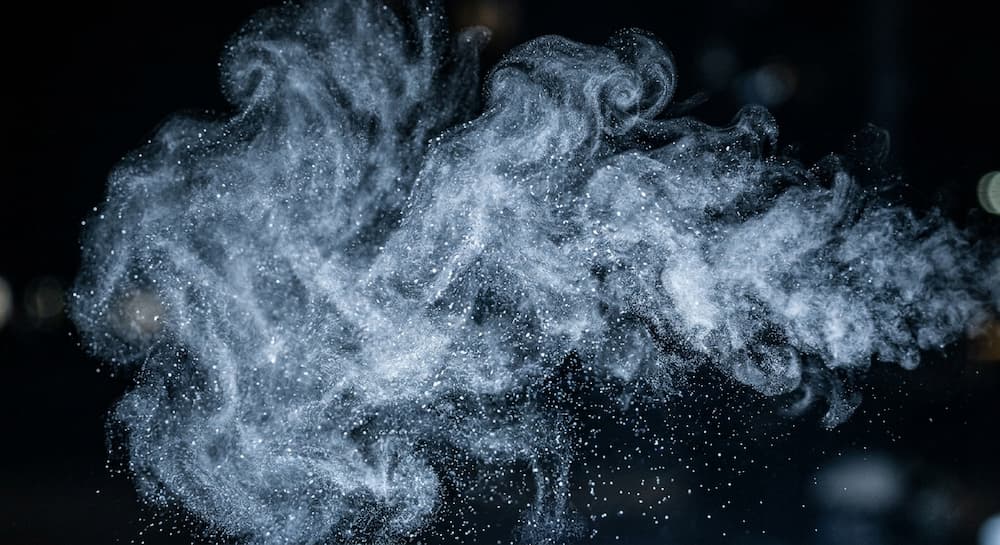
The warm, saturated breath exiting the lungs immediately encounters a harsh external environment. Ambient air outside the mouth is vastly colder and drier than the environment within the lungs. At this point, the first law of thermodynamics takes over as immediate heat transfer occurs. The warm breath surrenders its thermal energy to the cold outside air and cools rapidly. What happens when air temperature plunges? The saturated vapor capacity, which defines the maximum amount of moisture air can hold, drops precipitously.
As the air grows colder, it loses its capacity to retain water vapor in a gaseous state. Eventually, the air reaches a critical threshold temperature where it can no longer hold the moisture. We refer to this threshold as the dew point. The moment this dew point is reached, the water vapor molecules floating in a transparent gaseous state lose their kinetic balance. What becomes of these displaced vapor molecules? They bind together rapidly, changing their physical state into microscopic liquid water droplets. This phase change is known as condensation.
The white mist we observe with our eyes is actually not a gas. It is a miniature cloud composed of hundreds of millions of microscopic liquid water droplets suspended in the air. Because these tiny droplets scatter light in all directions, our eyes perceive the phenomenon as white smoke rising into the air. However, these rapidly cooled micro-droplets soon disperse into the dry surrounding air, vanishing within seconds. With every breath, a miniature cloud forms and disappears, displaying a tiny cosmic cycle right before our faces.
3. The Relationship Between Temperature and Relative Humidity: Why Breath Fog Appears Only in Specific Weather

Why is breath fog invisible on some freezing days below zero, while on other days above freezing, thick white vapor billows into the air? The answer does not depend on temperature alone. It results from a precise thermodynamic combination of temperature and relative humidity. For breath fog to become visible to the human eye, the exhaled breath must reach a supersaturated state where relative humidity exceeds 100 percent.
Generally, when ambient temperatures drop below 5 degrees Celsius, breath fog begins to form. However, this rule applies only when ambient air is not excessively dry. What happens if the outside air is extremely dry? The water vapor exiting the lungs evaporates rapidly into the parched environment before it can even reach the dew point. It is not granted sufficient time to condense into liquid micro-droplets. Conversely, on rainy or foggy days, vivid breath fog can form even in warmer conditions around 7 or 8 degrees Celsius. Because ambient air is already saturated with moisture, adding just a small amount of warm vapor from the body instantly pushes the system over its limit.
Ultimately, the breath fog we witness is an organic phenomenon created when internal physiological conditions align with atmospheric states. Strong winds quickly disperse the water droplets, causing the mist to vanish instantly. On days with high humidity and stagnant air, the fog lingers suspended in the atmosphere for an extended period. This explains why the shape and density of your breath fog vary every day despite identical respiratory action. Is this loss of heat and moisture with every breath a net disadvantage in terms of human bio-thermodynamics, or does it serve a vital purpose?
4. Respiration in Bio-Thermodynamics: Human Science Balancing Heat and Minimizing Energy Loss
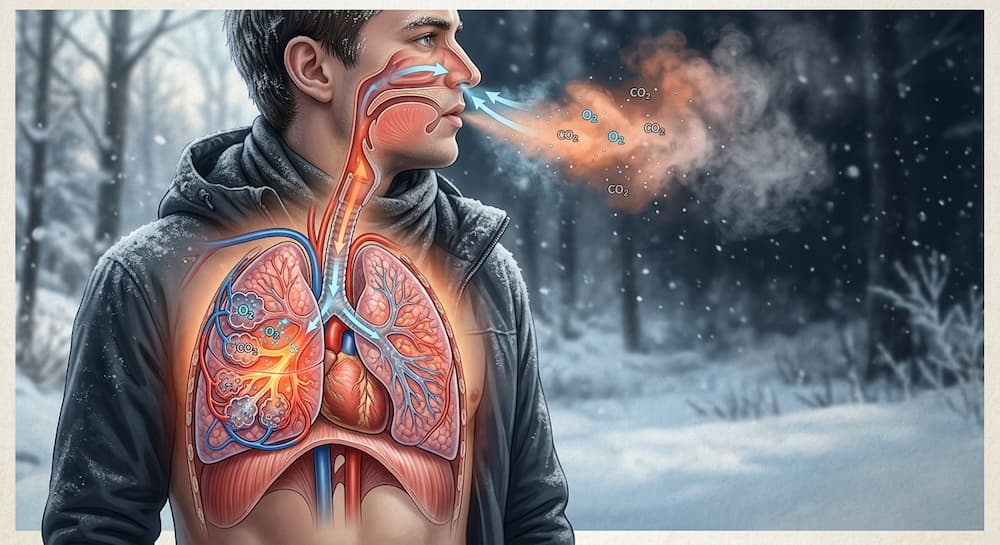
Is the loss of substantial heat and moisture with every breath merely a disadvantage from a bio-thermodynamic perspective? Absolutely not. The human body is a powerful thermal engine that burns calories to generate heat. Heat dissipation through respiration serves as a crucial cooling pathway to expel excess thermal energy generated by heartbeats and metabolic activity. Just as an engine relies on coolant to prevent overheating, humans continuously operate a thermoregulatory cooling system through breathing.
What is remarkable is the emergency response mechanism the body deploys when exposed to cold environments. The fine network of capillaries inside the nasal passages senses incoming cold air and dynamically expands and contracts. This network functions as a biological heat exchanger, rapidly warming external air before it reaches the lungs. When exhaling, the nasal structures reabsorb a portion of the departing water vapor, minimizing internal water loss. In essence, while we lose some energy in the form of visible breath fog during cold weather, we are simultaneously maintaining thermodynamic equilibrium across the entire body to sustain life.
The white breath fog rising into cold air serves as direct bio-thermodynamic proof that our bodies are alive at this very moment. It is a sign of life showing that individual cells are operating their engines tirelessly to protect a core temperature of 37 degrees Celsius, even amidst freezing cold.
Conclusion
The white mist spreading in cold weather represents a beautiful intersection where biological respiration meets atmospheric thermodynamics. Within a single breath that we casually exhale lies the delicate effort of the human body to preserve core temperature alongside the laws of nature. Looking at the white fog fading before your eyes, what thoughts cross your mind? Just as that mist forms for a fleeting moment and dissolves into the air, isn’t it a breathtaking natural miracle that our bodies exist by continuously exchanging energy and moisture with the world?
![[Bit#4] I Put Someone Else’s ‘Poop’ in My Body, and a Miracle Happened](https://hiddenbitknowledge.com/wp-content/uploads/2026/04/main.Fecal-Microbiota-Transplantation-768x512.jpg)
![[Bit#10] The Law of Viral Evolution: Why Are They Getting Deadlier?](https://hiddenbitknowledge.com/wp-content/uploads/2026/04/f00076102e67-768x512.jpg)
![[Bit#47] Identical Twins: Copies of the Genome, Yet Completely Distinct Individuals](https://hiddenbitknowledge.com/wp-content/uploads/2026/05/82efd79e8b40-768x431.jpg)
![[Bit#9] Why We Must Die: The ‘Expiration Date’ Chosen by Evolution](https://hiddenbitknowledge.com/wp-content/uploads/2026/04/0348b8923730-768x585.jpg)
![Why Does Flexibility Decrease With Age? [Bit#179]](https://hiddenbitknowledge.com/wp-content/uploads/2026/10/main-image-3-768x428.jpg)
![[Bit#168] Why Tears from Sadness and Onions Are Chemically Different](https://hiddenbitknowledge.com/wp-content/uploads/2026/09/main.tear_-768x419.jpg)