[Bit #154] Why 5 Nobel Prizes Went to Fruit Fly Research
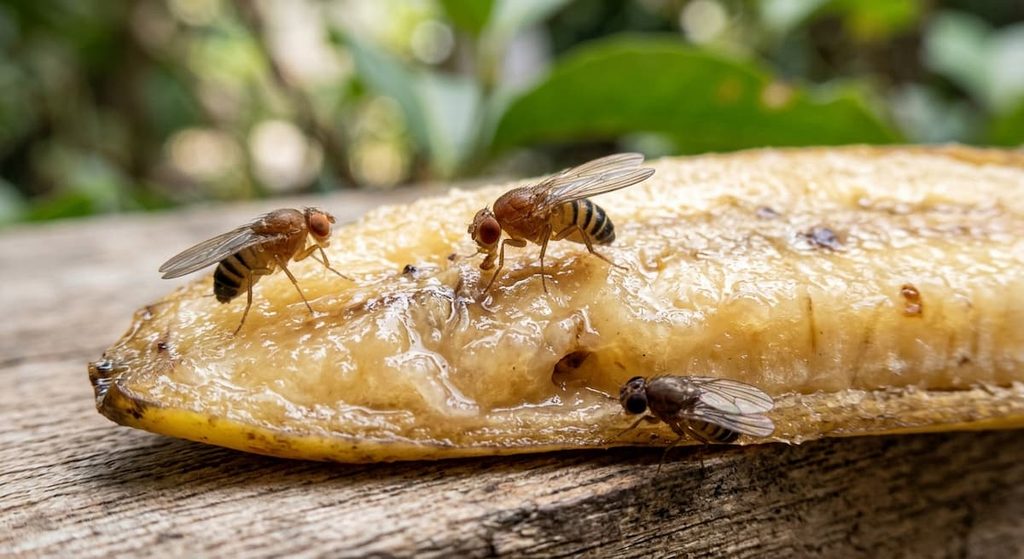
A tiny fruit fly has completely reshaped human science. Why were scientists so fascinated by this particular insect? It is because their genes are surprisingly similar to those of humans. We explore how a small, common insect became the key to curing human diseases. Through this journey, we examine the questions that advancements in life sciences pose for our lives and ethics.
1. The Decisive Reason Fruit Fly Genetics Transformed Life Sciences
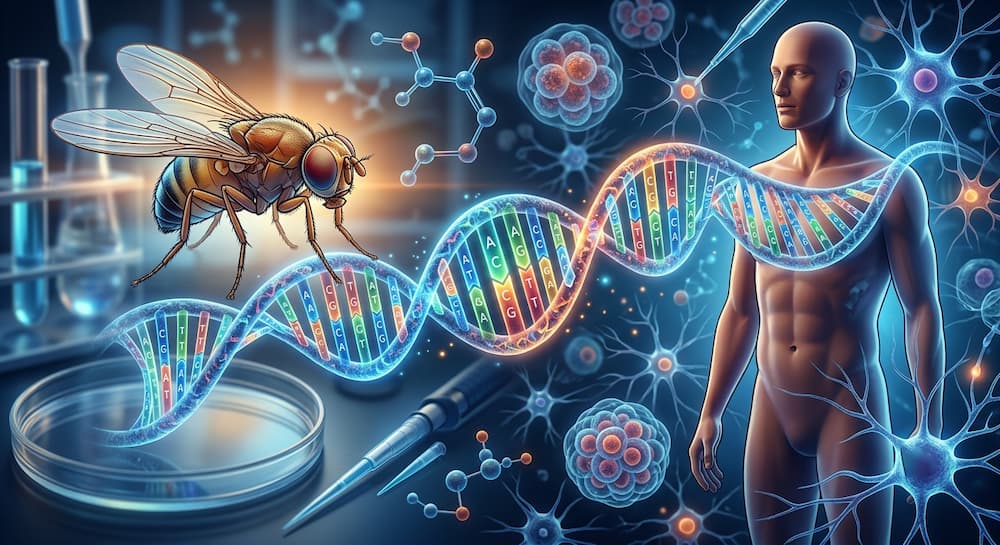
The tiny fruit fly you commonly see around you has completely changed the landscape of modern medicine. Is it hard to believe? This small insect has been a top contributor at the forefront of life sciences for over 100 years. It has produced more than five Nobel Prizes in Physiology or Medicine. Why on earth were scientists so enthusiastic about this seemingly insignificant bug?
The secret is simpler than you might think. Fruit flies and humans share the fundamental blueprint of life to a surprisingly similar degree. The core mechanisms by which cells divide and grow are identical. Although they are small, the principles driving them as living organisms remain the same.
We cannot use the complex human body directly as a test subject due to massive ethical constraints. To uncover the causes of countless diseases, scientists needed to find the ultimate model to replace humans. At that exact moment, the fruit fly emerged as the perfect savior.
When we analyze the DNA inside a fruit fly cell in detail, we find countless areas that correspond one-to-one with the human genetic map. They possess everything from cancer-causing mutations to genes responsible for rare neurodegenerative diseases. Artificially regulating a single gene reproduces the initial symptoms of human diseases in the insect’s body. The entire human cycle of life, aging, illness, and death is contained within that tiny frame.
Do they still look like annoying bugs flying before your eyes? Not at all. The fruit fly is the optimal research tool for cleanly demonstrating complex human biological phenomena. It teaches us the principles of pain and aging with unmatched clarity. The history of genetic engineering is divided into before and after bringing fruit flies into the laboratory. Without this small creature, modern human medicine might still be wandering in the dark.
2. The Astonishing 75 Percent Match Between Human and Fruit Fly Genes
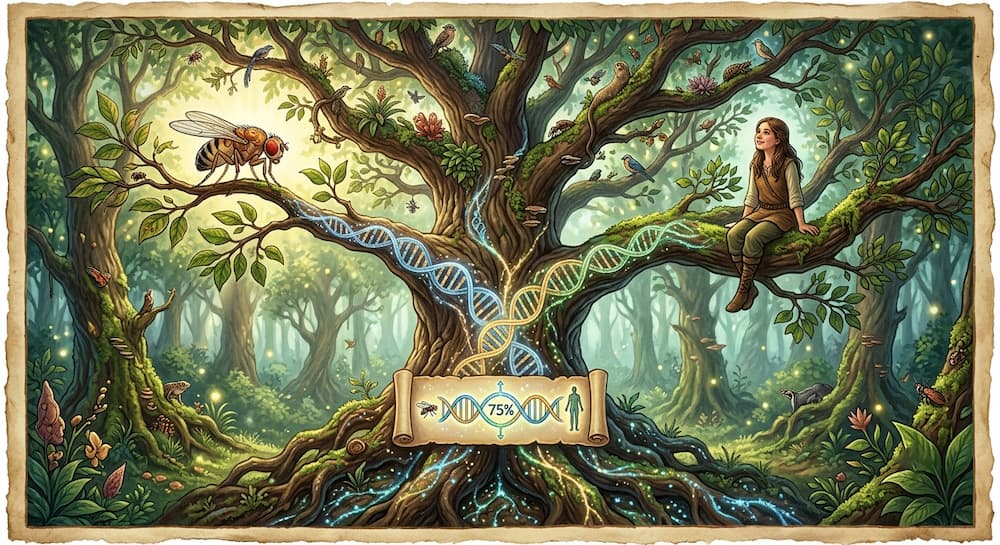
How can a seemingly insignificant insect resemble human genes so closely? The answer lies in the miraculous number of 75 percent. An astounding 75 percent of the genes that cause diseases in humans exist identically in fruit flies. Their outer appearances are as different as night and day, yet the core operating principles of their genomes resemble each other like twins. How is this possible?
Let us travel back to ancient times. Humans and fruit flies diverged from a common ancestor eons ago. Essential genetic information required for survival was preserved without changing through the turbulence of evolution. Genes controlling heartbeats are a prime example. The key proteins connecting neural networks are also identical. The gene responsible for eye development functions normally even when transplanted from a fruit fly into a human context.
This remarkable similarity became a massive breakthrough in genetic engineering. Consider intractable diseases such as cancer, Alzheimer’s, and Parkinson’s disease. Manipulating genes directly in humans to observe progress is virtually impossible. However, the story changes with fruit flies. What happens when human disease genes are injected into a fruit fly? The fruit fly experiences destroyed brain cells or tumor growths just like a human.
Ultimately, the fruit fly serves as the primary compass in genetics for pinpointing the true nature of human diseases. It is not merely a matter of sharing a few similar genes; it replicates the exact, intricate pathways through which diseases develop. Thanks to this small organism, we can peer into the genetic tragedies occurring deep within the human body and establish solutions in advance.
3. Experimental Dominance Powered by Rapid Reproduction and Short Lifespans
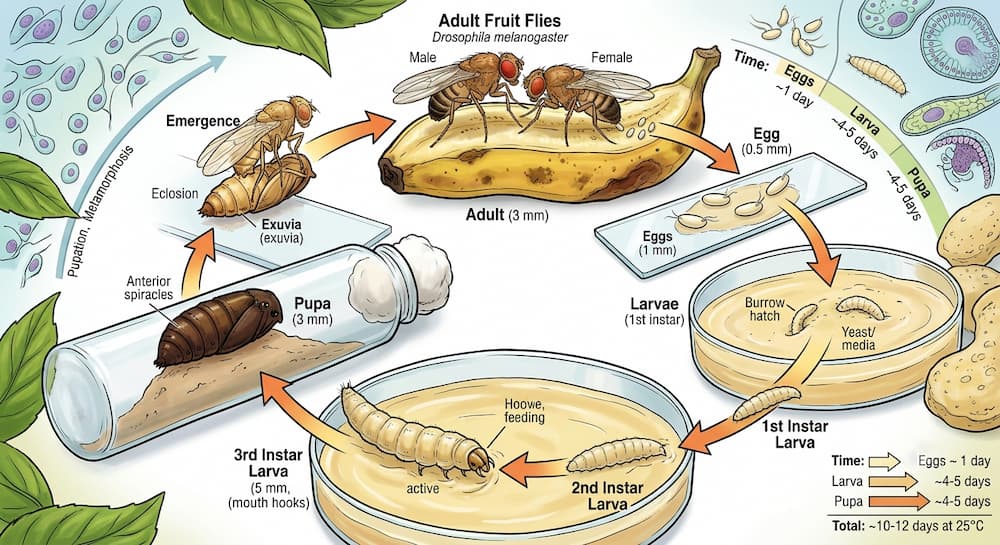
Why did researchers choose the fruit fly out of so many animals? The secret lies in its incredible reproductive capacity and rapid life cycle. A fruit fly takes just ten days to grow from an egg to a larva, a pupa, and finally an adult. You can observe three generations in a single month. Generational turnover that would take decades in human research occurs in just a few weeks.
Consider the efficiency of the laboratory environment. A single female fruit fly lays hundreds of eggs during her lifetime. Researchers can secure vast numbers of individuals quickly and at low cost. This provides the perfect conditions for statistically verifying how genetic mutations pass to the next generation. The ability to raise thousands of fruit flies in a few small glass jars is another massive advantage.
What if we conducted gene-tracking experiments on mammals? It would consume immense time and financial resources, not to mention spatial limitations. In contrast, the fruit fly is unrivaled in cost-effectiveness and efficiency. It is the only research subject that allows real-time tracking of genetic changes across successive generations.
Ultimately, the short lifespan of the fruit fly bought scientists immense time. It is the chief contributor that unlocked genetics secrets in a few years that would otherwise have taken centuries. Thanks to the explosive reproductive power of this tiny insect, humanity advanced genetic engineering progress by several decades.
4. The Future of the Fruit Fly Model Accelerating Intractable Disease Treatments
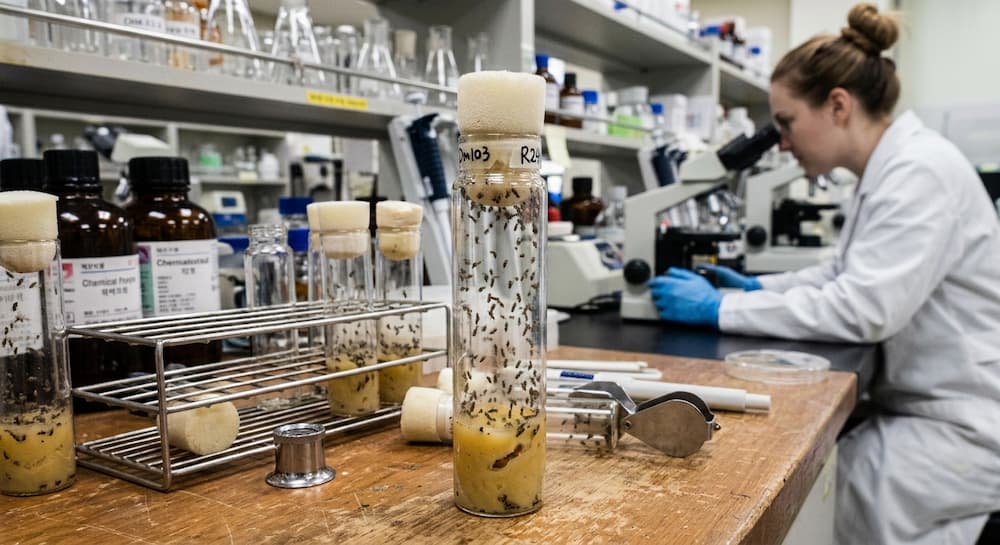
The fruit fly is stepping beyond basic genetic experiments to become the ultimate key to drug development. Is it believable? Global pharmaceutical companies actively utilize fruit flies when screening new drug candidates. Developing a new drug usually requires trillions of won and more than ten years. However, using the fruit fly model slashes early screening time dramatically.
Researchers administer thousands of drug candidates simultaneously and monitor reactions. They observe whether a fruit fly with damaged brain nerves moves normally again after consuming a specific compound. Experiments that would cost hundreds of millions of won are completed in a few days. From drugs preventing cancer cell metastasis to substances slowing Parkinson’s progression, breakthrough compounds are already discovered through fruit flies.
What will the future look like? The era of personalized medicine will open in earnest. A patient’s mutated gene can be transplanted directly into a fruit fly to test in advance which medication works best for that individual. We are approaching an era where optimal treatments are determined without administering drugs directly to human patients first.
The fruit fly has transcended being a simple experimental tool to become a partner in cutting-edge medicine saving human lives. Research that began with the curiosity of scientists 100 years ago now offers rays of hope to patients with incurable diseases. A single flap of small wings has transformed the health and lifespan of all humanity.
Conclusion
We have traced the trajectory of how a single fruit fly contributed to human genetic engineering and medical progress. Sharing genes with humans, this tiny organism fights incurable diseases on our behalf in laboratories at this very moment. We cannot help but ask: How should we evaluate the value of small lives sacrificed for human life extension and disease eradication? And when genetic engineering allows us to control all human diseases completely, will we truly find happiness as perfect beings?
![Why Do Your Fingers Wrinkle in Water? [Bit#177]](https://hiddenbitknowledge.com/wp-content/uploads/2026/10/mian-image-767x510.jpg)
![[Bit#64] From Ocean Menace to Medical Miracle: The Incredible Rediscovery of Starfish](https://hiddenbitknowledge.com/wp-content/uploads/2026/06/main.Starfish-768x512.jpg)
![[Bit#67] The Science of Dying: What Happens in Our Final Moments](https://hiddenbitknowledge.com/wp-content/uploads/2026/06/main.morgue-768x430.jpg)
![[Bit#29] The Evolutionary Secret of Right-Handed Dominance](https://hiddenbitknowledge.com/wp-content/uploads/2026/05/391c8203889c-768x512.jpg)
![[Bit#104] The Secret of Protein Folding: Why Structural Failures Cause Fatal Diseases](https://hiddenbitknowledge.com/wp-content/uploads/2026/07/main.protein-folding-768x429.jpg)
![[Bit#149] The Hidden Cytotoxicity of Oxidized Vegetable Oils in the Human Body](https://hiddenbitknowledge.com/wp-content/uploads/2026/09/main.oxidation-oil-768x419.jpg)