Why Does Flexibility Decrease With Age? [Bit#179]

Bending down to tie your shoes, reaching for something on a high shelf, or turning to look behind you can feel effortless when you are young. As the years pass, however, some of these movements may begin to feel tighter or more difficult.
This change is common, but it is not simply the result of muscles getting shorter. Flexibility depends on several parts of the body working together, including muscles, tendons, ligaments, joint capsules, and the nervous system. The properties of these tissues can change with age, while everyday movement habits also influence how comfortably we move.
There is another important detail: the entire body does not become less flexible at the same rate. Someone may have restricted shoulder movement but retain good mobility in the elbows and wrists. Another person may find bending forward difficult while still being able to reach overhead with ease.
Understanding what happens inside these tissues helps explain why flexibility changes—and why getting older does not automatically mean losing the ability to move comfortably.
What Actually Makes Your Body Flexible?
Flexibility is the ability to move a joint through a range of motion. It affects how far you can bend, twist, reach, or extend a limb.
Several structures contribute to this ability, but they do not all perform the same job.
Muscles produce the forces that move the body. As a muscle lengthens, it also resists being stretched. Tendons connect muscles to bones and transmit the forces needed for movement. Ligaments connect bones to other bones, helping stabilize joints and limit excessive movement.
Many joints are also surrounded by a joint capsule, a layer of connective tissue that helps enclose and support the joint. The properties of this capsule and other surrounding tissues can influence how freely the joint moves.
The nervous system matters too. The brain and spinal cord regulate muscle activity and help control responses to stretching. Pain, discomfort, and a person’s tolerance of a stretch can affect the range of motion they can comfortably achieve.
Consider bending forward to touch your toes. The movement involves the hips, pelvis, spine, and muscles along the back of the legs. If movement is restricted in one area, the overall reach may be limited even when other areas move normally.
That is why flexibility cannot be explained simply by saying that muscles become shorter with age. It reflects the combined effects of tissue mechanics, joint structure, nervous system responses, and the particular movement being performed.
Why Muscles May Feel Stiffer With Age
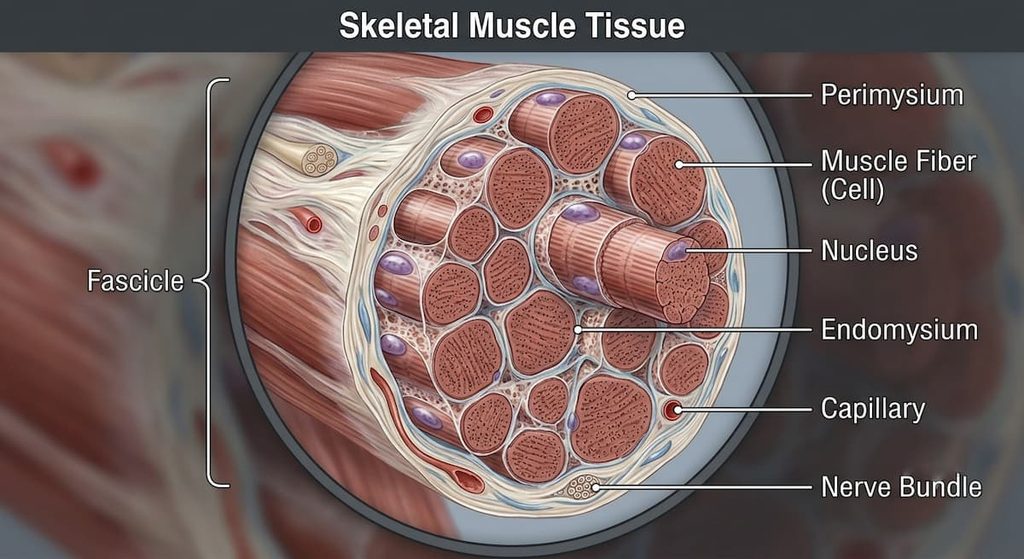
Muscles do more than contract to produce movement. They also respond when they are stretched, even when they are not actively contracting.
This passive resistance is one factor that influences flexibility. Research on aging suggests that resting muscle stiffness can increase in older adults, potentially making some movements more difficult.
Part of the explanation may involve changes in muscle fibers and the connective tissue that surrounds them. Muscle contains an extracellular matrix, a network of structural material that supports cells and helps organize the tissue. Changes in this network can affect how the muscle responds when it is stretched.
Muscle stiffness can also be influenced by the way the nervous system controls opposing muscles. For example, when the muscles that bend a joint and the muscles that straighten it are active at the same time, they can create additional resistance to movement. Researchers have discussed this as one possible contributor to reduced mobility in older adults.
These changes do not mean that every muscle becomes equally stiff. The findings vary according to the muscle studied, the person’s health and activity level, and the methods used to measure stiffness.
It is also important to distinguish stiffness from weakness. A muscle can lose strength without experiencing the same degree of change in its passive resistance to stretching. Likewise, someone can have reasonable muscle strength but still have a restricted range of motion.
The practical point is that age-related changes in muscle tissue can contribute to reduced flexibility, but they are only one part of the explanation.
Tendons and Ligaments Have Different Jobs
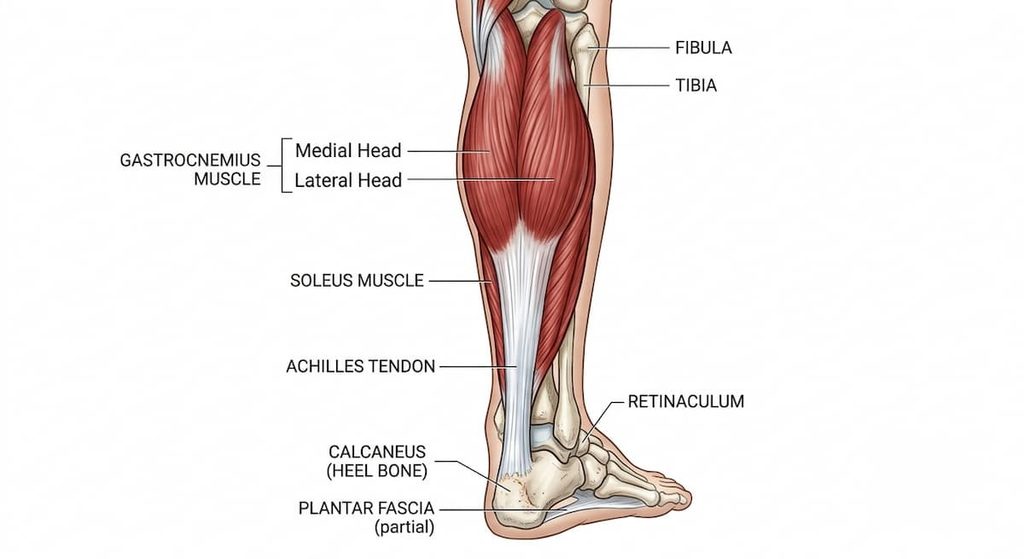
Tendons and ligaments are both connective tissues, but their functions are different.
A tendon transfers force from a muscle to a bone. The Achilles tendon, for example, connects the calf muscles to the heel and helps the body push off the ground when walking, running, or climbing stairs.
A ligament connects one bone to another and helps stabilize a joint. Ligaments around the knee, for instance, help guide movement and resist excessive displacement.
Both tissues contain collagen, a structural protein that provides much of their strength. However, the organization of collagen fibers and the mechanical properties of these tissues differ according to their roles.
As people age, connective tissues can undergo changes in composition and structure. These changes may influence how the tissues respond to force, how much they deform, and how they contribute to movement.
The Achilles tendon provides a useful example. A systematic review comparing younger and older adults found that Achilles tendon stiffness and elastic modulus were lower, on average, in the older groups studied. The researchers also discussed possible relationships between these changes and walking performance and balance.
This finding may seem surprising. If a tendon becomes less stiff, should the body not become more flexible?
Not necessarily. Tendon stiffness describes how much a tendon resists deformation under a given load. Joint flexibility describes how far a joint can move. These properties are related, but they are not interchangeable.
A tendon that deforms more under force does not automatically allow a joint to move through a larger range. The muscles, joint structure, surrounding tissues, and nervous system still influence the final movement.
Ligaments and joint capsules also contribute to stability and range of motion. However, it would be misleading to assume that every ligament becomes uniformly tighter with age.
The more accurate explanation is that aging can alter the mechanical behavior of different connective tissues, and those changes can affect movement in different ways.
Why Some Joints Become Less Flexible Than Others
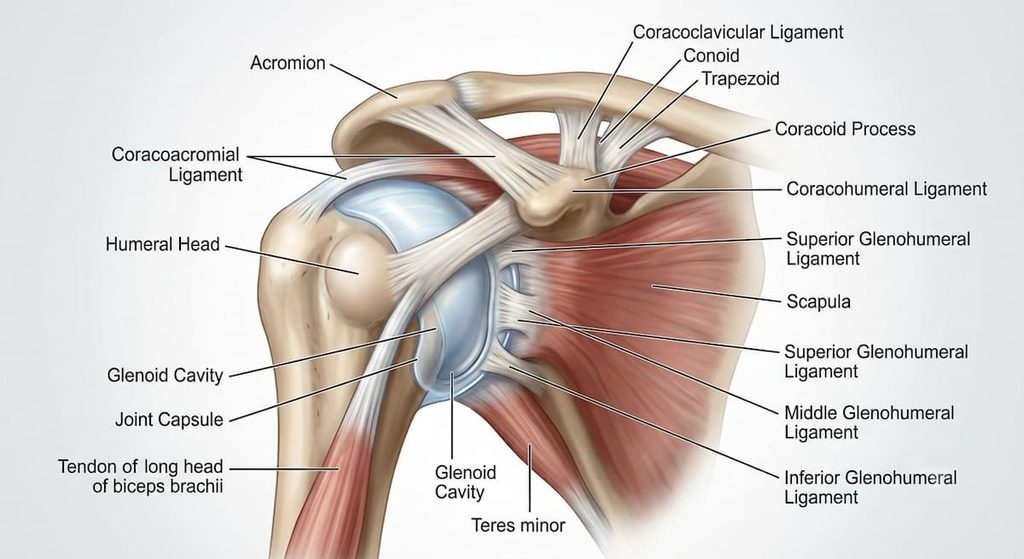
It is tempting to imagine aging as a process in which every part of the body gradually becomes equally stiff. Research on joint mobility suggests a more complicated picture.
Studies examining people across a wide range of ages have found that overall flexibility tends to decline with age. However, the pattern differs among joints. Shoulder and trunk mobility may show more pronounced age-related changes, while elbow and knee mobility can be comparatively better preserved.
This does not mean that every older adult will have stiff shoulders and flexible knees. These are general patterns observed in groups of people, not inevitable outcomes for each individual.
The difference makes sense when we consider how the body moves. The shoulder allows the arm to reach in many directions, while the trunk contributes to bending and rotation. These movements can be affected by changes in muscles, surrounding tissues, joint conditions, and the ways the body is used over time.
The elbows and knees have different mechanical roles. Their range of motion is influenced by their anatomy and by the activities in which they are used.
Previous injuries, joint disease, pain, individual anatomy, and physical activity can all influence these patterns. Two people of the same age may therefore have very different levels of mobility.
The key point is that there is no single flexibility score that fully describes how every part of the body moves. Someone may have limited shoulder mobility while retaining good movement at the wrists and elbows. Another person may have restricted hip movement but relatively flexible shoulders.
Age influences flexibility, but its effects are not distributed evenly throughout the body.
Does Sitting Too Much Make You Less Flexible?
Modern life often involves long periods of sitting at a desk, in a car, or on a sofa.
During many of these activities, the joints remain in relatively limited positions. The hips stay bent, the knees remain flexed, and the shoulders may spend hours in similar positions while typing or using a phone.
Sitting itself does not automatically damage the body. However, a lifestyle that rarely challenges the available range of motion gives the body fewer opportunities to practice those movements.
For example, a person who seldom reaches overhead may gradually find the movement less familiar or comfortable. Someone who rarely performs movements requiring substantial hip mobility may notice restrictions when attempting a deep squat or bending toward the floor.
Researchers have suggested that differences in how joints are routinely used may help explain why some joints show greater age-related mobility loss than others. However, habitual movement is not the only explanation, and the relationship has not been established as the cause of every age-related change.
Biological aging, previous injuries, joint conditions, and individual differences also matter. Even highly active people can experience changes in their tissues as they get older.
The useful distinction is that chronological age and physical activity are not the same thing. Two people of the same age can have very different movement habits and very different levels of flexibility.
Can You Improve Flexibility When You Are Older?
Yes. Flexibility is not a fixed ability that disappears permanently after a certain birthday.
Research examining stretching programs has found that repeated stretching can improve joint range of motion. A systematic review and meta-analysis of 77 studies found an overall improvement in range of motion after stretching training compared with control conditions.
The results suggest that flexibility remains responsive to practice. However, the amount of improvement varies, and the findings do not guarantee that every person will experience the same results.
One commonly used method is static stretching, in which a position is held without bouncing. Another method, called proprioceptive neuromuscular facilitation, combines stretching with controlled muscle contractions. Both methods have been shown to improve range of motion in research.
This does not mean that dynamic movement is useless. Different stretching methods serve different purposes, and the most suitable approach depends on the person’s goals, abilities, and circumstances.
For everyday mobility, a practical starting point is to move regularly and perform controlled stretches within a comfortable range. The movement should gently challenge flexibility without forcing a joint into sharp pain.
Consistency matters more than trying to achieve an extreme stretch in one session. Progress may be gradual, particularly when a movement has been restricted for a long time.
People with significant joint pain, recent injuries, or medical conditions that affect movement may benefit from individualized guidance from a qualified healthcare professional before beginning a new stretching routine.
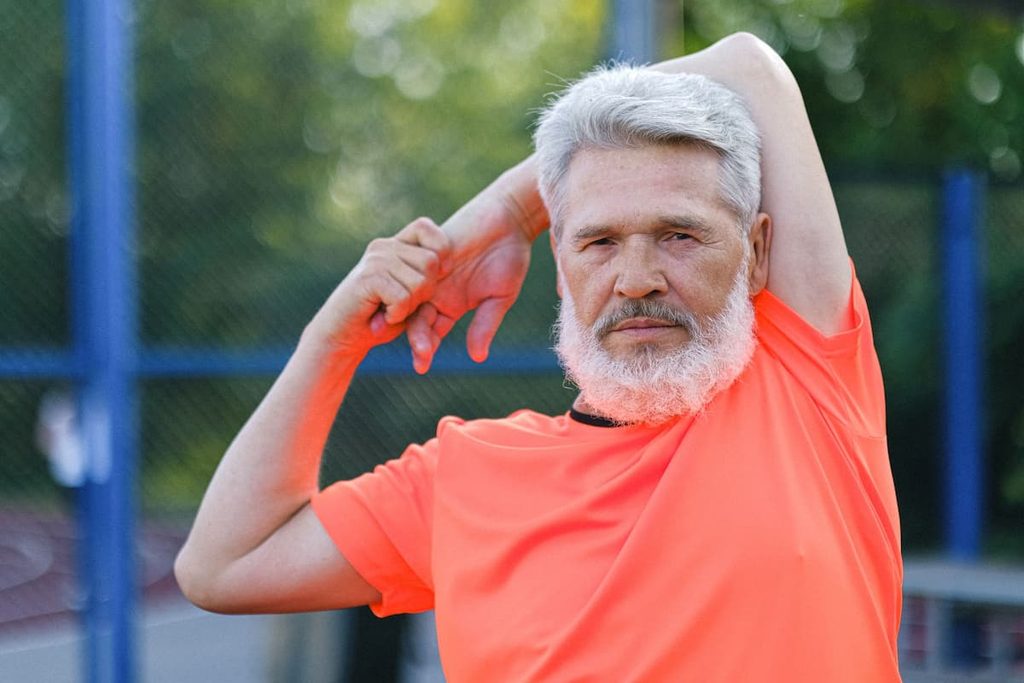
What Flexibility Can and Cannot Tell You About Aging
Being able to touch your toes is not a complete measure of physical health. Neither is the ability to raise your arms overhead or sit comfortably on the floor.
Flexibility is one component of physical function. Muscle strength, balance, coordination, and endurance also influence how easily a person performs everyday activities.
Improving flexibility does not automatically improve all these other abilities. Likewise, a person with limited flexibility is not necessarily unhealthy or physically weak.
The most useful goal is to preserve the mobility needed for everyday life. Reaching a shelf, turning to look behind while walking, putting on clothing, and moving comfortably during exercise may matter far more than achieving an impressive stretch.
It is also important to recognize when a change should not simply be attributed to aging. A sudden loss of movement, substantial pain, swelling, or a new restriction following an injury deserves appropriate medical attention.
Understanding the difference between gradual changes and a new problem helps put age-related stiffness into perspective.
Flexibility Can Change Without Disappearing
The body changes throughout life, and the tissues responsible for movement are no exception. Muscles may become stiffer, tendons can change their mechanical properties, and joint mobility can follow different patterns depending on the body region.
These changes help explain why movements that once felt easy may become more difficult. But they do not mean that every joint must become equally restricted or that flexibility can no longer improve.
Regular movement and appropriate stretching can help maintain or increase range of motion, even though they cannot reverse every age-related change in the body’s tissues.
The goal is not to keep the body exactly as it was decades ago. It is to understand how it changes and give it opportunities to keep moving comfortably.
Aging influences flexibility, but it does not tell the whole story. How your body moves depends on the tissues you were born with, the changes they experience over time, and the ways you continue to use them.
Scientific Sources
- Medeiros, H. B. O., Araújo, D. S. M. S., & Araújo, C. G. S. Age-related mobility loss is joint-specific: an analysis from 6,000 Flexitest results. Age, 2013, 35(6), 2399–2407. PMID: 23529505. DOI: 10.1007/s11357-013-9525-z. Read the study on PubMed
- Doriot, N., & Wang, X. Effects of age and gender on maximum voluntary range of motion of the upper body joints. Ergonomics, 2006, 49(3), 269–281. PMID: 16540439. DOI: 10.1080/00140130500489873. Read the study on PubMed
- Marcucci, L., & Reggiani, C. Increase of resting muscle stiffness, a less considered component of age-related skeletal muscle impairment. European Journal of Translational Myology, 2020, 30(2), Article 8982. PMID: 32782762. DOI: 10.4081/ejtm.2019.8982. Read the study on PubMed
- Delabastita, T., Bogaerts, S., & Vanwanseele, B. Age-Related Changes in Achilles Tendon Stiffness and Impact on Functional Activities: A Systematic Review and Meta-Analysis. Journal of Aging and Physical Activity, 2018. PMID: 29722592. DOI: 10.1123/japa.2017-0359. Read the study on PubMed
- Konrad, A., Alizadeh, S., Daneshjoo, A., et al. Chronic effects of stretching on range of motion with consideration of potential moderating variables: A systematic review with meta-analysis. Journal of Sport and Health Science, 2024, 13(2), 186–194. PMID: 37301370. DOI: 10.1016/j.jshs.2023.06.002. Read the study on PubMed
![[Bit#109] Aspirin: How Science Turned Toxic Willow Bark into Medicine?](https://hiddenbitknowledge.com/wp-content/uploads/2026/07/main.Aspirin-768x432.jpg)
![[Bit#79] Electricity Conducting Bacteria: Earth’s Hidden Battery](https://hiddenbitknowledge.com/wp-content/uploads/2026/07/main.Geobacter-768x419.jpg)
![[Bit#56] Deadly Toxin or Magic of Life? The Two Faces of Microbes](https://hiddenbitknowledge.com/wp-content/uploads/2026/06/6b131e0f931c-768x512.jpg)
![[Bit#4] I Put Someone Else’s ‘Poop’ in My Body, and a Miracle Happened](https://hiddenbitknowledge.com/wp-content/uploads/2026/04/main.Fecal-Microbiota-Transplantation-768x512.jpg)
![[Bit #155] The Secret of Unihemispheric Sleep: Why Some Animals Sleep with Half Their Brains](https://hiddenbitknowledge.com/wp-content/uploads/2026/09/mian.sleeping-768x419.jpg)
![[Bit#172] Why Facial Expressions Change: Unconcealable Brain Signals](https://hiddenbitknowledge.com/wp-content/uploads/2026/10/main.human-face-768x581.jpg)