[Bit #156] The Real Reason It Hurts Less When You Rub Where You Hit

When you suddenly stub your toe on a doorframe or bump your knee, you instinctively rub the spot with your hand. Surprisingly, this simple action instantly reduces the sensation of pain. Is it just a psychological effect? Or is it a clever defense mechanism built into our bodies? In this article, we explore the neurological secrets hidden within the subconscious acts of acupressure and friction, revealing the remarkable ways our bodies regulate pain.
1. The Instinct to Rub a Hurt Spot and the Signal to the Brain

What is your immediate reaction when you hit your toe against a sharp corner? You grab and rub the area without a second thought. Nobody taught us this behavior. From toddlers to the elderly, everyone reacts the exact same way. What secret lies behind this instinctive response? Is it merely for emotional comfort, or does physical pressure truly alleviate pain? The answer resides within our nervous system.
The moment an impact occurs, receptors distributed throughout the body detect an emergency. They instantly send danger signals toward the brain, which we perceive as pain. However, a fascinating phenomenon takes place. The moment you rub the painful area, the intensity of the sharp pain drops noticeably. The brain has a limited capacity for processing sensory information at any given time. When pain signals and tactile signals from friction flood the spinal cord simultaneously, a fierce competition begins along the pathway to the brain.
Rubbing your skin is not just simple friction; it is an active generation of continuous, powerful tactile stimuli. These stimuli stimulate specific pathways within the spinal cord, drastically reducing the proportion of pain signals recognized by the brain. Ultimately, rubbing acts as emergency first aid that shrinks the volume of pain signals reaching the brain. Without realizing it, we actively control our own neural networks to manage pain.
2. The Nervous System Barrier: Core Principles of Gate Control Theory
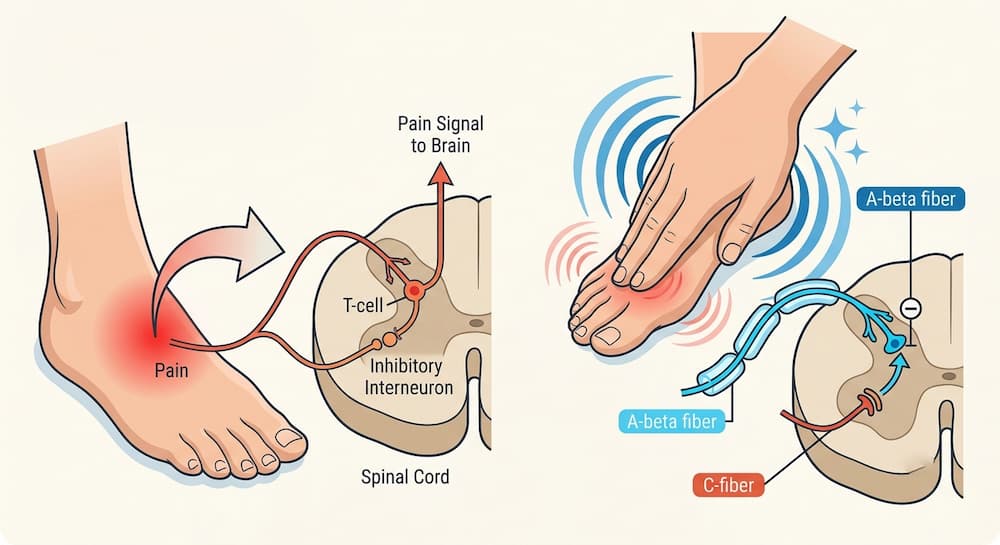
The phenomenon of reducing pain through friction was clearly explained in 1965 by Ronald Melzack and Patrick Wall through the Gate Control Theory. The name itself is intriguing, implying the existence of an actual gate inside our nervous system. Where is this gate located? It sits in the dorsal horn of the spinal cord. Every sensory signal heading toward the brain must pass through this gate.
When the gate opens, signals pass to the brain and we feel pain. Conversely, when the gate closes, signals are blocked and pain is suppressed. What key opens and closes this door? It depends on the type of sensation we apply. Pain signals travel mainly along thin C fibers. On the other hand, sensations of friction or pressure travel along thick A-beta fibers.
When you rub a painful spot firmly, the thick A-beta fibers activate intensely. These fibers race to the spinal cord and stimulate inhibitory interneurons. What do these inhibitory cells do? They block the pain signals sent by the thin C fibers, effectively locking the gate. Once closed, pain signals fail to reach the brain and vanish along the way. Rubbing acts as a physical key that locks the pain gate, allowing us to hit a natural pain-blocking switch without medication.
3. Speed Differences Between Touch and Pain: Sensory Signals Claiming the Brain First
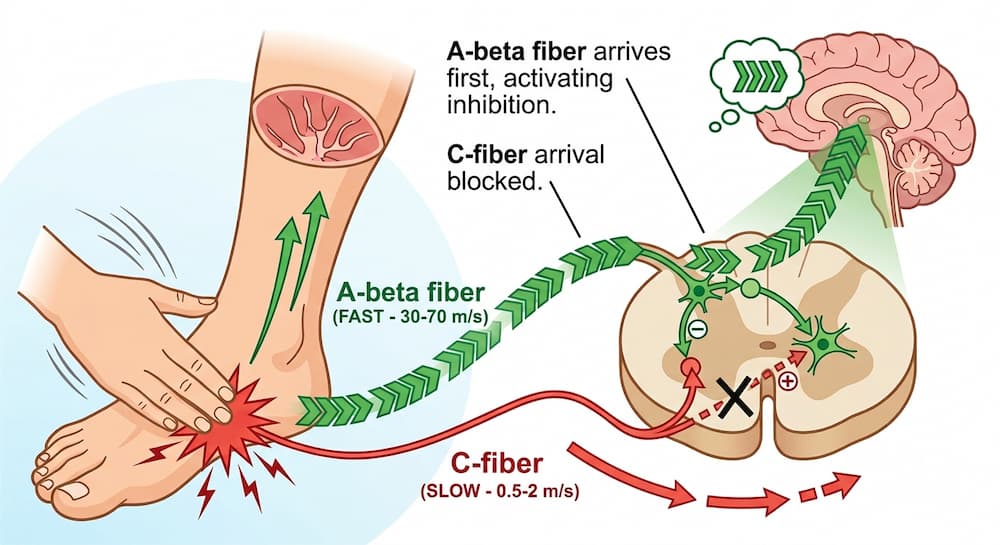
Why do friction signals always work faster than pain signals? The answer lies in the structural differences between nerve fibers. Not all nerve fibers transmit signals at the same speed. Some behave like sports cars on a highway, while others move like slow carts on an unpaved road.
The C fibers that carry pain signals resemble stripped electrical wires. They lack a fatty protective coating called the myelin sheath, which acts as an insulator. Consequently, their transmission speed is a mere 0.5 to 2 meters per second—slower than a human walking pace. Why do they move so slowly? They were designed to maintain continuous warnings without signal interference.
In contrast, A-beta fibers transmitting friction and pressure are heavily wrapped in thick myelin sheaths. Their transmission speed ranges from an impressive 30 to 70 meters per second. When both signals depart simultaneously, tactile signals reach the brain dozens of times faster than pain signals. The brain naturally prioritizes the earliest arrivals. The slow pain signals are pushed aside by the tactile signals that have already claimed the space, filling the brain’s processing circuit.
Rubbing a hurt spot leverages this physical time delay in signal transmission. It floods the brain with harmless touch signals first, overriding the sensation of pain through a natural defense mechanism.
4. Daily Pain Management and Applied Science Tricking the Brain
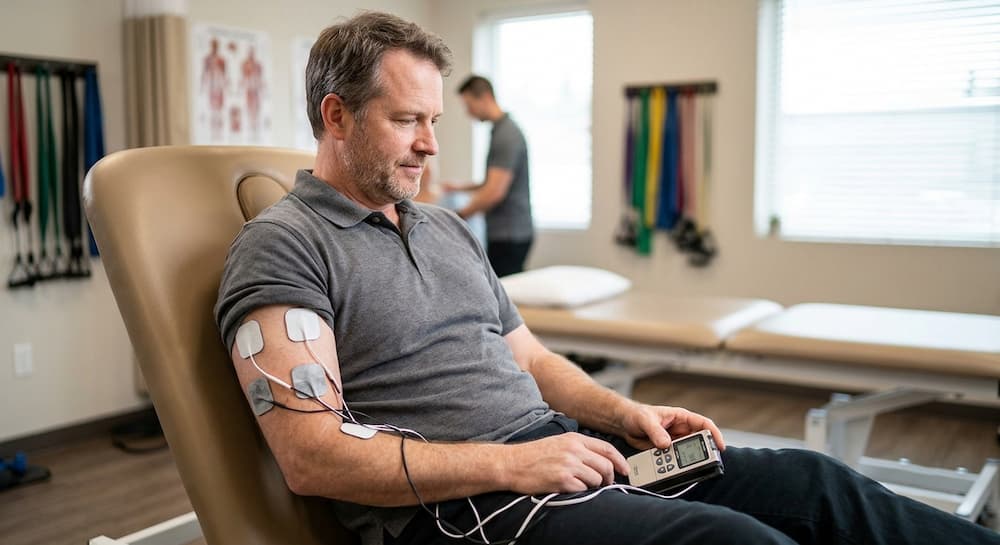
The Gate Control Theory and sensory speed differences extend beyond theory into modern medical treatments. A prime example is Transcutaneous Electrical Nerve Stimulation, commonly known as TENS. TENS devices send light electrical impulses across the skin surface. Rather than transmitting pain, these impulses stimulate A-beta fibers with painless signals, artificially replicating the effect of continuous skin friction.
This technology closes the spinal pain gate without needing painkillers. Manual therapy and shockwave therapy similarly maximize these sensory interference effects. In daily life, gently rubbing or pressing the uninjured area around a hurt spot effectively occupies the sensory pathway before pain signals arrive.
For chronic pain sufferers, tactile stimulation serves as a non-pharmacological tool to raise pain tolerance thresholds. A light friction on the skin completely reshapes how the brain perceives sensation. Our bodies come equipped with built-in controllers to soothe pain, and activation requires nothing more than a gentle touch from our fingertips.
Conclusion
A simple act of rubbing a hurt spot contains remarkable order and science within our nervous system. While we view pain as an unpleasant sensation to avoid, it functions as an active warning system to protect the body. Remarkably, our bodies also provide a gentle built-in control mechanism to manage those warnings.
The pain we experience may not be a fixed, absolute value. It is a flexible signal that shifts depending on how the brain selects and interprets sensory input. Realizing that the key to managing pain lies at our fingertips offers profound insight into the human body’s capacity for healing.
![[Bit#105] Forensic Genetics: Reconstructing Suspect Faces and Biological Traits from a Single Cell](https://hiddenbitknowledge.com/wp-content/uploads/2026/07/main.DNA-tracing-technology-768x544.jpg)
![[Bit#158] Why Do We Spill Food More Often as We Age?](https://hiddenbitknowledge.com/wp-content/uploads/2026/09/main.senior-767x428.jpg)
![[Bit#102] Bacteriophage: The Natural Predator Virus Therapy Attacking Only Bacteria](https://hiddenbitknowledge.com/wp-content/uploads/2026/07/main.bacteriophage-768x620.jpg)
![[Bit#117] Forensic Entomology: The Last Witness at the Crime Scene](https://hiddenbitknowledge.com/wp-content/uploads/2026/08/main.Forensic-Entomology-768x429.jpg)
![[Bit#159] Secrets of Delayed Onset Muscle Soreness: Why Does It Hurt More the Next Day?](https://hiddenbitknowledge.com/wp-content/uploads/2026/09/main.after-pain-768x419.jpg)
![[Bit#67] The Science of Dying: What Happens in Our Final Moments](https://hiddenbitknowledge.com/wp-content/uploads/2026/06/main.morgue-768x430.jpg)