Why Do Your Fingers Wrinkle in Water? [Bit#177]
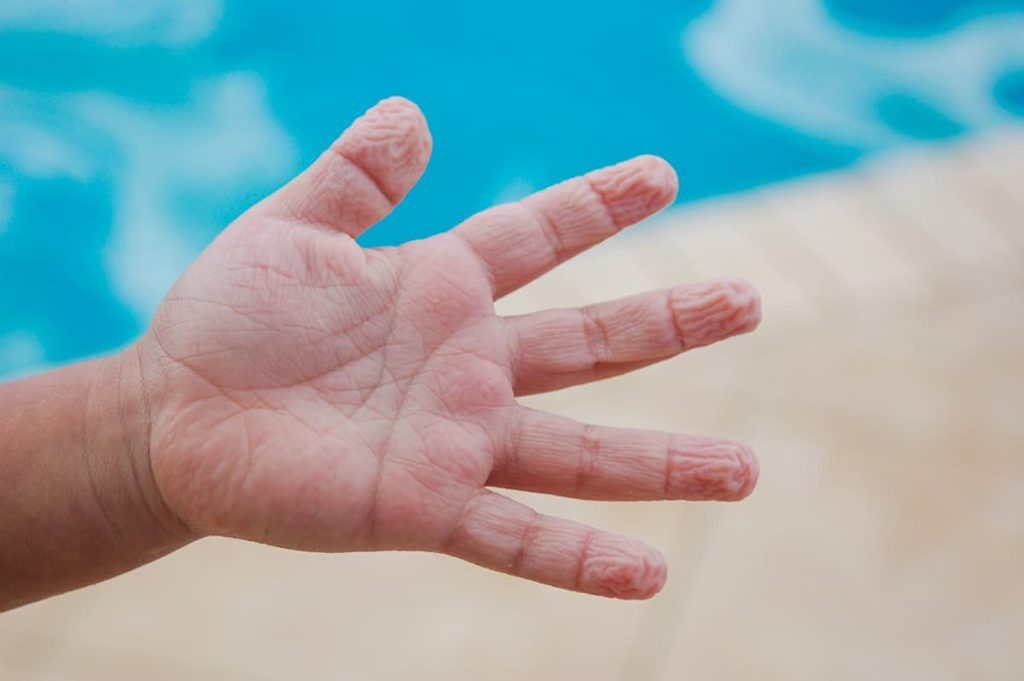
After spending a long time in a bath, swimming pool, or even a bowl of water, you may notice something strange happening to your fingertips.
The smooth skin becomes covered with tiny ridges and wrinkles.
Most people assume the explanation is simple: the skin absorbs water, swells, and becomes wrinkled.
That explanation sounds reasonable, but it is incomplete.
Water-induced finger wrinkling is actually an active physiological response involving the nervous system and blood vessels. As your fingers remain underwater, blood vessels inside the fingertips constrict, changing the volume of the tissue beneath the skin. The skin then folds into the familiar wrinkles.
So what looks like a simple effect of soaking your hands is actually a small physiological event happening beneath the surface.
Your Skin Is Not Simply Swelling
The first important clue came from studies measuring blood flow in the fingers during water immersion.
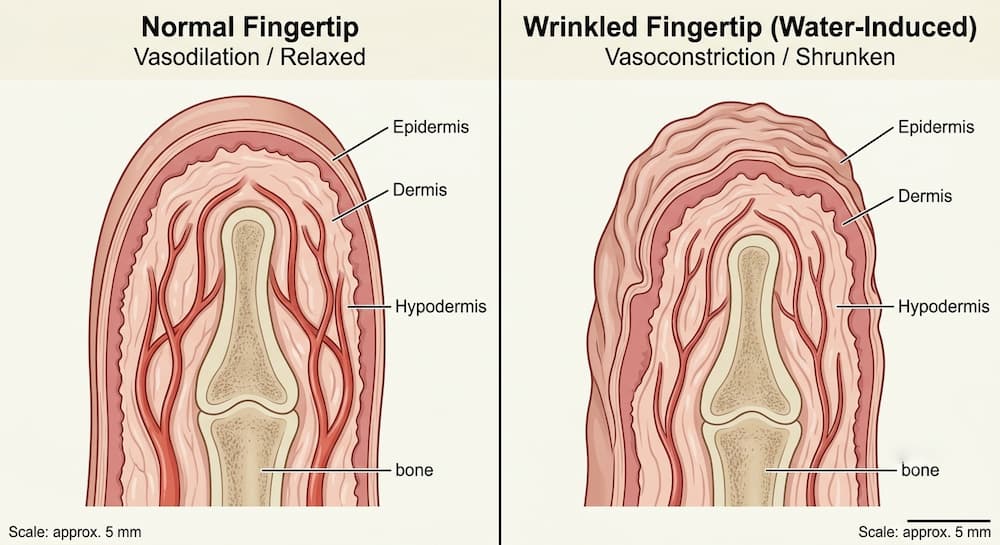
When the fingertips begin to wrinkle, blood flow through the small vessels of the fingers decreases. Researchers found that the reduction is particularly pronounced in the digital blood vessels supplying the fingertips.
This is called vasoconstriction, meaning that blood vessels become narrower.
As the vessels constrict, the amount of blood and fluid occupying the fingertip tissue decreases. That changes the volume and pressure inside the fingertip.
The skin on the outside does not shrink at exactly the same rate. Instead, it becomes relatively loose over the reduced underlying volume and forms folds.
The basic sequence is therefore:
Water exposure → sympathetic nerve activity → blood-vessel constriction → reduced fingertip volume → skin wrinkles
This is why the common idea that the skin simply “soaks up water” does not explain the entire phenomenon.
In fact, experiments have provided direct evidence for the vascular mechanism. When researchers compared water immersion with another treatment known to cause vasoconstriction, the changes in blood flow and the degree of wrinkling were remarkably similar.
The evidence strongly supports vasoconstriction as a major driver of the wrinkling response.
The Nervous System Is Involved
The next question is even more interesting:
Why do the blood vessels constrict in the first place?
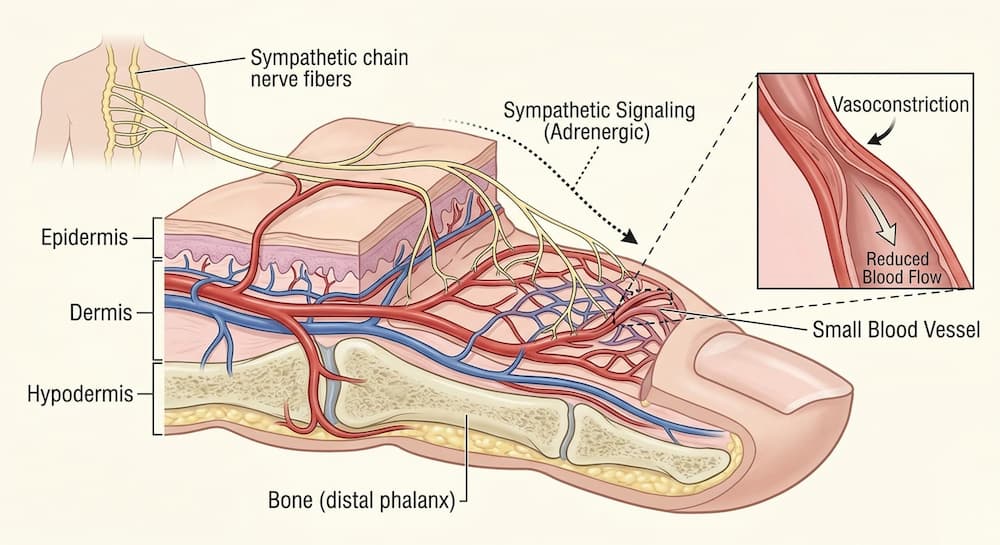
Part of the answer lies in the sympathetic nervous system.
The sympathetic nervous system is a branch of the autonomic nervous system. It controls many processes that happen without conscious effort, including changes in blood vessel diameter.
When sympathetic nerve activity increases in the fingertips, the small blood vessels can constrict.
Water immersion appears to trigger this response in the specialized skin of the hands and feet.
This is important because it means that finger wrinkling is not simply a passive physical reaction. Your nervous system is actively involved in producing the change.
Scientists discovered just how important this nervous control is by studying people with disrupted nerve supply to their fingers.
What Happens When the Nerves Are Damaged?
One of the strongest pieces of evidence comes from studies of replanted fingers.
When a finger is surgically reattached after being completely amputated, its blood vessels can be restored while its nerve connections may remain disrupted or altered.
Researchers compared normal fingers with successfully replanted fingers during water immersion.
Normal fingers showed a decrease in blood flow and developed the expected wrinkles.
The replanted, denervated fingers behaved differently. Instead of showing the normal decrease in blood flow, they showed an increase, and the skin did not develop the usual wrinkles.
This finding is difficult to explain if wrinkling were simply caused by the skin absorbing water.
Instead, it supports the idea that intact sympathetic nerve signaling is necessary for the normal response.
Earlier clinical observations had reached a similar conclusion: when sympathetic nerve pathways were damaged, water-induced finger wrinkling could be reduced or abolished.
Because of this relationship, researchers have investigated stimulated skin wrinkling as a simple way to assess aspects of sympathetic nerve function.
That does not mean that wrinkled or non-wrinkled fingers can diagnose a neurological condition on their own. Rather, the response has been studied as a physiological indicator that can provide information about autonomic nerve function.
Why Does the Wrinkling Happen on the Fingertips?
The phenomenon is especially obvious on the glabrous skin of the fingertips, palms, and soles.
Glabrous skin is skin without ordinary hair follicles. These areas have specialized sensory structures and a dense network of sweat glands and autonomic nerve fibers.
The fingertips also contain a large number of small blood vessels that help regulate blood flow and temperature.
When these vessels constrict, the tissue volume beneath the fingertip skin changes.
Imagine placing a flexible sheet over a slightly smaller object. The sheet no longer lies completely flat, so it develops folds.
A similar principle helps explain what happens to the skin of the fingertip.
The wrinkles are therefore not random damage to the skin. They reflect changes in the shape and volume of the tissue underneath it.
Why Do the Wrinkles Have Such a Regular Pattern?
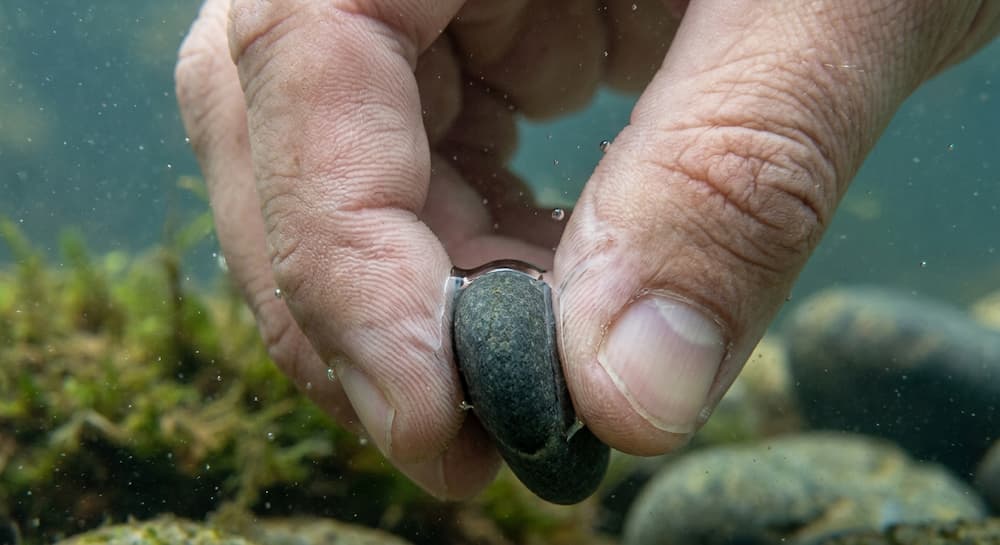
The wrinkles on your fingertips often form a surprisingly organized pattern.
Scientists have proposed that this pattern may be related to the way fluid moves across the surface of the skin.
The grooves can form interconnected channels rather than completely random folds. This observation led researchers to ask whether the wrinkles might have a practical function.
One possibility is that they help move water away from the contact surface between the fingertip and a wet object.
This idea makes biological sense because the wrinkling response is actively controlled by the nervous system. If the response were completely useless, it would be harder to explain why the body maintains such a coordinated process.
But an interesting hypothesis is not the same thing as a proven evolutionary explanation.
Could Wrinkled Fingers Help You Grip Wet Objects?
Researchers have tested this question experimentally.
In a 2013 study, participants handled objects submerged in water with either wrinkled or unwrinkled fingers.
The participants were able to transfer submerged objects faster when their fingers were wrinkled. The advantage was not observed when they handled dry objects.
The researchers proposed that the wrinkles could function somewhat like drainage channels, allowing water to move away from the contact surface and helping the fingers interact with wet objects.
A later study also found that wrinkled fingers could reduce the grip force required to hold a wet object, suggesting that the wrinkles may improve grip efficiency under watery conditions.
These findings make the idea of an adaptive function plausible.
However, the evidence is not completely consistent.
Another study found no improvement in manual dexterity when participants with wrinkled fingers handled wet objects. It also found no measurable improvement in several aspects of touch sensitivity.
This means we should be careful with the popular claim that “humans developed wrinkled fingers specifically so we could grip wet objects better.”
The physiological mechanism is well supported.
The evolutionary explanation is still more uncertain.
What Recent Research Is Exploring
Scientists are still investigating exactly how the response is triggered and why the degree of wrinkling varies.
Recent research has examined the effects of factors such as water temperature, solution concentration, chemical conditions, sympathetic stimulation, and even the time of day.
These studies suggest that water-induced wrinkling is not controlled by a single simple mechanism. Instead, it appears to involve interactions between the skin, sweat glands, microcirculation, and autonomic nervous system.
This is another reason why the old explanation that “your skin just absorbs water” is too simple.
The visible wrinkle is the final result of several physiological processes occurring beneath the surface.
A Simple Bath-Time Effect Reveals Your Nervous System at Work
Finger wrinkling may look like one of the most ordinary things that happens when we spend too long in water.
But the science behind it is surprisingly sophisticated.
Water exposure is associated with a sympathetic response in the fingertips. Small blood vessels constrict, blood flow decreases, and the volume of the tissue beneath the skin changes. The overlying skin then forms the characteristic wrinkles.
Studies of people with disrupted nerve supply provide strong evidence that the nervous system is essential to this response.
Scientists have also found evidence that wrinkled fingers may make certain wet-object handling tasks more efficient, although the evolutionary explanation remains unsettled.
So the next time your fingertips become wrinkled in the bath, remember that you are not simply looking at waterlogged skin.
Those tiny wrinkles are evidence of your nervous system changing the blood flow and structure of your fingertips.
Scientific Sources
1. Wilder-Smith EPV, Chow A.
Water-immersion wrinkling is due to vasoconstriction.
Muscle & Nerve. 2003;27(3):307–311.
PMID: 12635117
DOI: 10.1002/mus.10323
Used for: The central physiological mechanism: water-induced finger wrinkling is accompanied by reduced digital blood flow and is driven by vasoconstriction.
Read the study on PubMed
2. Wilder-Smith EPV.
Water immersion wrinkling—physiology and use as an indicator of sympathetic function.
Clinical Autonomic Research. 2004;14(2):125–131.
PMID: 15095056
DOI: 10.1007/s10286-004-0172-4
Used for: The relationship between sympathetic nerve activity, vasoconstriction, fingertip volume, and skin wrinkling, as well as the physiological basis for using the response to assess sympathetic function.
Read the review on PubMed
3. Hsieh CH, Huang KF, LiLiang PC, Jeng SF, Tsai HH.
Paradoxical response to water immersion in replanted fingers.
Clinical Autonomic Research. 2006;16(3):223–227.
PMID: 16612557
DOI: 10.1007/s10286-006-0340-9
Used for: Evidence that sympathetic nerve supply is important for water-induced wrinkling, based on the different blood-flow and wrinkling responses of normal and replanted fingers.
Read the study on PubMed
4. Kareklas K, Nettle D, Smulders TV.
Water-induced finger wrinkles improve handling of wet objects.
Biology Letters. 2013;9(2):20120999.
PMID: 23302867
DOI: 10.1098/rsbl.2012.0999
Used for: Experimental evidence that wrinkled fingers can improve performance when handling submerged objects, supporting the possible adaptive-function hypothesis.
Read the study on PubMed
5. Gallego PH, et al.
Water-induced finger wrinkles do not affect touch acuity or dexterity in handling wet objects.
PLOS ONE. 2014;9(1).
PMID: 24416318
DOI: 10.1371/journal.pone.0084949
Used for: Important counter-evidence showing that water-induced wrinkling did not improve dexterity in the tested wet-object task and did not alter measured touch sensitivity.
Read the study on PubMed
6. Davis NJ.
Water-immersion finger-wrinkling improves grip efficiency in handling wet objects.
PLOS ONE. 2021;16(7).
PMID: 34288934
DOI: 10.1371/journal.pone.0253185
Used for: More recent experimental evidence that wrinkled fingers can reduce the grip force required to hold wet objects, supporting a possible functional advantage.
Read the study on PubMed
7. Martimiano BD, Belli MCV, Lai MR, et al.
Influence of Physical, Chemical, and Sympathetic Stimuli on Water-Immersion Finger Wrinkling.
Skin Pharmacology and Physiology. 2025;38(3):121–126.
PMID: 40451152
DOI: 10.1159/000546695
Used for: Recent investigation of how temperature, solution properties, sympathetic stimulation, and other factors influence the finger-wrinkling response.
Read the study on PubMed
![[Bit#99] The Reality of Designed Babies in the Era of CRISPR Gene Editing](https://hiddenbitknowledge.com/wp-content/uploads/2026/07/main.CRISPR-Gene-Editing-768x526.jpg)
![[Bit#158] Why Do We Spill Food More Often as We Age?](https://hiddenbitknowledge.com/wp-content/uploads/2026/09/main.senior-767x428.jpg)
![[Bit#110] Bioelectricity Unlocked: How Ion Channels Work](https://hiddenbitknowledge.com/wp-content/uploads/2026/07/main.ion-channel-768x429.jpg)
![[Bit#56] Deadly Toxin or Magic of Life? The Two Faces of Microbes](https://hiddenbitknowledge.com/wp-content/uploads/2026/06/6b131e0f931c-768x512.jpg)
![[Bit#162] Why Do We Lose Hair When We Are Stressed?](https://hiddenbitknowledge.com/wp-content/uploads/2026/09/main.Stressed-Person-768x419.jpg)
![[Bit#65] Why Do Women Live Longer Than Men?](https://hiddenbitknowledge.com/wp-content/uploads/2026/06/main.grave_-768x512.jpg)