Why Do We Get Hiccups? The Science Behind That Sudden “Hic” [Bit#176]

A hiccup can appear out of nowhere. Your chest suddenly jerks, your breathing is interrupted for a moment, and a familiar “hic” escapes from your throat.
It seems like a simple muscle spasm. But a hiccup is actually a coordinated reflex involving the diaphragm, respiratory muscles, nerves, and the larynx.
Understanding what happens during that brief moment reveals why something as ordinary as a hiccup is more complicated than it looks.
What Actually Happens During a Hiccup?
A hiccup begins with a sudden, involuntary contraction of the diaphragm, the main muscle used for breathing. The muscles between the ribs can become involved as well.
The contraction creates a rapid inward movement of air, similar to the beginning of a normal breath.
But the inhalation does not continue normally.
Almost immediately, the glottis—the opening between the vocal folds—closes. This sudden closure interrupts the incoming airflow and produces the characteristic sound of a hiccup.
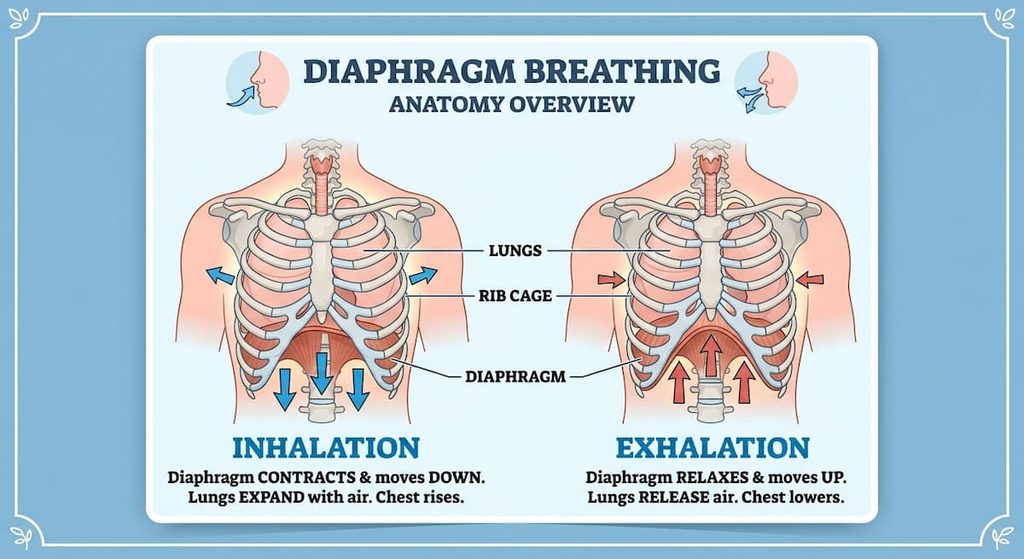
The sequence happens extremely quickly:
involuntary contraction → sudden inhalation → glottic closure → “hic”
So the sound does not come simply from the diaphragm “making a noise.” It is produced because airflow is suddenly interrupted at the larynx.
The Hiccup Is a Reflex, Not Just a Diaphragm Spasm
The diaphragm is the most obvious muscle involved, but it is only one part of the process.
Hiccups involve a reflex pathway that carries sensory information toward the central nervous system and then sends motor signals back to the muscles involved in the response.
Several nerves can participate in this pathway, including the vagus nerve and phrenic nerve, along with sympathetic pathways. Motor signals traveling through the phrenic nerve activate the diaphragm, while neural pathways involving the larynx coordinate the sudden closure of the glottis.
Researchers have described this system as a hiccup reflex arc.
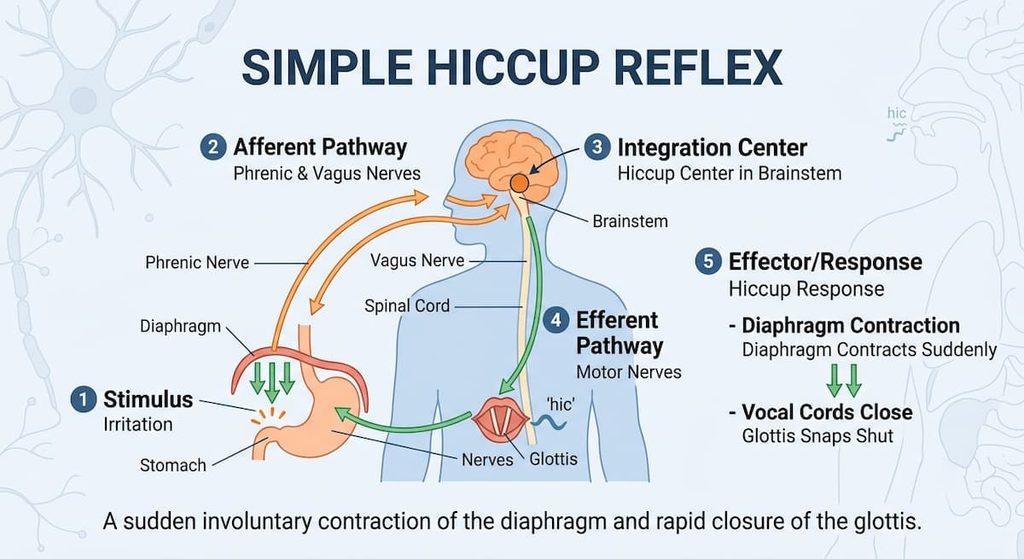
The exact organization of the central component is still not completely understood. Rather than thinking of the hiccup as being controlled by one simple “hiccup switch,” it is more accurate to think of it as a coordinated neural network involving several regions and pathways.
That is also why irritation in very different parts of the body can sometimes trigger hiccups.
Why Does Eating Sometimes Give You Hiccups?
Many people notice hiccups after eating a large meal, eating quickly, or drinking carbonated beverages.

One possible reason is mechanical stimulation of the upper digestive tract.
When the stomach or esophagus becomes distended, sensory receptors can send signals through nerves that are connected to the hiccup reflex pathway.
Experiments in healthy volunteers provide more direct evidence for this connection. Researchers found that rapidly stretching the upper esophagus could trigger hiccups in some subjects.
This does not mean that every hiccup is caused by an enlarged stomach.
A hiccup can have many different triggers, and in ordinary short episodes the precise trigger is often impossible to identify. Digestive stimulation is one possible way of activating a reflex that ultimately involves the respiratory system.
This helps explain an interesting feature of hiccups: the trigger and the visible symptom can occur in completely different parts of the body.
A stimulus in the digestive tract can ultimately produce a sudden contraction of a respiratory muscle.
Why Does the “Hic” Sound So Distinctive?
The sound itself is a consequence of timing.
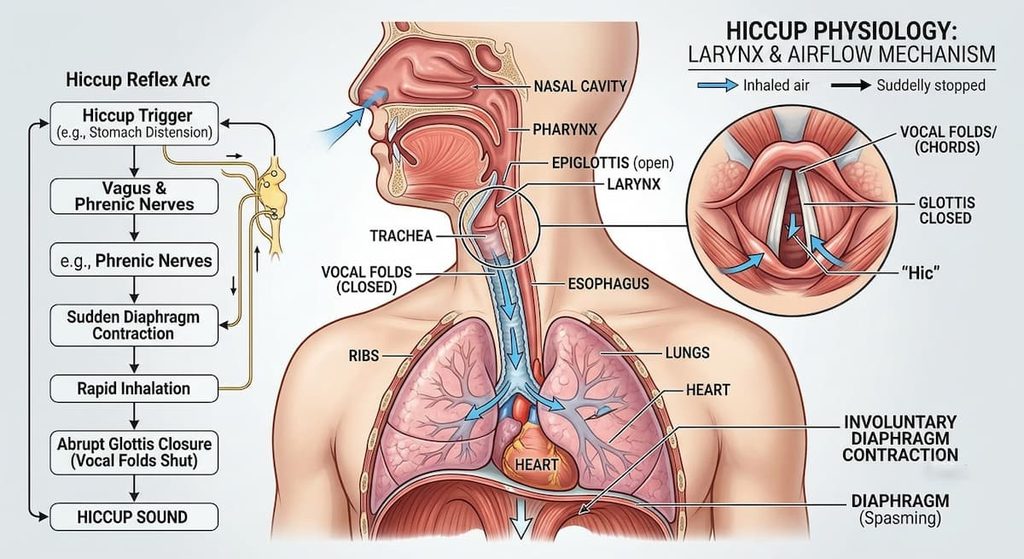
First, the diaphragm and other inspiratory muscles contract. Air begins moving inward.
Then, only a short time later, the glottis suddenly closes.
The incoming airflow is therefore interrupted almost immediately. That abrupt interruption creates the characteristic vocal sound we recognize as a hiccup.
In other words, the sound is not an accidental side effect. It is closely tied to the specific sequence of muscle contraction and airway closure that defines the reflex.
This is also why simply saying that a hiccup is “your diaphragm jumping” misses an important part of the physiology.
The diaphragm contraction starts the movement, but the laryngeal closure helps create the recognizable event.
Why Do Hiccups Usually Stop?
Most hiccups disappear on their own.
The reflex is normally temporary, and the nervous system eventually stops generating the repeated pattern of diaphragm contraction and glottic closure.
But scientists still do not have a complete explanation for why a particular bout of hiccups begins at one moment and ends at another.
The basic mechanism is much better understood than the biological purpose of the reflex.
Several evolutionary explanations have been proposed. One hypothesis suggests that the reflex may have developed in early mammals to help remove swallowed air from the stomach, particularly in young suckling mammals.
That idea is scientifically interesting, but it remains a hypothesis rather than an established explanation for why humans hiccup.
When Hiccups Become a Medical Problem
An occasional bout of hiccups is usually harmless.
The situation changes when hiccups continue for an unusually long time. Hiccups lasting more than 48 hours are generally classified as persistent hiccups, while very prolonged episodes are sometimes described as intractable hiccups.
Persistent hiccups can interfere with eating, sleeping, speaking, and normal daily activities. They can also be associated with disorders affecting the gastrointestinal tract, nervous system, chest, metabolism, or with certain medications.
That does not mean that persistent hiccups automatically indicate a serious disease. It means that a reflex that normally lasts only a short time can sometimes become a symptom worth investigating.
A Tiny Reflex With a Complicated Mechanism
A hiccup lasts only a moment, but several systems have to work together to produce it.
A sensory stimulus activates a neural pathway. The nervous system coordinates the response. The diaphragm contracts suddenly. Air begins moving into the lungs. Then the glottis closes and interrupts the airflow.
The result is the familiar sound that we call a hiccup.
What makes hiccups especially interesting is the gap between what we know and what remains uncertain.
We understand much of how a hiccup happens. We know the major muscles, nerves, and airway movements involved, and we know that stimulation of different parts of the body can activate the reflex.
But why humans have this reflex in the first place remains uncertain.

For something that most people experience without giving it a second thought, a hiccup is a remarkably complex little event.
Scientific Sources
- Lee GW et al. Hiccup: Mystery, Nature and Treatment. Journal of Neurogastroenterology and Motility, 2012. PMID 22523721. PubMed
- Fass R et al. Stimulus and site specific induction of hiccups in the oesophagus of normal subjects. Gut, 1997. PMID 9414962. PubMed
- Neurotransmitters in hiccups. Journal of Clinical and Translational Research, 2016. PubMed Central (PMC)
![[Bit#31] The Origin of Life: From Chemical Evolution to the Birth of Cells](https://hiddenbitknowledge.com/wp-content/uploads/2026/05/f009466cf8b1-768x419.jpg)
![[Bit#77] Cosmic Radiation and Its Fatal Impact on Human Genetics](https://hiddenbitknowledge.com/wp-content/uploads/2026/06/main.Cosmic-Radiation-768x430.jpg)
![[Bit#63] Why Did Life That Once Hatched From Eggs Choose the Placenta?](https://hiddenbitknowledge.com/wp-content/uploads/2026/06/main.Eggs-and-chickens-768x512.jpg)
![[Bit#101] Why Your Body Kills Millions of Cells Every Day: The Science of Apoptosis](https://hiddenbitknowledge.com/wp-content/uploads/2026/07/main.apoptosis-768x431.jpg)
![[Bit#144] Hidden Mechanisms of How Fine Dust Destroys the Lungs](https://hiddenbitknowledge.com/wp-content/uploads/2026/09/main.dust_-767x428.jpg)
![[Bit#130] Stop Ignoring Your Arteries: The Secret Power of Bioflavonoids](https://hiddenbitknowledge.com/wp-content/uploads/2026/08/main.bioflavonoids-767x428.jpg)