Can Humans Breathe Through Skin? [Bit#193]

Breathing seems simple enough. Air enters the lungs, oxygen moves into the blood, and carbon dioxide leaves the body when we exhale. But the lungs are not the only place where oxygen can cross an animal’s body surface. In some species, the skin itself performs a vital part of this exchange.
Frogs are a familiar example. They can absorb oxygen through their moist skin, allowing them to exchange gases even while underwater. Some salamanders take this ability even further, relying on skin and the lining of the mouth rather than lungs.
Humans also absorb small amounts of oxygen through the skin. This is a real, measurable biological process, not a myth. Yet it does not mean that our skin can function as a substitute for our lungs.
The difference lies in how much gas can cross the skin, how the skin is built, and how much oxygen the body needs.
What Does Skin Respiration Actually Mean?
Skin respiration, also called cutaneous respiration, is the exchange of respiratory gases across an animal’s skin. Oxygen moves from the surrounding air or water into the body, while carbon dioxide can move in the opposite direction.
The process depends on diffusion. When a gas is more concentrated on one side of a surface than the other, its molecules tend to move down that concentration gradient. If the surface is sufficiently thin and permeable, gases can cross it without the animal actively pumping air through an organ.
However, diffusion alone is not enough to make skin an effective respiratory surface. The skin must allow gases to pass through, and oxygen must reach tissues that can use it. Blood vessels near the surface can help transport absorbed oxygen and carry carbon dioxide toward the skin for release.
Moisture also matters. Gases generally cross moist biological surfaces more readily than dry, impermeable ones. This is one reason why the skin of many amphibians is so important for gas exchange.
Skin respiration is therefore not simply a matter of oxygen touching the body. It requires a combination of suitable skin structure, an adequate gas gradient, and the movement of gases between the surface and living tissues.
Humans Really Do Absorb Oxygen Through Their Skin
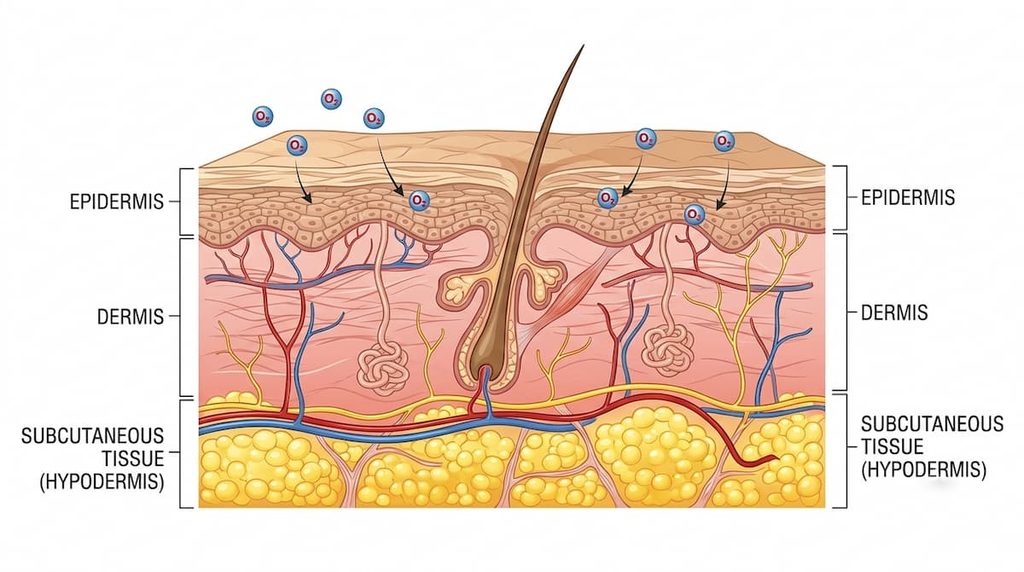
Human skin is not completely impermeable to gases. Oxygen from the surrounding atmosphere can pass through the outer surface and supply cells in the upper layers of the skin.
A study published in The Journal of Physiology in 2002 measured oxygen uptake through the skin of 20 healthy volunteers. The researchers used a specialized sensor to quantify oxygen moving from the atmosphere into the skin.
Their results showed that the oxygen entering through the skin could contribute to the oxygen supply of superficial skin tissues. Under the study’s conditions, atmospheric oxygen was estimated to supply the outer skin layers to a depth of approximately 0.25 to 0.40 millimeters.
This finding is important because it reveals that oxygen reaching skin cells does not always have to arrive through the bloodstream. Oxygen from the surrounding air can contribute directly to the local supply.
But there is a crucial distinction between supplying a small area of tissue and supplying the entire body.
The same study estimated that the total amount of oxygen absorbed through the skin of an adult at rest was approximately 0.4 percent of the oxygen taken up through the lungs. In other words, the skin’s contribution to the body’s overall oxygen supply was very small.
This is why the existence of oxygen absorption through human skin should not be confused with the idea that humans breathe through their skin in the same way that frogs do.
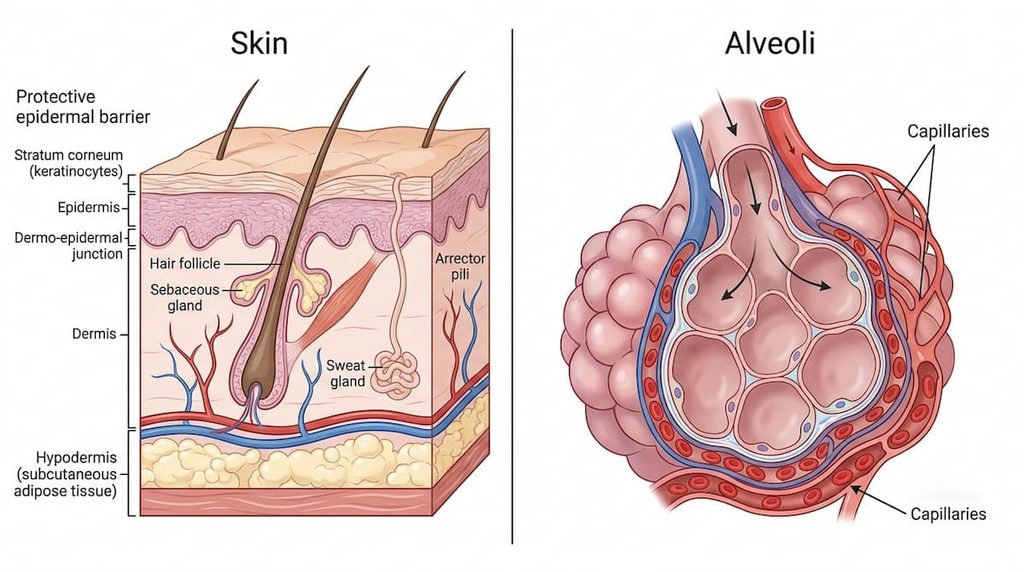
Human skin participates in gas exchange, but it is not a major respiratory organ.
Why Can’t Human Skin Replace the Lungs?
The answer begins with the structure of the skin.
Human skin is designed primarily to protect the body. Its outermost layer, the stratum corneum, consists of flattened, dead cells surrounded by lipid-rich material. This arrangement helps reduce water loss and protects the body against chemicals, microorganisms, and environmental damage.
That barrier is essential for survival on land, where an organism must retain water. However, it also restricts the movement of substances across the skin.
The lungs have a different design. Deep inside the lungs are millions of tiny air sacs called alveoli. Their walls are extremely thin, and they are surrounded by dense networks of blood capillaries.
This arrangement creates an enormous surface area across which oxygen and carbon dioxide can move. Breathing continually renews the air inside the alveoli, while circulation carries oxygen away and brings carbon dioxide back.
Together, these processes maintain the concentration gradients needed for efficient gas exchange.
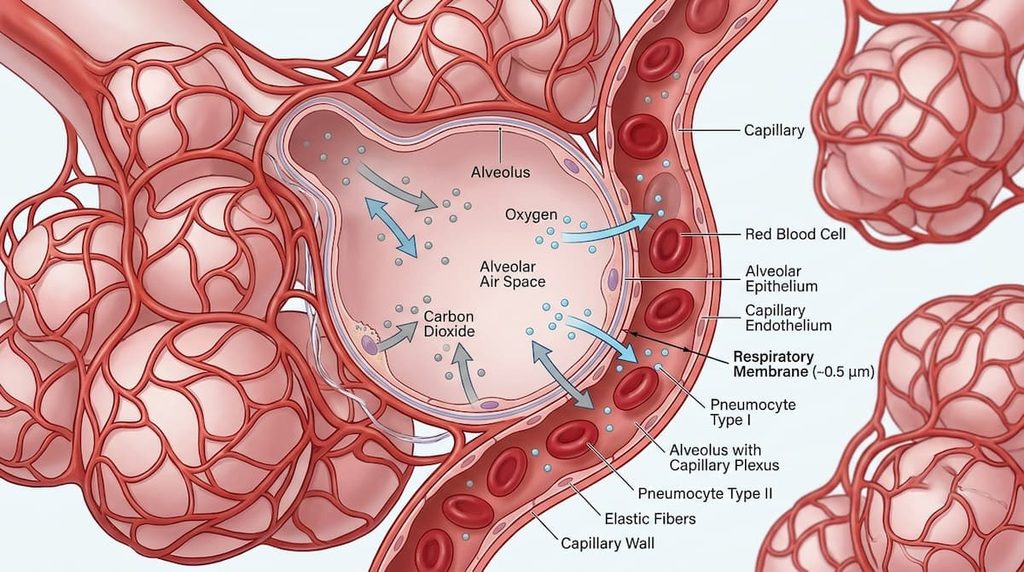
The skin lacks an equivalent respiratory system. Its outer barrier limits gas movement, and oxygen entering from the atmosphere primarily supplies relatively superficial tissues. It cannot deliver oxygen to the body at a rate comparable to the lungs.
The difference is not that human skin cannot absorb oxygen at all. It is that the amount it absorbs is far too small to meet the body’s overall demand.
How Frogs Use Their Skin to Breathe
Frogs provide a striking example of how the same basic biological process can serve a very different purpose.
A frog’s skin is relatively thin, moist, and well supplied with blood vessels. These characteristics make it suitable for exchanging gases with the surrounding environment.
When oxygen is available outside the body, it can dissolve in the moist surface layer and diffuse through the skin. Oxygen then enters nearby blood vessels and can be transported to tissues. Carbon dioxide produced by metabolism can travel in the opposite direction and escape through the skin.
Unlike the lungs, which require air to be moved in and out, skin gas exchange can continue across the body surface without a separate breathing movement.
This is particularly useful when frogs are underwater. Depending on the species, temperature, oxygen availability, and activity level, the skin can provide a substantial share of the oxygen required by the animal.
It also helps remove carbon dioxide while a frog remains submerged.
Frogs do not all rely on their skin to the same degree. Many use both lungs and skin, with the relative contribution of each changing with environmental conditions and physiological needs.
For example, a frog resting underwater in cool conditions may have a different oxygen demand and pattern of gas exchange from one that is active on land. The surrounding water’s oxygen concentration also affects how much oxygen can enter through the skin.
Skin respiration is therefore not a fixed percentage that applies to every frog in every situation. It is a flexible part of the animal’s respiratory system.

Some Salamanders Have No Lungs at All
The most remarkable examples of skin-based respiration occur among lungless salamanders.
Members of the salamander family Plethodontidae lack functional lungs as adults. Instead, they obtain oxygen through their skin and the moist lining of the mouth and throat.
For these animals, gas exchange across moist surfaces is not a minor supplement to lung function. It is central to how they stay alive.
Their biology also illustrates an important limitation of diffusion. Oxygen must travel across a body surface and reach living tissues, so the effectiveness of this system depends on the animal’s size, metabolic demand, skin properties, and surrounding conditions.
A respiratory strategy that works for a small salamander cannot automatically support a much larger animal with different oxygen requirements and a protective outer skin barrier.
Lungless salamanders are not evidence that lungs are unnecessary for all animals. They demonstrate that evolution can produce different solutions to the same biological problem.
The right solution depends on the organism and the environment in which it lives.
Skin Respiration and Lung Respiration: The Main Differences
Both forms of gas exchange depend on the movement of gases down concentration gradients. Beyond that shared principle, they differ substantially.
In human lungs, air is brought into contact with an extensive network of thin-walled alveoli. Blood transports oxygen to tissues throughout the body and returns carbon dioxide to the lungs for removal.
In skin-based respiration, gases cross the body’s external surface directly. The skin must be sufficiently permeable, and the distance between the surface and the tissues or blood vessels receiving oxygen must remain suitable for diffusion.
These differences affect efficiency.
Lungs can support the high oxygen demands of active mammals because ventilation, a large exchange surface, and circulation work together. Skin respiration can be sufficient for certain amphibians, but its effectiveness depends strongly on the animal’s biology and the surrounding conditions.
Water introduces another complication. Although oxygen can diffuse through water and enter suitable skin, water generally contains much less oxygen per unit volume than air. The oxygen available also varies with temperature and other environmental conditions.
A skin-breathing animal must therefore operate within the limits of its respiratory surface and habitat.
Humans, by contrast, rely on the lungs to supply oxygen to the body at a rate that the skin cannot approach.
Does Skin Respiration Mean Skin Needs No Blood Supply?
No. The idea that skin can obtain oxygen directly from the atmosphere does not mean that blood circulation is unnecessary.
In fact, gas exchange and circulation often work together. Oxygen that crosses a respiratory surface must reach the cells that need it, and carbon dioxide produced by those cells must be removed.
In humans, the outermost layers of the skin can receive oxygen directly from the atmosphere, but deeper tissues also depend on oxygen delivered by the blood. The relative importance of these sources varies with skin depth and local conditions.
The skin is also a living organ with many other demands. Its cells need energy to maintain their structure, repair damage, and perform their normal functions.
The discovery that atmospheric oxygen contributes to the oxygen supply of superficial skin tissue helps explain local skin physiology. It does not establish that increasing oxygen exposure at the skin surface will necessarily improve overall health, wound healing, or the effects of a cosmetic treatment.
Those are separate questions that require their own evidence.
Can Humans Survive by Breathing Through Their Skin?
No. Under normal conditions, the amount of oxygen absorbed through human skin is far too small to sustain the body’s overall needs.
The measured contribution of approximately 0.4 percent of pulmonary oxygen uptake makes the scale of the difference clear. Human skin absorbs some oxygen, but the lungs remain essential for supplying the body with enough oxygen and removing carbon dioxide efficiently.
The distinction also helps explain why skin injuries, skin treatments, and oxygen exposure should not be interpreted through the same framework as lung function. A local effect on the skin does not automatically translate into a meaningful change in the body’s total oxygen supply.
Skin respiration is a real biological phenomenon, but its significance depends on the organism.
For humans, it is a small contribution to the oxygen supply of superficial tissues. For frogs, it can be an important part of everyday breathing. For lungless salamanders, it is fundamental to survival.
The same physical principle, gas diffusion, can support very different biological roles.
That is one of the most revealing lessons of comparative biology: evolution does not give every animal the same respiratory system. It shapes different structures to meet the needs of different bodies and environments.
Scientific Sources
1. Stücker M, Struk A, Altmeyer P, Herde M, Baumgärtl H, Lübbers DW. “The cutaneous uptake of atmospheric oxygen contributes significantly to the oxygen supply of human dermis and epidermis.” The Journal of Physiology. 2002;538(Pt 3):985-994. PMID: 11826181. DOI: 10.1113/jphysiol.2001.013067. Read the study on PubMed
2. Hansen TN, Sonoda Y, McIlroy MB. “Transfer of oxygen, nitrogen, and carbon dioxide through normal adult human skin.” Journal of Applied Physiology: Respiratory, Environmental and Exercise Physiology. 1980;49(3):438-443. PMID: 6782048. DOI: 10.1152/jappl.1980.49.3.438. Read the study on PubMed
3. Burggren W, Moalli R. “‘Active’ regulation of cutaneous gas exchange by capillary recruitment in amphibians: experimental evidence and a revised model for skin respiration.” Respiratory Physiology. 1984;55(3):379-392. PMID: 6429804. DOI: 10.1016/0034-5687(84)90059-8. Read the study on PubMed