The Strange Symbiosis Inside Salamander Eggs [Bit#200]
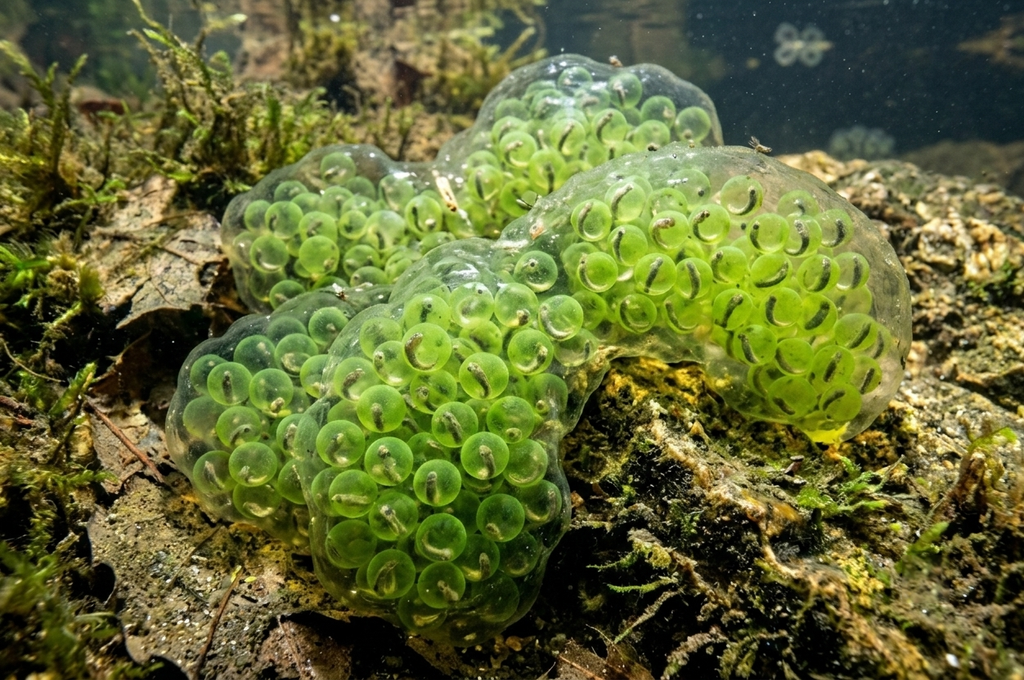
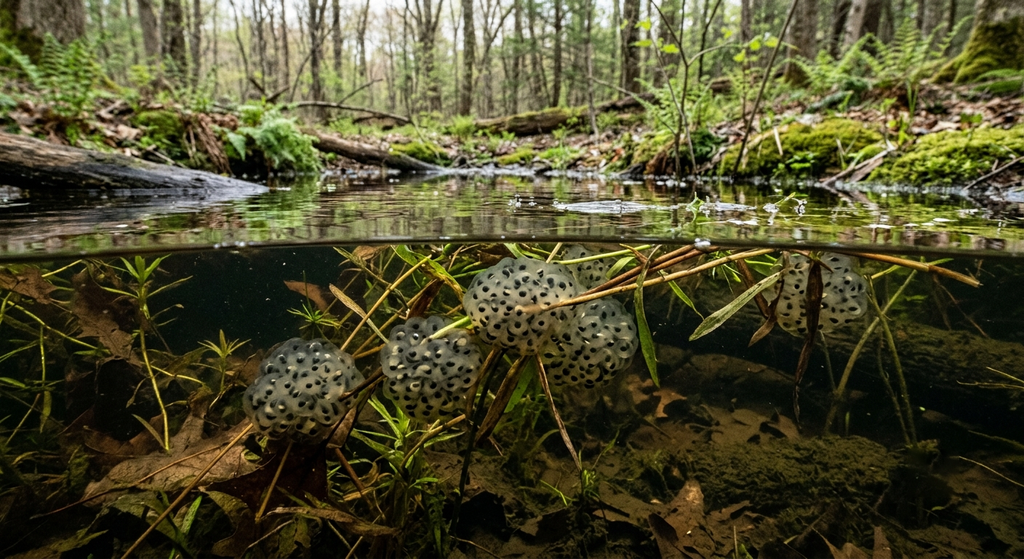
In a quiet freshwater pond, something unusual happens every spring. A spotted salamander lays hundreds of eggs, surrounding them with a thick, transparent jelly. At first, the eggs look like ordinary clusters of developing embryos. But after a while, something begins to change. The clear jelly turns green.
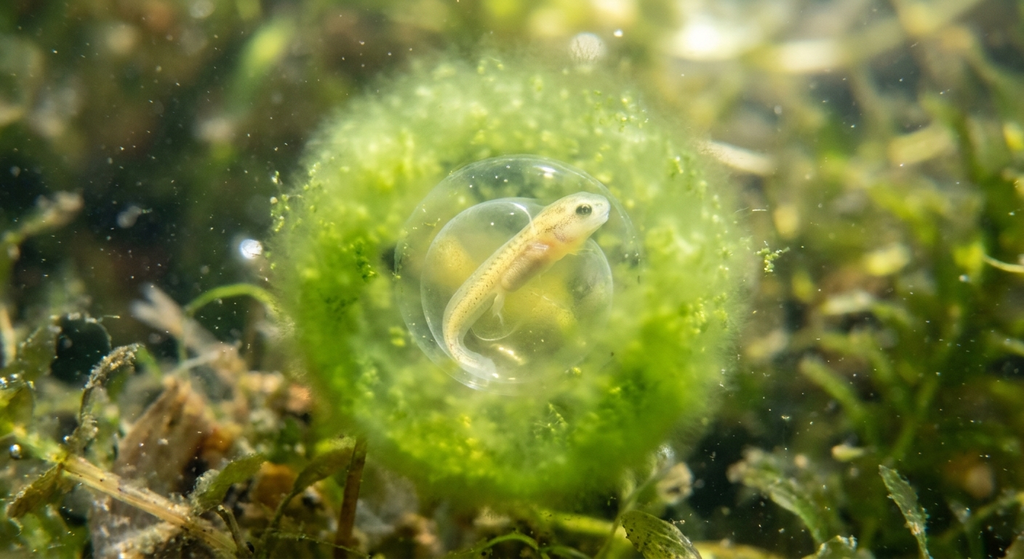
The color does not come from the salamander itself. Tiny green algae are growing inside the egg capsules, surrounding the developing embryos.
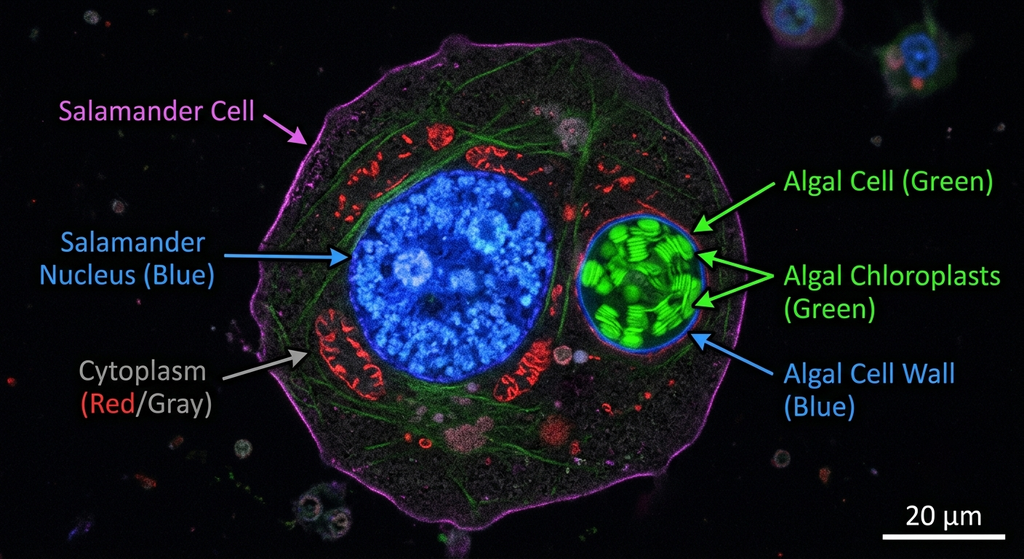
At first glance, this might seem like nothing more than algae growing on an animal’s eggs. But scientists have discovered something far more surprising. These algae do not simply live near the embryos. They can enter the salamander’s tissues and even its cells.
This unusual relationship has become one of the most fascinating examples of symbiosis between a vertebrate animal and a photosynthetic organism.
A Partnership That Begins Inside an Egg
The spotted salamander (Ambystoma maculatum) lives in eastern North America, where it breeds in temporary freshwater pools and woodland ponds.
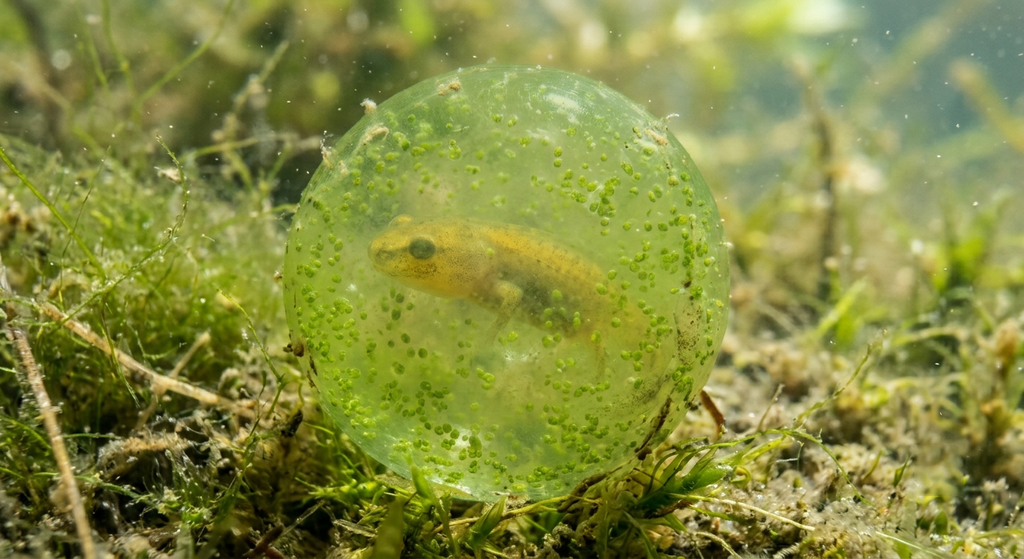
During the breeding season, females lay egg masses containing many individual eggs. Each embryo develops inside a protective capsule surrounded by layers of transparent jelly.
These jelly-covered masses provide protection, but they also create a problem.
As embryos grow, they need increasing amounts of oxygen. However, oxygen cannot always move easily through a dense mass of jelly. Eggs near the center may receive less oxygen than those closer to the outside.
This is where a microscopic green alga called Oophila amblystomatis enters the story.
The alga naturally colonizes the egg capsules, multiplying inside the jelly surrounding the developing embryos. As its population grows, the entire egg mass can take on a noticeable green color.
For a long time, scientists understood this relationship mainly as an association between algae and amphibian eggs.
But the more researchers investigated, the stranger the partnership became.
The Algae Help Supply Oxygen
One of the most important benefits of this relationship comes from photosynthesis.
Like plants, Oophila algae use light energy to convert carbon dioxide and water into organic compounds. Oxygen is released as a byproduct.
For a developing salamander embryo, this oxygen can be extremely valuable.
Remember that the embryos are packed together inside a gelatinous mass. Water movement between individual eggs is limited, making oxygen delivery more difficult, particularly for embryos near the center.
A 1994 study examined how oxygen moves through amphibian egg masses, including those of the spotted salamander.
The researchers found that diffusion alone could not provide enough oxygen to the innermost embryos during later developmental stages. However, when light was available, photosynthesis by the algae increased oxygen levels inside the egg mass.
This means the algae were doing something important for their animal neighbors. They were helping improve the oxygen conditions in an environment where oxygen could otherwise become limited.
There is an interesting detail, though.
Algae do not produce oxygen continuously. They need light for photosynthesis. During darkness, they also consume oxygen through cellular respiration.
As a result, oxygen levels inside the egg mass can change throughout the day. During daylight, photosynthesis can raise oxygen levels considerably. At night, oxygen levels can fall again.
The embryos therefore experience a changing environment created partly by the daily activity of their microscopic partners.
The Algae May Influence How Quickly Embryos Develop
Oxygen is not just something animals need to survive. It is also essential for the energy-producing processes that support growth and development.
When oxygen availability becomes limited, developing embryos can experience physiological stress.
Researchers have investigated whether the presence of algae influences salamander development.
A 2013 study published in the Journal of Experimental Biology examined how the number of algae inside egg capsules related to embryo growth.
The researchers found that embryos associated with larger algal populations showed faster growth and development.
This supports the idea that algae can provide meaningful benefits during embryonic development.
However, the relationship is not necessarily as simple as algae providing oxygen and salamanders growing faster.
The egg capsule is a complicated environment containing several organisms and interacting chemical processes. Oxygen availability, waste accumulation, light exposure, and developmental stage can all influence what happens inside it.
The algae are important, but scientists are still investigating exactly how every part of this relationship works.
Something Even Stranger: Algae Enter the Embryo’s Cells
For many years, the relationship between the salamander and its algae was considered an example of organisms living alongside one another.
Then, in 2011, researchers reported something unexpected.
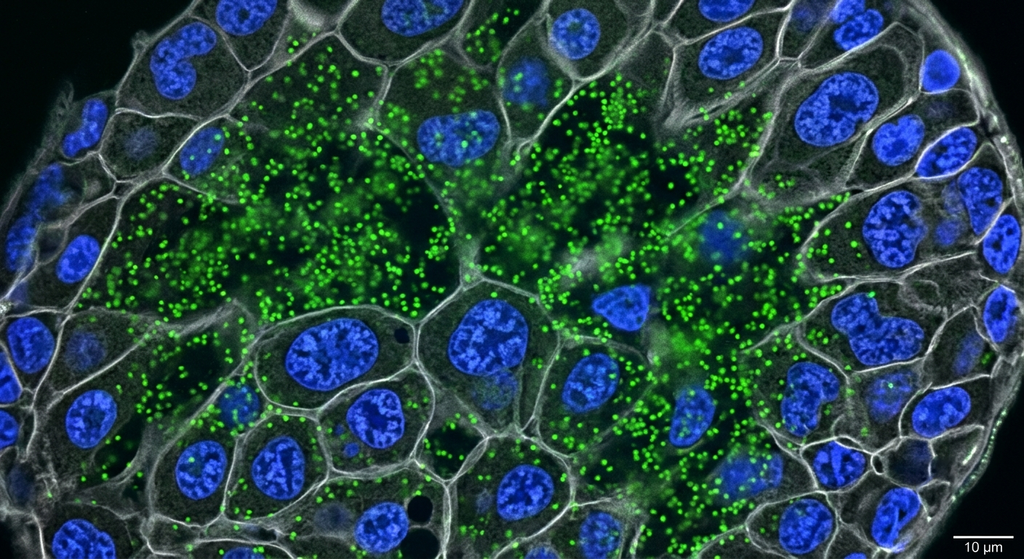
Using microscopy and molecular techniques, they discovered algal cells inside salamander embryonic tissues.
Even more remarkably, some algae were found inside individual animal cells.
This was a surprising discovery because relationships between photosynthetic algae and animals are already known in several groups of invertebrates. Finding algae inside the cells of a vertebrate animal was much more unusual.
The researchers detected algae in several developing tissues, including muscle and other regions of the embryo.
This raised an important question.
How could an algal cell enter the tissues of an animal that was developing inside an egg?
The researchers proposed that algae first accumulated inside the egg capsule and then entered the developing embryo through its developing digestive tract and surrounding tissues.
The discovery suggested that this partnership was much more intimate than scientists had previously understood.
However, an important distinction is necessary.
Finding algae inside animal cells does not automatically mean that the algae remain healthy there or permanently establish themselves as functioning residents.
Later studies revealed that the relationship inside the embryo is more complicated.
What Happens to Algae Inside Animal Cells?
In 2017, researchers investigated the interaction at the molecular level.
Instead of simply looking for green cells under a microscope, they examined gene activity in both organisms.
They compared salamander cells containing algae with cells that did not contain algae. They also compared algae living inside the salamander with algae living in the surrounding egg capsule.
The results revealed different conditions for the two partners.
Algae inside salamander cells showed signs of cellular stress. Their metabolism also changed, shifting away from their usual oxidative metabolism toward fermentation.
In contrast, salamander cells containing algae did not show major signs of stress.
This suggests that the animal cells may tolerate the presence of algae relatively well, while the algae experience a more challenging environment inside their host.
The researchers also found evidence that the algae might use glutamine from the salamander as a nitrogen source.
Glutamine is an amino acid involved in many biological processes, including nitrogen metabolism.
This finding raised the possibility that the relationship involves more than oxygen production. The two organisms may also interact through the exchange of nutrients and other biological compounds.
But there is still much to discover about how these interactions work.
The algae found inside the embryo may not be functioning in the same way as those growing in the egg capsule.
Do Salamanders Actually Receive Food From Algae?
One of the most interesting questions about this partnership concerns carbon.
During photosynthesis, algae capture carbon dioxide and convert its carbon into organic molecules. These molecules can become building materials or sources of energy.
In many photosynthetic symbioses, animals receive some of these products from their algal partners.
Could the same thing happen between salamanders and Oophila?
A 2013 experiment provided evidence supporting this possibility.
Researchers used radioactive carbon to trace carbon fixed by algae during photosynthesis. They detected labeled carbon in developing salamander embryos.
The researchers reported that carbon transfer was most noticeable during particular stages of development. At one stage, the average measured transfer was approximately 6.5% of the carbon fixed by the algae.
This was an exciting result because it suggested that photosynthetic products could move from a microscopic alga to a developing vertebrate animal.
However, a later study published in 2020 raised an important methodological concern.
The researchers found that salamander embryos themselves could fix inorganic carbon. In other words, the embryos could contribute to carbon fixation independently of the algae.
This made it difficult to determine exactly how much of the carbon detected in the embryo had originally come from algal photosynthesis.
The 2020 study therefore did not establish that algae never transfer photosynthetic products. Instead, it showed that the earlier experimental approach could not reliably separate the algae’s contribution from the embryo’s own carbon-fixing activity.
This distinction matters.
The oxygen-producing role of the algae is supported by physiological experiments. Direct nutritional support through carbon transfer remains a more complicated question.
Science does not always move forward by confirming earlier discoveries. Sometimes, a later experiment reveals that an apparently clear result needs another explanation.
When the Partnership Stops Being Helpful
It is tempting to think of symbiosis as a permanent agreement in which both organisms always benefit.
But nature rarely follows such simple rules.
The salamander-algae relationship can change depending on environmental conditions.
A 2012 study investigated what happens when spotted salamander eggs develop in acidic water.
Researchers compared egg masses exposed to water with a pH of 4.5 against those kept at pH 8.0.
The acidic conditions altered the chemical environment inside the egg masses. Oxygen availability was lower, while ammonia levels increased.
The embryos also accumulated higher concentrations of ammonia and lactate, and their body mass was reduced compared with embryos raised under the less acidic conditions.
These findings suggest that environmental conditions can interfere with the benefits normally associated with the algae.
The relationship is therefore not simply about having algae present or absent.
The surrounding environment influences how effectively the partnership works.
Another study published in 2020 examined how light conditions during embryonic development affected later growth and survival.
Embryos raised without light showed reduced growth and survival compared with those exposed to normal or extended light conditions. However, continuous light also produced some negative effects in the larvae after hatching.
This suggests that more photosynthesis is not automatically better.
The balance between oxygen production, oxygen consumption, and the developing animal’s physiological needs is important.
A Different Way to Understand Symbiosis
The relationship between spotted salamanders and green algae challenges the way we usually imagine interactions between animals and plants.
We often picture animals eating plants, competing with them, or simply living nearby.
But here, a microscopic photosynthetic organism grows inside the protective environment of an animal embryo, improves its oxygen conditions, and has even been found inside its cells.
The relationship also reveals how complicated the word symbiosis can be.
Some benefits are supported by strong experimental evidence. Others remain under investigation. Conditions that help one organism at a particular stage may not provide the same advantage later.
Most importantly, this is not a story about an animal becoming a plant or learning to perform photosynthesis.
The salamander remains an animal. The algae remain independent photosynthetic organisms with their own biological needs.
Yet their lives become closely connected during one of the most vulnerable periods of the salamander’s life.
A developing embryo depends on its environment for almost everything it needs. In this case, part of that environment is alive, microscopic, and capable of changing the chemistry surrounding the embryo.
Perhaps the most surprising lesson is that an animal’s development does not always happen alone. Sometimes, even before it hatches, another organism is already helping shape the conditions in which its life begins.
Scientific Sources
1. Kerney R, Kim E, Hangarter RP, Heiss AA, Bishop CD, Hall BK. “Intracellular invasion of green algae in a salamander host.” Proceedings of the National Academy of Sciences. 2011;108(16):6497-6502. PMID: 21464324. DOI: 10.1073/pnas.1018259108. Read the study on PubMed.
2. Pinder A, Friet S. “Oxygen transport in egg masses of the amphibians Rana sylvatica and Ambystoma maculatum: convection, diffusion and oxygen production by algae.” Journal of Experimental Biology. 1994;197(1):17-30. PMID: 9317252. DOI: 10.1242/jeb.197.1.17. Read the study on PubMed.
3. Graham ER, Fay SA, Davey A, Sanders RW. “Intracapsular algae provide fixed carbon to developing embryos of the salamander Ambystoma maculatum.” Journal of Experimental Biology. 2013;216(Pt 3):452-459. PMID: 23038736. DOI: 10.1242/jeb.076711. Read the study on PubMed.
4. Burns JA, Zhang H, Hill E, Kim E, Kerney R. “Transcriptome analysis illuminates the nature of the intracellular interaction in a vertebrate-algal symbiosis.” eLife. 2017;6:e22054. PMID: 28462779. DOI: 10.7554/eLife.22054. Read the study on PubMed.
5. Bianchini K, Tattersall GJ, Sashaw J, Porteus CS, Wright PA. “Acid water interferes with salamander-green algae symbiosis during early embryonic development.” Physiological and Biochemical Zoology. 2012;85(5):470-480. PMID: 22902375. DOI: 10.1086/667407. Read the study on PubMed.
6. Burns JA, Kerney R, Duhamel S. “Heterotrophic Carbon Fixation in a Salamander-Alga Symbiosis.” Frontiers in Microbiology. 2020;11:1815. PMID: 32849422. DOI: 10.3389/fmicb.2020.01815. Read the study on PubMed.
7. Small DP, Bishop CD. “Physiological benefits and latent effects of an algal-salamander symbiosis.” Comparative Biochemistry and Physiology Part A: Molecular & Integrative Physiology. 2020;246:110715. PMID: 32320756. DOI: 10.1016/j.cbpa.2020.110715. Read the study on PubMed.