[Bit#104] The Secret of Protein Folding: Why Structural Failures Cause Fatal Diseases
Introduction
The blueprint of our body, DNA, contains protein information stretched out like a 1D thread. However, if this 1D chain does not precisely fold into a complex 3D shape, the protein remains nothing more than a useless molecular component. Protein folding is an essential process for life to function. What happens if a folding error occurs in this seemingly perfect system? It goes beyond mere functional paralysis and leads to fatal diseases that destroy brain cells. Let us delve into the mysterious principle of a 1D chain transforming into a 3D living entity, and the tragic mechanisms brought about by misfolding.
1. From DNA Code to 3D Shape: How 1D Chains Fold Into Life
Cells inside our body run like sophisticated chemical factories at every moment. The core workers in this factory are proteins. Where do proteins come from? The starting point is DNA inside the cell nucleus.
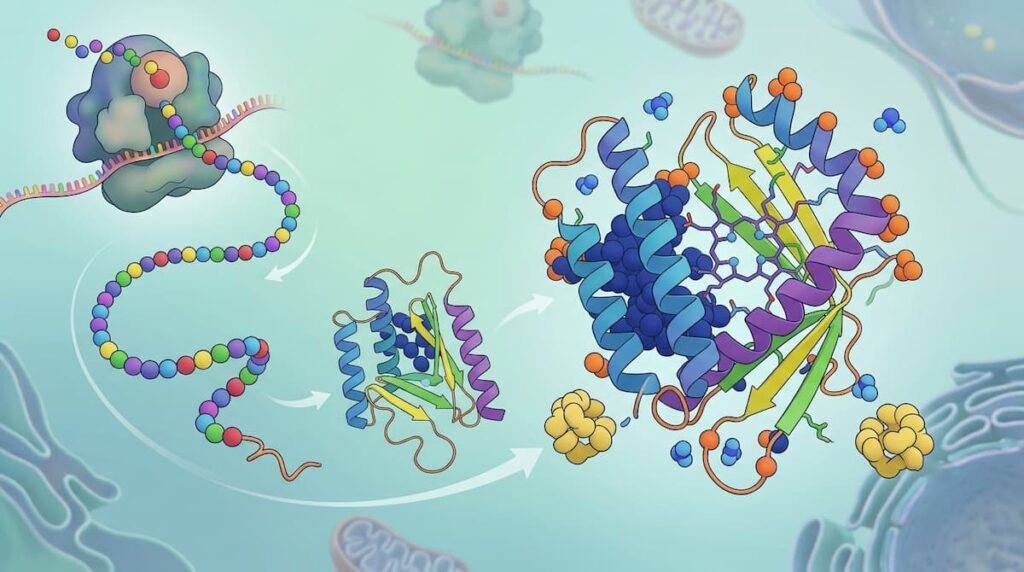
However, DNA does not hold a hammer and work directly. It is merely a long blueprint with encoded information. This blueprint is delivered to a molecular factory called the ribosome. The ribosome reads the code of the DNA and links building blocks called amino acids one by one. Thus, a single-line 1D amino acid chain is born.
Right at this point, the astonishing miracle of life begins. As soon as the chain, which is nothing more than a 1D thread, is completed, it begins to twist and bend on its own. In a fraction of a second, it transforms into a complex and sophisticated 3D structure. In science, this is called protein folding.
Why must it fold into such a complex 3D shape? The answer lies in an absolute rule of biology: protein shape equals function.
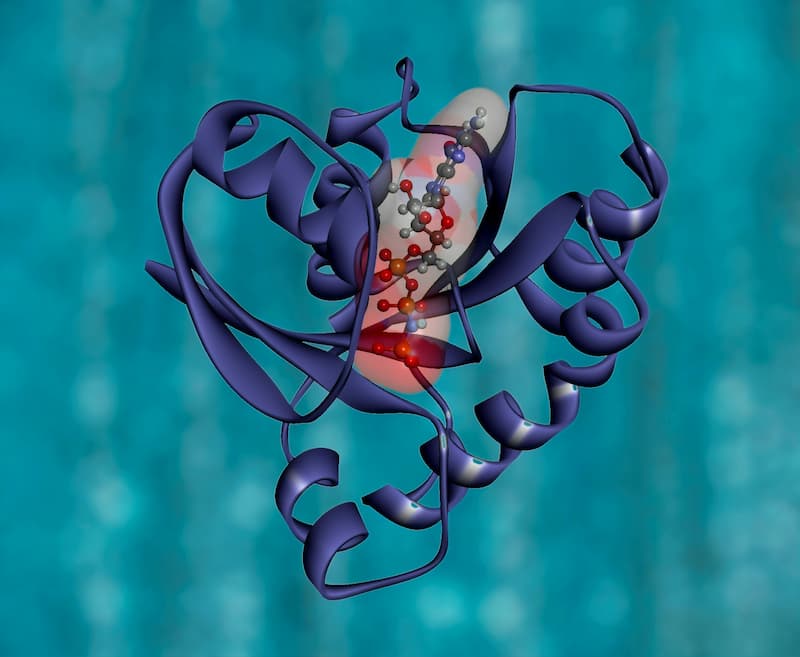
Think of a lock and a key. A key must have its unique ridges and grooves to open a lock. The same applies to proteins. Only when they possess a perfect 3D structure can they become enzymes in cells to trigger chemical reactions. They can become antibodies to block invaders or act as transport ships carrying oxygen. Conversely, an unfolded 1D protein is a useless entity incapable of performing any function.
How does a long chain fold into an exact shape without getting lost? Within a few milliseconds, a sophisticated chemical interplay takes place. Hydrophobic amino acids that hate water hide deep inside the protein to avoid water. Conversely, hydrophilic amino acids that love water emerge to face the moisture inside the cell.
On top of this, electrical forces act to pull or push amino acids toward each other. Strong chemical bonds securely fix various spots. All these physical laws match up perfectly like a pre-calculated machine.
Ultimately, protein folding is not a simple chemical reaction. It is the first gateway through which DNA, a piece of 1D digital information, gains life as a 3D analog machine. Only when this perfect folding succeeds can all vital activities in our body truly begin.
2. Misfolded Proteins: When 3D Structural Collapses Cause Fatal Diseases
If you understand how sophisticated protein folding is, now it is time to look at the chilling danger hidden behind it. What if the angle tilts even by a single degree while the 1D amino acid chain folds into a 3D structure?
It does not end with simply performing poorly. A deformed protein turns into a toxic substance. It becomes a terrifying bomb that destroys cells.
Why are misfolded proteins so dangerous? The answer lies in the surface properties of proteins.
A normal protein hides its water-hating hydrophobic parts deep inside its structure. However, if folding fails, these hydrophobic regions are exposed to the outside. Due to their property of avoiding water, misfolded proteins begin to tangle with each other. It is like sticky trash gathering to form a massive clump.
This hard clump of debris is called amyloid fibrils. These debris items take a form that cells find extremely difficult to break down or clean up on their own. Uncleaned trash continues to accumulate inside the cell.
What happens when trash clumps accumulate inside a cell?
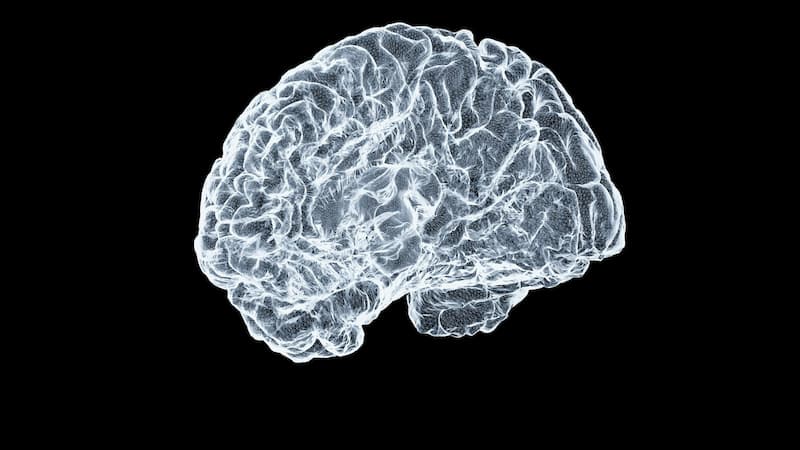
The very first victim is our brain. Brain cells have a long lifespan and are difficult to regenerate. As debris accumulates, the pathways for normal neurotransmitters become blocked. The internal nutrient supply network of the cell is also destroyed. Eventually, brain cells cannot endure it and begin to die one by one.
This is the representative reason why Alzheimer’s disease occurs. Beta-amyloid proteins misfold and stack up in the brain, killing cells responsible for memory. Parkinson’s disease also occurs as alpha-synuclein proteins tangle up and destroy brain cells.
Ultimately, protein folding errors become the direct cause of fatal brain diseases. A microscopic collapse in the 3D structure that should be sophisticated leads to a biological tragedy that shatters a person’s memory and life.
3. The Chaperone System and Prions: Quality Control and Cascading Dangers

Can all proteins fold perfectly at once? Of course not. Because the inside of a cell is a complex and busy environment, folding errors occur on a daily basis.
However, our healthy body does not leave this unattended. Inside the cell, helper proteins exist to correct fatal folding errors. Scientists call them molecular chaperones.
What do chaperones do? They act like quality control inspectors in a factory. When they find a misfolded protein, they immediately approach it and help it refold into the correct 3D structure. What if it is damaged beyond repair? They send it to the trash disposal site to break it down without hesitation.
Thanks to this sophisticated chaperone system, we can maintain our health every day amidst countless folding errors.
What happens if this seemingly perfect quality control system is breached? Here, the most bizarre and terrifying entity appears: prions.
Prions are not viruses or bacteria. They are merely abnormal, mutated proteins. However, their destructive power is surreal.
The moment a mutated prion meets a normal protein, it copies its own deformed structure onto it. Like dominoes, it forcibly mutates healthy proteins into incorrect 3D shapes in a row. This chain explosion spreads in an instant, far beyond what the chaperone system can handle.
When prion debris accumulates uncontrollably inside brain cells, holes begin to form in the brain like a sponge. Mad Cow Disease and Creutzfeldt-Jakob Disease are disorders caused by this tragic cascading collapse.
In the end, living organisms maintain a precarious balance between molecular-level quality control and structural collapse. The moment this fragile balance crumbles, the entire cell faces an instant catastrophe.
4. AI and Protein Folding: Decoding Biological Structures for Future Cures

Humanity has spent vast resources and time trying to unlock the secret of protein folding. Predicting how a 1D amino acid chain will fold into a 3D structure was a challenge that stumped biology for over 50 years. There were so many variables that even supercomputers would take decades to process it.
Then artificial intelligence appeared, and the game changed completely.
Biological AI programs like Google’s AlphaFold predicted the 3D structure of proteins accurately in just a few minutes. AI learned from millions of protein data points to thoroughly master the folding rules of amino acid chains.
What changes will this revolution bring to our lives?
Now scientists can observe the exact causes of diseases like Alzheimer’s and Parkinson’s at the molecular level, caused by misfolded proteins. Having found the misfolded regions, the path has opened to design targeted drug molecules that fit those exact spots.
Thanks to AI, the development time for rare disease treatments is shrinking from years to a matter of months.
Furthermore, scientists have begun designing entirely new proteins that do not exist in nature. They synthesize protein enzymes that degrade plastic in an instant or antibodies with 3D structures that precisely target cancer cells.
In the end, what does decoding the secret of protein folding mean? It means an era has opened where humans can control and repair the basic machinery of life on their own. We are now directly conducting the orchestra of life that began from a 1D code.
Conclusion
The process in which an amino acid chain, once merely a 1D thread, transforms into a sophisticated 3D structure is the wonder of life itself. Yet, the fact that tilting a single angle can turn it into a fatal toxic substance shows the fragility of life.
Even at this very moment as we remember, breathe, and think, hundreds of millions of chaperones inside our cells are struggling for perfection at the molecular level.
Is life inherently a precision machine designed to be perfect, or is it an unstable, precarious balance that constantly repeats collapse and repair?
Now that humanity can repair the blueprint of life through AI, will we truly become the complete masters of this molecular machine?
Understanding the 3D folding of proteins goes beyond curing diseases; it is a grand journey to discover the fundamental definition of life.
![[Bit#146] Why Coffee Makes You Urinate Frequently: Caffeine and Diuresis](https://hiddenbitknowledge.com/wp-content/uploads/2026/09/main.man-and-coffee-767x428.jpg)
![[Bit#137] The Science of 36.5°C: The Secret of Cellular Thermodynamics Optimized for Survival](https://hiddenbitknowledge.com/wp-content/uploads/2026/08/main.36.5-767x428.jpg)
![[Bit#35] The Night Owl Myth: Why Your DNA Rebels Against Mornings](https://hiddenbitknowledge.com/wp-content/uploads/2026/05/b2de24ca8745-768x419.jpg)
![[Bit#88] Saliva Secrets: Predict Your Health with DTC Genes](https://hiddenbitknowledge.com/wp-content/uploads/2026/07/main.sariva-768x429.jpg)
![[Bit#112] Rare Blood Type Rh-null: The Rarest Blood in the World](https://hiddenbitknowledge.com/wp-content/uploads/2026/08/main.rh-null-768x399.jpg)
![[Bit#173] Why Do Wounds Itch When They Heal?](https://hiddenbitknowledge.com/wp-content/uploads/2026/10/main.Healing-wound-768x419.jpg)