Is Cholesterol Really the Problem? [Bit#217]
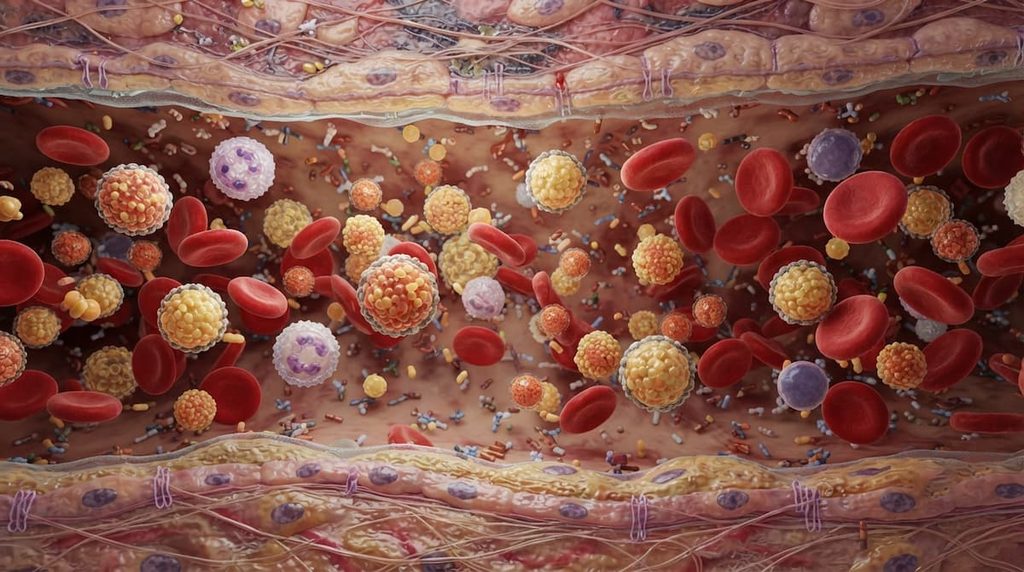
For years, cholesterol has been treated almost like a dietary villain.
Eat too much of it, people are told, and your cholesterol rises. High cholesterol then clogs your arteries, increasing the risk of heart disease.
It sounds simple.
But there is a problem with that story: the cholesterol you eat and the cholesterol that circulates in your blood are not the same thing.
Your body actually needs cholesterol. It is part of cell membranes and is used to make steroid hormones, bile acids, and other essential molecules. The real question is not whether your body contains cholesterol. It is where that cholesterol is, how it is transported, and how much atherogenic lipoprotein remains in circulation over time.
That distinction changes the way we should think about cholesterol.
Cholesterol is not a toxin
Cholesterol is a waxy, fat-like molecule that your body needs. It is an essential component of cell membranes and a building block for several important molecules. So the body does not treat cholesterol as a toxin that must simply be eliminated.
Cells need it to maintain their membranes. The body also uses cholesterol as a starting material for several important molecules, including steroid hormones and bile acids.
And your body does not rely entirely on food to obtain it.
The liver and other cells can make cholesterol themselves. At the same time, the body has mechanisms that adjust cholesterol absorption, production, and disposal.
This means eating cholesterol is not equivalent to pouring cholesterol directly into your bloodstream.
That does not mean dietary cholesterol has no effect.
It can raise blood cholesterol in some people, and controlled feeding studies have demonstrated that increasing dietary cholesterol can increase LDL cholesterol. But the response varies among individuals, and the relationship is not a simple one-to-one conversion.
Your body is constantly trying to maintain cholesterol balance.
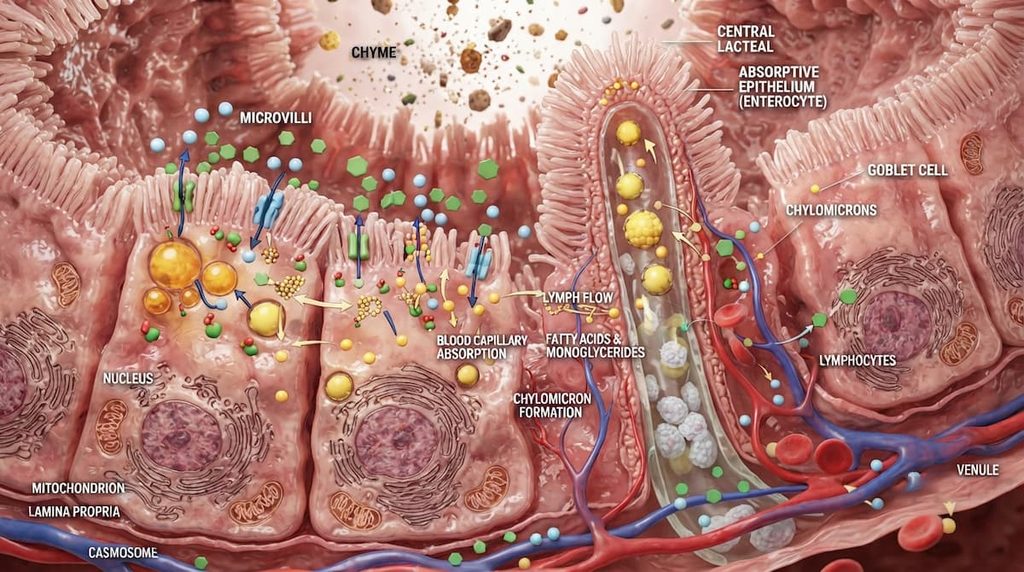
The cholesterol you eat takes a detour
Consider what happens after you eat an egg.
The cholesterol in the egg enters the digestive system. Some is absorbed through the intestine. From there, cholesterol becomes part of a complex transport system involving lipoproteins and the liver.
It does not simply travel from your plate to an artery.
Your body can also change how much cholesterol it produces when dietary cholesterol intake changes. In controlled studies, many people compensate for increased cholesterol intake by reducing cholesterol synthesis or absorption.
This is one reason why the effect of dietary cholesterol differs between people.
Some people experience a larger increase in blood cholesterol after consuming more dietary cholesterol, while others show a smaller response.
So the statement “I ate cholesterol, therefore my blood cholesterol must rise by the same amount” is biologically misleading.
But there is an even more important distinction.
The cholesterol molecule itself is not what makes LDL dangerous.
The problem is the lipoprotein particles carrying cholesterol through the bloodstream.
LDL is more than “bad cholesterol”
You have probably heard LDL described as “bad cholesterol.”
Strictly speaking, that phrase is inaccurate.
LDL stands for low-density lipoprotein. It is a particle that transports cholesterol and other lipids through the bloodstream.
The cholesterol inside an LDL particle is not a separate substance called “bad cholesterol.”
Yet the LDL system really does matter.
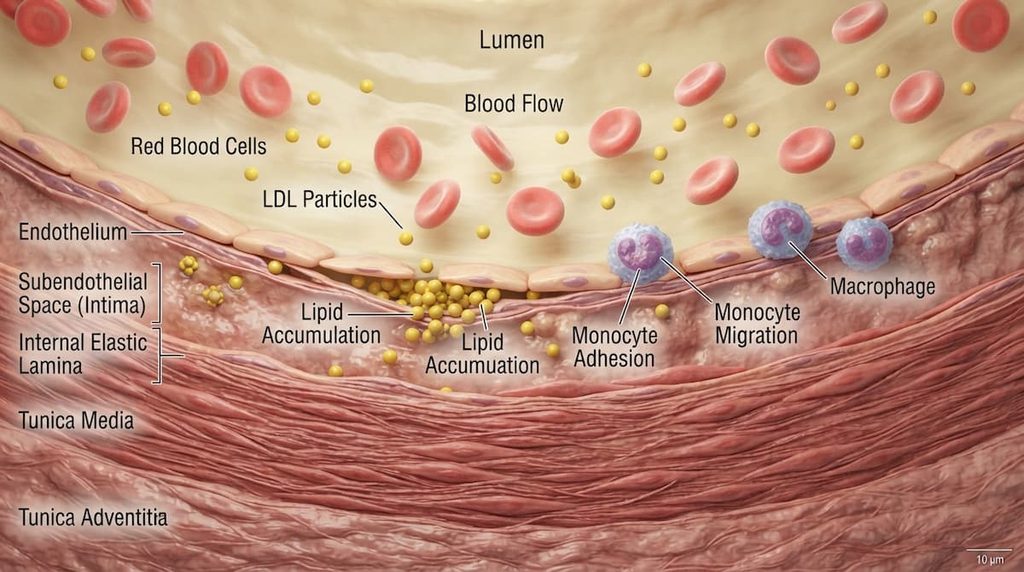
LDL and other apoB-containing lipoproteins can enter the artery wall. When these particles become retained there, they can trigger a chain of biological responses involving inflammation, lipid accumulation, and plaque formation.
Over years, this process can contribute to atherosclerosis, the disease in which plaques build up inside arteries.
This is why researchers now distinguish between cholesterol as a necessary molecule and atherogenic lipoproteins as a major driver of cardiovascular disease.
The difference may sound technical, but it changes the whole story.
You do not need to eliminate cholesterol from your body.
You need to understand what happens when atherogenic particles containing cholesterol circulate at elevated levels for long periods.
So what about eggs?
This is where the old cholesterol story becomes especially confusing.
Eggs contain a substantial amount of dietary cholesterol. That fact is real.
But it does not automatically mean that eating eggs causes arteries to become clogged.
Recent controlled research illustrates why the surrounding diet matters.
In a 2025 randomized crossover trial, 61 adults followed three different diets for five weeks each. One diet included two eggs per day while keeping saturated fat relatively low. Another provided less dietary cholesterol but more saturated fat.
The researchers found that saturated fat intake was positively associated with LDL cholesterol, while dietary cholesterol was not. Compared with the high-saturated-fat control diet, the low-saturated-fat diet containing two eggs per day actually produced lower LDL cholesterol.
That does not prove that everyone can eat unlimited eggs without consequences.
The study was relatively small and short, and it was designed to examine LDL-related effects rather than long-term heart attacks or strokes.
Other research has also produced mixed findings about egg consumption and cardiovascular outcomes. A 2025 umbrella review found that the overall evidence from previous meta-analyses was generally weak and highly heterogeneous.
So the scientifically honest conclusion is not “eggs are completely safe” or “eggs are dangerous.”
It is more interesting:
The cardiovascular meaning of an egg cannot be determined from its cholesterol content alone.
What replaces the egg, what the rest of the diet looks like, and how an individual’s blood lipids respond all matter.
Saturated fat changes the picture
This is one of the most important pieces missing from the old cholesterol story.
Imagine two meals.
One contains a food relatively high in cholesterol but fits into a diet relatively low in saturated fat.
The other contains less dietary cholesterol but substantially more saturated fat.
If we judge these meals only by the amount of cholesterol on the nutrition label, we might expect the second meal to be healthier for cholesterol.
But biology does not work that way.
The effect of dietary fat quality on blood lipids can be substantial, and controlled feeding studies have repeatedly shown that replacing saturated fat with unsaturated fat can lower LDL cholesterol.
This is why modern thinking about cholesterol has moved away from simply asking:
“How much cholesterol did you eat?”
and toward questions such as:
“What kind of fat replaced what?”
“What happens to LDL?”
and
“What does the overall dietary pattern look like?”
That is a much more useful way to think about food.
HDL is not simply the opposite of LDL
There is another common shortcut that sounds scientific but can be misleading:
LDL is bad. HDL is good.
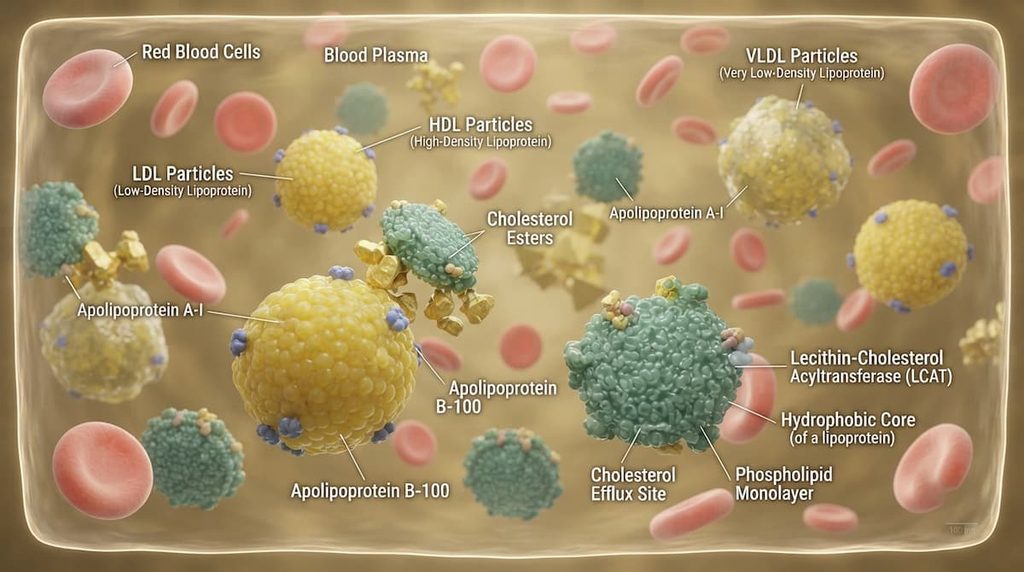
HDL stands for high-density lipoprotein. HDL particles participate in cholesterol transport and have several biological functions that may contribute to cardiovascular protection.
But HDL cholesterol, or HDL-C, is not the same thing as having a guaranteed protective effect.
For years, researchers noticed that people with higher HDL-C often had lower cardiovascular risk. This led to the idea that raising HDL-C should reduce heart disease.
Clinical trials did not consistently support that idea.
Simply increasing the amount of cholesterol carried inside HDL particles has not reliably produced the expected reduction in cardiovascular events. Recent research therefore increasingly focuses on HDL function and particle characteristics rather than treating the HDL-C number as a simple measure of protection.
So even the familiar “good cholesterol” label needs qualification.
A high HDL-C number does not cancel out a high LDL-related risk.
And a low HDL-C number does not tell the entire story either.
The number on your blood test is a clue, not the whole story
This does not mean cholesterol blood tests are useless.
Far from it.
LDL cholesterol remains an important clinical measure because extensive genetic, observational, and randomized-trial evidence supports a causal relationship between LDL exposure and atherosclerotic cardiovascular disease.
In fact, newer research is paying increasing attention to the number of atherogenic particles themselves.
Apolipoprotein B, or apoB, is found on atherogenic lipoprotein particles. Measuring apoB can therefore provide information about the number of particles capable of contributing to atherosclerotic disease.
This becomes especially interesting when LDL-C and apoB do not tell exactly the same story.
Two people can have similar LDL-C values but different numbers of apoB-containing particles.
That does not mean everyone needs an apoB test.
It means that “cholesterol” is not a single number representing the entire biological process.
The deeper we look, the more the simple good-versus-bad picture breaks apart.
The real problem is not cholesterol itself
So should we stop worrying about cholesterol?
No.
That would simply replace one oversimplification with another.
Elevated LDL and other atherogenic lipoproteins are important causes of atherosclerotic cardiovascular disease. Lowering LDL can reduce cardiovascular risk, particularly in people at elevated risk.
But saying “cholesterol is bad” misses the biology.
Cholesterol is necessary for life.
Dietary cholesterol can affect blood cholesterol, but the effect varies between individuals and depends on the surrounding diet.
Saturated fat can have a substantial influence on LDL.
Eggs cannot be judged solely by their cholesterol content.
HDL-C is not a simple protective shield.
And LDL is not merely a number to fear. It represents part of a transport system whose long-term exposure matters for what happens inside the artery wall.
That leads to a much better question than “Is cholesterol good or bad?”
What happens to cholesterol after it enters the body?
That question takes us from a food label to physiology, from physiology to lipoprotein metabolism, and from there to the actual biology of atherosclerosis.
The goal, then, is not to eliminate cholesterol.
It is to understand the system that moves it through the body.
And that is why the most important distinction may not be between good cholesterol and bad cholesterol, but between a molecule your body needs and the particles that can carry it into places where it becomes harmful.
Scientific Sources
1. Pedro-Botet J, Climent E, Benaiges D. “LDL cholesterol as a causal agent of atherosclerosis.” Clin Investig Arterioscler. 2024;36 Suppl 1:S3-S8. PMID: 39043480. DOI: 10.1016/j.arteri.2024.07.001. Read the study on PubMed
2. Carter S, Hill AM, Yandell C, Wood L, Coates AM, Buckley JD. “Impact of dietary cholesterol from eggs and saturated fat on LDL cholesterol levels: a randomized cross-over study.” Am J Clin Nutr. 2025;122(1):83-91. PMID: 40339906. DOI: 10.1016/j.ajcnut.2025.05.001. Read the study on PubMed
3. de Castro et al. “Effect of egg consumption on health outcomes: An updated umbrella review of systematic reviews and meta-analysis of observational and intervention studies.” 2025. PMID: 39934049. Read the study on PubMed
4. Soffer DE, Marston NA, Maki KC, et al. “Role of apolipoprotein B in the clinical management of cardiovascular risk in adults: An Expert Clinical Consensus from the National Lipid Association.” J Clin Lipidol. 2024;18(5):e647-e663. PMID: 39256087. DOI: 10.1016/j.jacl.2024.08.013. Read the study on PubMed
5. Andraski AB, Sacks FM, Aikawa M, Singh SA. “Understanding HDL Metabolism and Biology Through In Vivo Tracer Kinetics.” Arterioscler Thromb Vasc Biol. 2024;44(1):76-88. PMID: 38031838. DOI: 10.1161/ATVBAHA.123.319742. Read the study on PubMed