Why Is Childbirth So Painful? The Evolutionary Trade-Off Behind Birth [Bit#220]
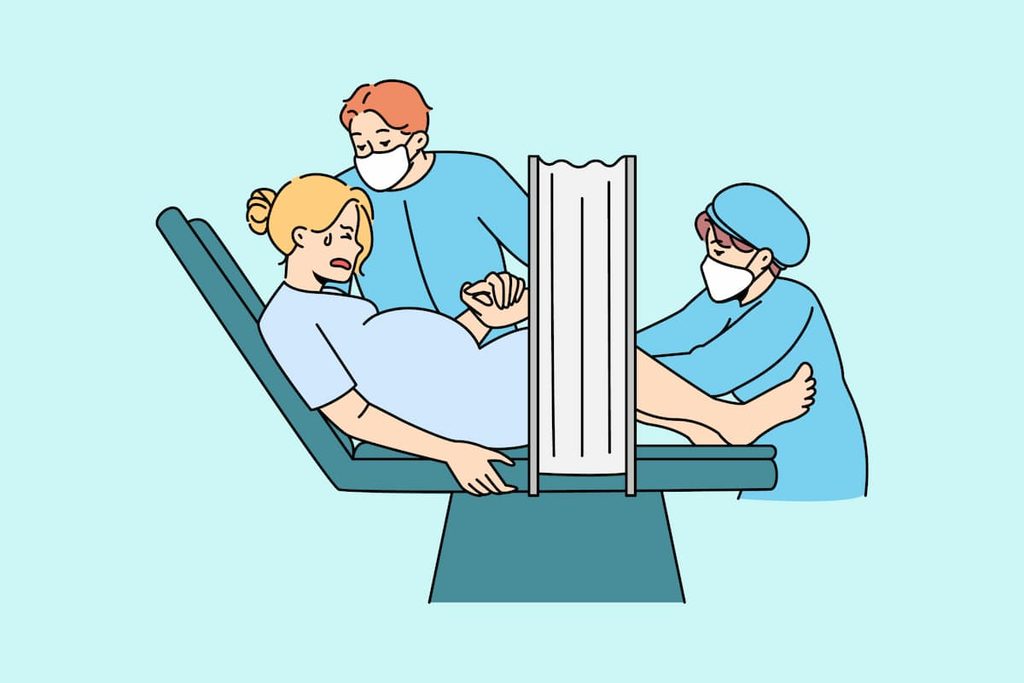
For something as important as reproduction, childbirth seems surprisingly difficult.
The uterus contracts again and again. The cervix has to open. The baby has to pass through a narrow birth canal. In humans, the baby often has to rotate as it moves through the pelvis.
And the mother experiences pain throughout the process.
This raises a strange evolutionary question.
If painful and difficult childbirth is such a problem, why didn’t evolution make it easier?
It might seem like humans were simply poorly designed for giving birth. But the real story is more interesting.
Human childbirth is difficult for specific anatomical reasons, but humans are not the only mammals that can experience difficult or painful birth. And the problem cannot be explained simply by saying that evolution made the human pelvis too narrow.
The difficulty of childbirth is better understood as a trade-off between several biological demands.
Why does childbirth hurt?

The pain of childbirth is not caused by one single event.
During labor, the uterus contracts strongly to push the baby toward the birth canal. As the cervix opens, tissues around the uterus, cervix, vagina, and pelvic floor are stretched and compressed.
These mechanical changes activate pain-sensing nerve pathways. Signals travel through the nervous system and are interpreted by the brain as pain.
The intensity can increase as contractions become stronger and more frequent and as the baby moves lower into the pelvis.
So there is a straightforward biological explanation for why childbirth hurts.
But that explanation creates another question.
Why does human childbirth seem especially difficult?
Part of the answer lies in the unusual relationship between the human baby and the mother’s pelvis.
The baby is large, but the birth canal is not simply a hole
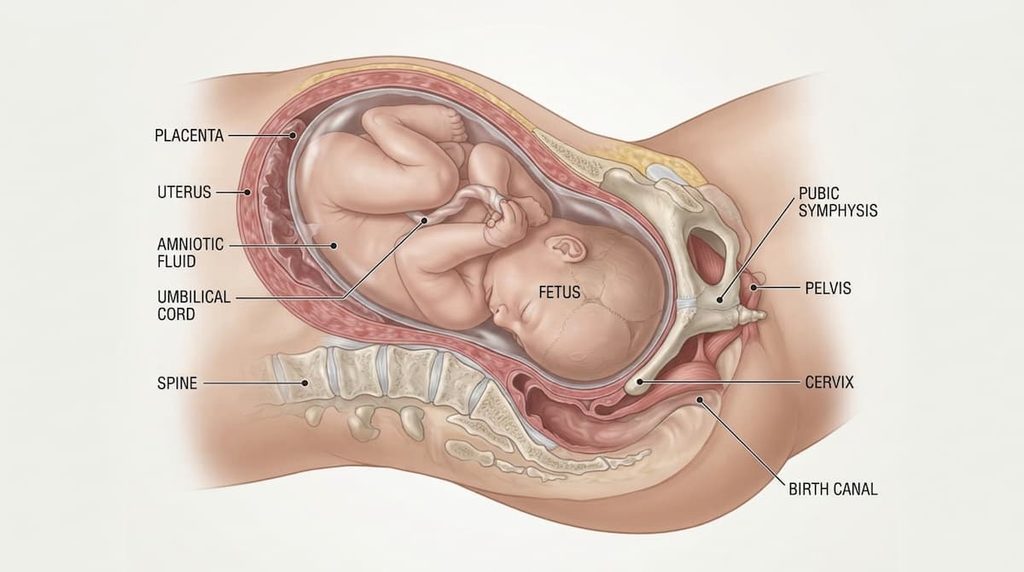
Human babies have relatively large heads compared with the mother’s birth canal.
That creates a tight fit.
The baby’s head is not just pushed straight through the pelvis. Because of the shape of the human pelvis and the baby’s head and shoulders, the baby typically changes orientation as it moves through the birth canal.
This is one reason human birth is mechanically demanding.
For a long time, scientists explained this using a simple evolutionary story.
Humans evolved to walk on two legs. That changed the shape of the pelvis. At the same time, our ancestors evolved much larger brains and therefore larger-headed babies.
The result was thought to be an evolutionary conflict:
efficient walking required one kind of pelvis, while childbirth favored another.
This idea became known as the obstetrical dilemma.
There is truth in this explanation, but modern research suggests that it is too simple.
Evolution was not choosing a pelvis just for childbirth
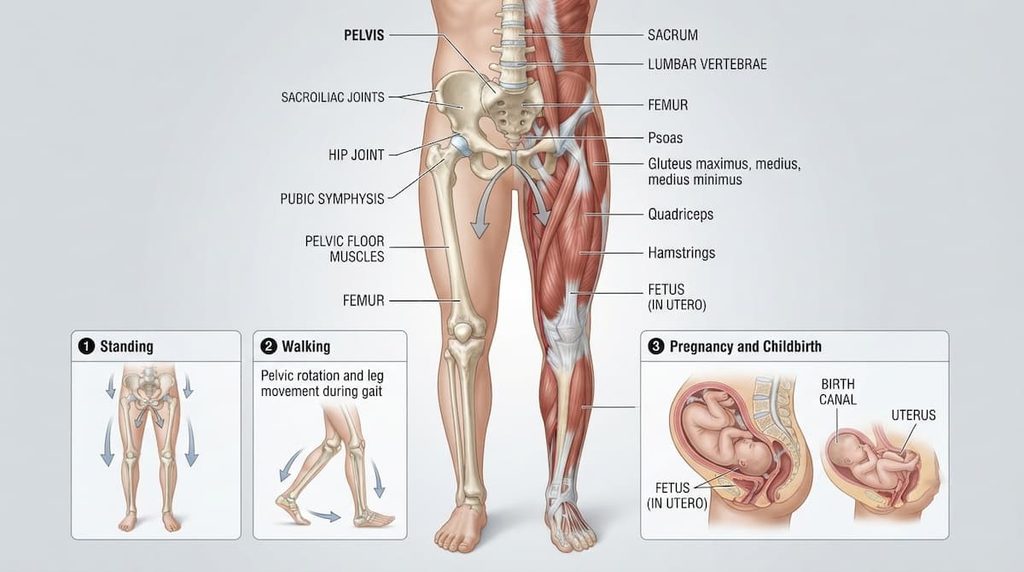
The human pelvis has many jobs.
It supports the body during movement. It connects the legs to the trunk. It helps support the growing weight of pregnancy. And the muscles and tissues of the pelvic floor help support internal organs.
That means evolution could not simply make the birth canal as wide as possible.
A wider pelvis might make some aspects of childbirth easier, but changing pelvic structure can also affect other functions.
Recent research has therefore expanded the traditional obstetrical dilemma. Scientists are investigating not only walking and brain size, but also pelvic-floor stability, pregnancy, body support, energy demands, and other factors that may have influenced the evolution of the human pelvis.
A 2026 study, for example, proposed that the ability of the pelvic floor to support the body and the increased load of pregnancy may have been an important constraint on pelvic shape.
Another 2025 study found genetic relationships between traits related to pelvic form and head width, supporting the idea that the evolution of the pelvis and the evolution of large human brains cannot be considered completely separately.
In other words, the human pelvis was not evolving toward one goal.
It had to work for an entire human body.
And childbirth was only one of the problems it had to solve.
But are humans really the only animals with difficult births?
No.
This is where the usual story becomes more interesting.
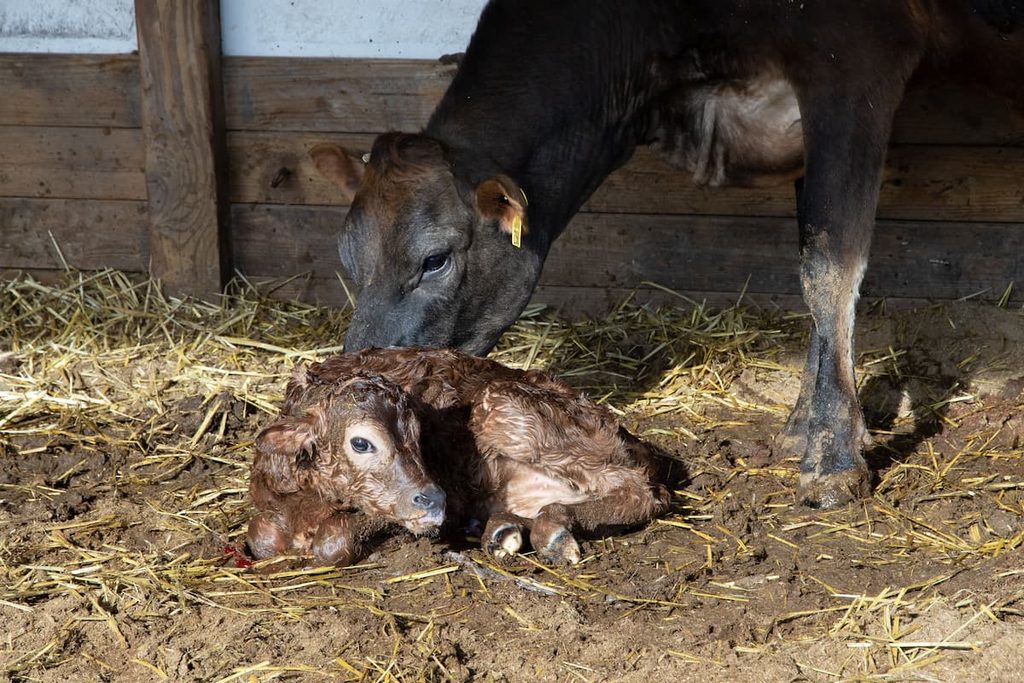
Humans are unusual in several aspects of childbirth, but difficult birth is not uniquely human.
A 2026 comparative study examined difficult birth across placental mammals and argued that problems similar to human fetopelvic constraints occur in many other species.
This makes biological sense.
Whenever a relatively large offspring has to pass through a mother’s birth canal, there is a physical limit.
If the offspring becomes larger, birth can become more difficult.
If the mother’s anatomy changes, the relationship between offspring size and the birth canal can change as well.
Different species solve this problem in different ways, but none has complete freedom to ignore the physical limits involved.
So humans are not the only mammals for which childbirth can go wrong.
Nature has never produced a universal design that makes birth easy.
Do other animals feel pain during birth?
There is strong evidence that other mammals experience the biological processes associated with pain during labor.
But there is an important distinction.
Humans can tell researchers, “This hurts.”
Animals cannot describe their subjective experience in the same way.
Scientists therefore look for indirect evidence, such as changes in behavior, movement, hormones, heart rate, and other physiological responses.
A 2026 systematic review of pain during parturition in humans and domestic animals found evidence of nociceptive processes during labor in several animal species. In some animals, including goats and pigs, the evidence suggests substantial pain during the birth process.
But scientists cannot reliably put animal and human childbirth pain on exactly the same scale.
So the scientifically careful answer is:
Other mammals can experience pain during birth, but we cannot know that their subjective experience is identical to ours.
That distinction matters.
So why hasn’t evolution eliminated the problem?
This is the most important question.
It is tempting to imagine evolution as an engineer.
If a problem appears, evolution should fix it.
But evolution does not work that way.
Natural selection does not design each body part from scratch. It modifies existing anatomy while dealing with many competing demands.
A change that helps one function can create a cost somewhere else.
For childbirth, imagine that a much wider pelvis made birth easier.
That sounds obviously beneficial.
But what if changing pelvic shape affected walking, body support, pelvic-floor function, or other aspects of reproduction?
The best evolutionary outcome would not necessarily be the pelvis that makes childbirth easiest.
It could be a pelvis that allows an individual to walk, survive pregnancy, support the body, give birth, and reproduce successfully enough for the trait to persist.
That is a very different idea from perfect biological design.
Pain is not necessarily the part evolution “wanted”
There is another important distinction.
We can explain why childbirth produces pain.
But that does not mean we know that pain itself evolved specifically because it was useful during childbirth.
Pain is a nervous-system response to potentially damaging mechanical and chemical signals.
During childbirth, strong contractions and tissue stretching naturally activate these pathways.
Some researchers have proposed that pain might have behavioral benefits, such as encouraging protective behavior or seeking assistance. But these ideas are not strong enough to say that childbirth pain itself is a clearly established evolutionary adaptation.
So we should separate two questions:
Why does childbirth hurt?
We have a good physiological answer.
Why did evolution allow childbirth to remain painful?
That is a much harder evolutionary question, and there may not be a single answer.
Childbirth is not an evolutionary failure
This brings us back to the original question.
Is painful childbirth evidence that evolution made humans badly?
Not really.
Human childbirth involves a difficult combination of a relatively large baby, a complex pelvic structure, and the physical demands placed on the mother’s body.
But those characteristics did not evolve independently.
The human body had to solve many problems at once.
And difficult birth itself is not unique to humans.
The better way to think about childbirth is not as a design that evolution forgot to fix, but as the result of biological trade-offs.
A body can be very successful overall while still having serious limitations in one part of its life.
Human beings can walk efficiently, support pregnancy, grow large brains, and reproduce.
None of those abilities comes without costs.
Childbirth is one place where those costs become especially obvious.
The strange lesson of childbirth
There is an easy assumption hiding behind the question, “Why didn’t evolution make childbirth easier?”
It assumes that evolution should produce the best possible version of every biological function.
But nature does not work that way.
Evolution does not ask:
“What would make childbirth easiest?”
It effectively favors combinations of traits that allow organisms to survive and reproduce under their particular conditions.
That can leave behind compromises.
Human childbirth is one of the clearest examples.
The pain is real. The mechanical difficulty is real. The risks are real.
But those facts do not mean that human reproduction is an evolutionary mistake.
And humans are not alone in facing the physical limits of birth.
The surprising part is not that evolution left childbirth imperfect. The surprising part is that “perfect” childbirth was never the evolutionary goal in the first place.
Scientific Sources
- Grunstra ND. “Humans are not unique: difficult birth is common in placental mammals.” Biological Reviews. 2026;101(5):2214-2239. PMID: 42089329. DOI: 10.1002/brv.70174. Read the study on PubMed.
- Fischer B, Stansfield E. “Human evolution and the obstetrical dilemma: The pelvic floor hypothesis.” The Anatomical Record. 2026. PMID: 42444616. DOI: 10.1002/ar.70279. Read the study on PubMed.
- Grunstra NDS, Betti L, Fischer B, et al. “There is an obstetrical dilemma: Misconceptions about the evolution of human childbirth and pelvic form.” American Journal of Biological Anthropology. 2023;181(4):535-544. PMID: 37353889. DOI: 10.1002/ajpa.24802. Read the study on PubMed.
- Xu J, et al. “Genetic evidence for the evolution of the human pelvis and obstetrical constraints.” Science. 2025. PMID: 40208988. Read the study on PubMed.
- Rota A, et al. “Pain during parturition in humans and domestic animals: A systematic review.” 2026. PMID: 42651878. Read the study on PubMed.