Why Can’t Humans Regrow Teeth? [Bit#221]
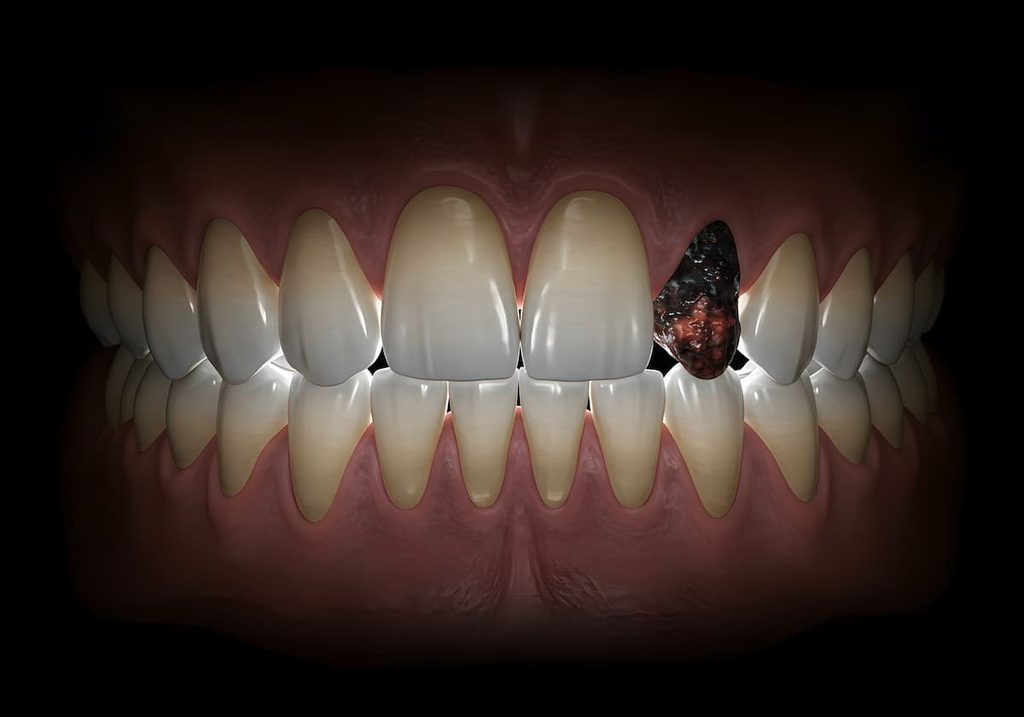
Most people get two chances to grow teeth.
The first is childhood, when baby teeth appear. The second is when those teeth are replaced by permanent teeth. After that, the biological program that makes new teeth becomes largely inactive.
But sharks follow a very different rule.
They can continuously produce new teeth throughout life, replacing teeth that are lost or worn down. This raises a surprisingly fundamental question: if vertebrates already evolved a system for repeatedly making teeth, why can’t humans simply use it again?
The answer is more interesting than the idea that sharks have some special “tooth gene.” Scientists have found that the biological machinery involved in making shark teeth is deeply connected to the machinery used during tooth development in other vertebrates, including humans.
And researchers are now trying to work out whether parts of that machinery can be switched back on.
Sharks Never Really Stop Making Teeth
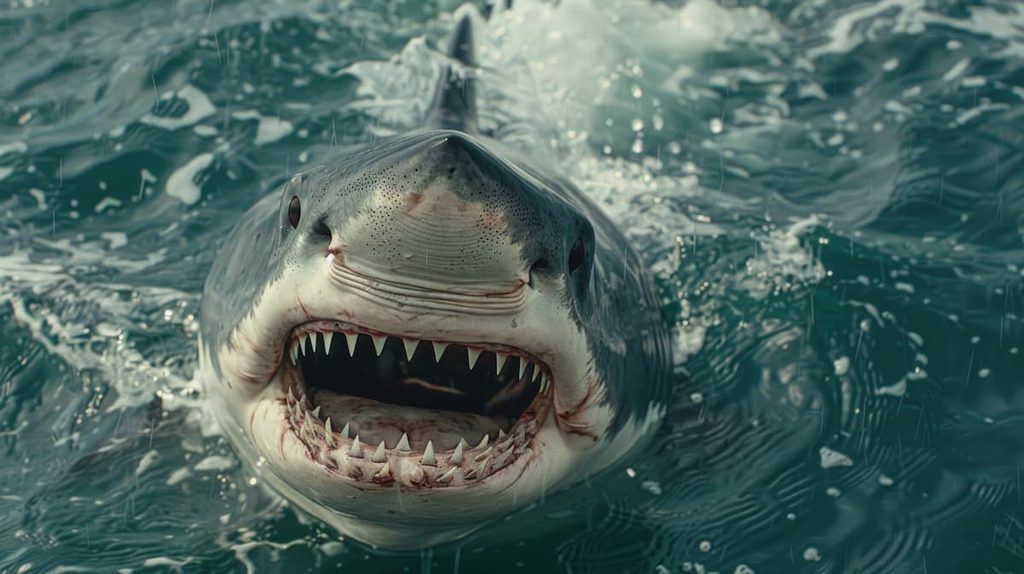
A shark’s mouth is not built around a single permanent set of teeth.
Instead, new teeth develop continuously in rows behind the functional teeth. As an older tooth is lost, another moves forward to replace it. Different shark species have different replacement rates, but the basic strategy is remarkably consistent: keep producing new teeth throughout life.
This ability is known as polyphyodonty, meaning that teeth are replaced repeatedly rather than just once.
The important biological structure behind this process is the dental lamina, a band of epithelial tissue involved in initiating tooth development.
In humans, the dental lamina is important during early tooth formation. After the permanent dentition develops, much of this tissue undergoes programmed cell death and breaks apart. Sharks, however, maintain a functional dental lamina that can repeatedly initiate new tooth generations.
That difference already suggests something important.
The problem may not be that humans never had the machinery to make more teeth.
It may be that our tooth-making system is designed to shut down.
The Shark Secret Is Not a Single Gene
It would be tempting to imagine that sharks possess a special gene that humans lack.
The evidence points somewhere else.
Researchers studying catsharks found that several major developmental signaling systems involved in tooth formation and regeneration are active in shark teeth. These include the Hedgehog, Wnt/β-catenin, BMP, and FGF pathways.
These pathways are not exotic shark inventions. They are fundamental biological signaling systems used in many animals during development.
The remarkable part is how deeply these systems are conserved.
Research suggests that a core set of tooth-development mechanisms has been conserved across hundreds of millions of years of vertebrate evolution. In other words, the biological instructions involved in making a tooth are much older than modern mammals.
Sharks did not necessarily invent a completely different way to build teeth.
They appear to have retained and repeatedly reused an ancient developmental program.
This changes the question.
Instead of asking:
“What special gene gives sharks new teeth?”
scientists can ask:
“Why does the tooth-building program remain active in sharks but become largely inactive in humans?”
That is a much more useful question for regenerative medicine.
Humans May Still Carry Part of the Machinery
There is another surprising clue.
After human teeth develop, fragments of the original dental lamina can remain in the tissues. These are called dental lamina rests.
For a long time, these remnants were generally considered relatively inactive.
But research comparing human dental lamina rests with the dental lamina of sharks found that human dental lamina rests contained a small population of proliferating cells and expressed several markers associated with dental stem cells, including Sox2, Bmi1, and β-catenin.
That does not mean adults can naturally grow another set of teeth.
The researchers did not demonstrate that a missing human tooth could simply regenerate from these cells.
Instead, the finding suggests something more subtle: adult human dental tissue may retain some cellular features associated with the machinery that once helped build teeth.
That distinction matters.
Finding cells with regenerative characteristics is not the same thing as producing a complete, functional tooth.
Growing a Tooth Is Much Harder Than Growing Tooth Tissue
This is where the idea of “stem cells growing new teeth” can become misleading.
Scientists are investigating stem cells for regenerating parts of the tooth, such as dental pulp and dentin, and for repairing tissues that support the tooth.
But a complete tooth is a much more complicated structure.
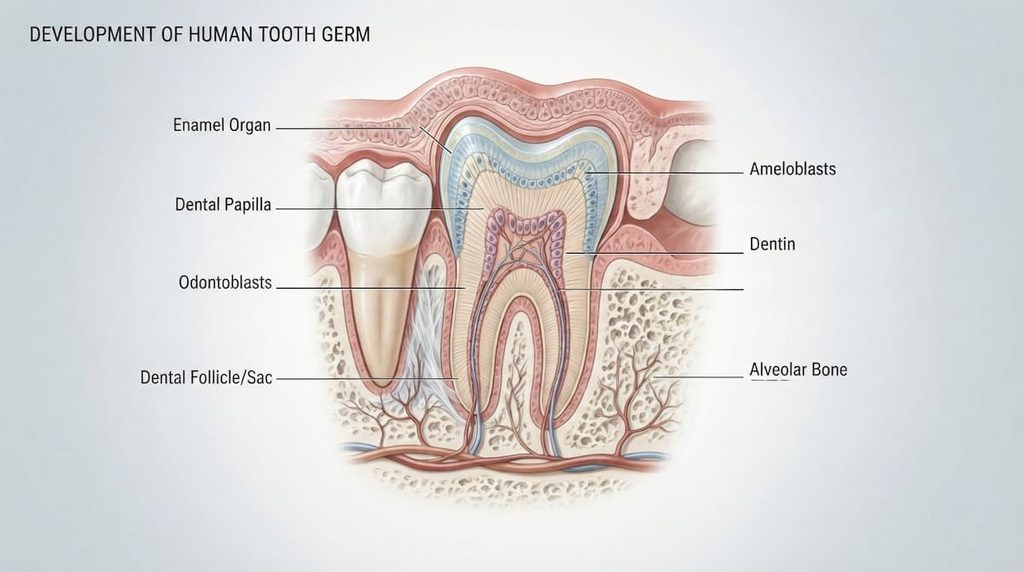
A functional tooth requires several tissues to develop in the correct locations and at the correct times. Enamel, dentin, pulp, cementum, periodontal tissues, nerves, blood vessels, and surrounding bone all have to interact properly.
So there are actually several different goals hiding inside the phrase tooth regeneration.
Repairing damaged tissue is one goal.
Regenerating part of an existing tooth is another.
Creating an entirely new tooth is something else again.
And getting an adult human to grow a complete replacement tooth in the correct position is arguably the most difficult version of the problem.
This is why the most interesting current research is not necessarily about simply adding more stem cells.
Some researchers are trying to manipulate the signals that tell developing tissue whether a tooth should form in the first place.
One of Those Signals Is Called USAG-1
A major development came from research into a protein called USAG-1.
USAG-1 acts as an antagonist of signaling pathways including BMP and Wnt, which are important during tooth development.
Researchers discovered that mice lacking USAG-1 could develop extra teeth. This suggested that USAG-1 normally helps prevent additional tooth formation.
That led to a striking experiment.
Researchers used antibodies against USAG-1 to interfere with its function. In mouse models of congenital tooth agenesis, blocking USAG-1 helped restore tooth development that had previously been interrupted. The researchers also reported tooth-development effects in other animal models.
The concept is fundamentally different from simply implanting a new population of stem cells.
Instead, the researchers are trying to remove a biological brake.
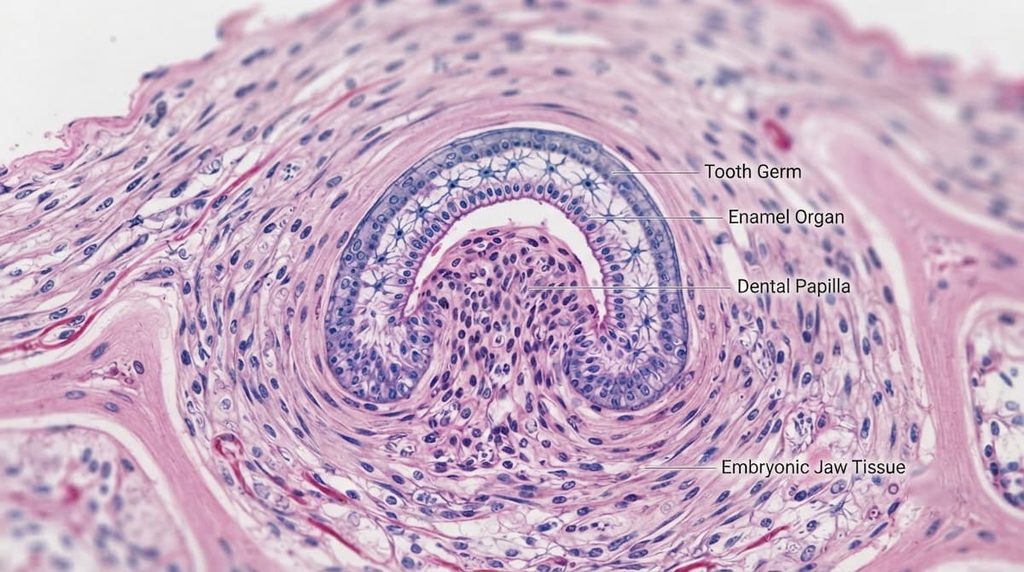
The idea is that some developing tooth germs may already have the potential to continue developing, but inhibitory signals prevent that process from proceeding.
If those signals can be controlled, perhaps a tooth can be encouraged to form using the body’s own developmental machinery.
From Shark Biology to a Human Drug Candidate
This is where an idea that began as basic developmental biology starts becoming a medical technology.
Researchers developed antibodies targeting USAG-1 and eventually selected a humanized antibody candidate called TRG035.
The initial goal is not simply to treat a cavity or repair damaged enamel. The first target is congenital tooth agenesis, a condition in which some teeth fail to develop from the beginning.
This distinction is crucial.
A person who loses a tooth because of decay, trauma, or periodontal disease already had a tooth there and lost it.
A person with congenital tooth agenesis never developed that tooth in the first place.
Researchers are initially asking whether a developmental signal can be used to help a missing tooth develop.
In other words, they are not yet demonstrating that any adult can grow a replacement tooth on demand.
From the Laboratory to Human Clinical Trials
This research has already reached human clinical development.
The TRG035 Phase I clinical trial began in Japan in October 2024 and was completed in September 2025. The first phase was designed primarily to evaluate safety, tolerability, and pharmacokinetics rather than to prove that patients could grow new teeth.
That distinction is critical.
A Phase I trial does not mean that a new tooth has successfully grown in humans. It means that the candidate treatment has entered the stage where its safety and behavior in people can be evaluated.
According to a 2026 project update from Japan’s Agency for Medical Research and Development, the development program had moved toward a Phase II study for congenital tooth agenesis. The document reports completion of regulatory consultation and preparation for the next clinical stage.
The project is therefore much closer to testing tooth regeneration in the intended patient population than a purely experimental laboratory study.
But the target remains limited.
The current development program is aimed at congenital tooth agenesis, not at giving every adult a new tooth after one has been lost to decay, trauma, or periodontal disease.
That difference is easy to miss when tooth-regeneration research is described in headlines.
So, Can Humans Become More Like Sharks?
Not yet.
At least, not in the way a headline might suggest.
There is currently no established treatment that allows an adult who lost a tooth to simply grow a completely new replacement tooth.
There is also no evidence that researchers have taken a shark gene and inserted it into humans to make new teeth.
The real scientific story is much more interesting.
Shark research helped reveal how an ancient tooth-development program operates in an animal that keeps using it throughout life. Comparative studies then showed that important parts of this developmental machinery are deeply conserved among vertebrates, while human dental tissues retain some cellular features associated with tooth formation.
Researchers have since identified molecular regulators such as USAG-1 that can suppress tooth development.
And now, rather than merely observing these mechanisms, scientists are beginning to test whether they can manipulate them in humans.
The progression is remarkable:
Shark tooth regeneration
↓
Ancient tooth-development signals
↓
Related cellular machinery in human dental tissue
↓
Identification of developmental brakes such as USAG-1
↓
Tooth formation restored in animal models
↓
Human drug development
↓
Clinical trials for congenital tooth agenesis
The important story is not that sharks have magical teeth.
It is that the biological instructions for building teeth are older and more widely shared than we might expect.
The Real Challenge May Be Turning the Program Back On
Humans did not simply evolve teeth and then forget how to make them.
Our bodies still use many of the same developmental signaling systems that participate in tooth formation. What changed is how those systems are regulated and when they stop being active.
Sharks appear to keep a tooth-making environment running throughout life.
Humans normally do not.
That makes tooth regeneration less like inventing an entirely new organ and more like solving a difficult biological control problem.
Scientists need to determine which cells can still respond, which signals need to be activated, which inhibitory signals need to be removed, and how to make the resulting tooth develop in the right place and with the right structure.
That is why the future of tooth regeneration may not depend on finding a magical stem cell that can grow a tooth by itself.
It may depend on understanding how the body knows when to make a tooth, and why that instruction normally becomes silent in humans.
Sharks have been solving that problem for millions of years.
Humans are now trying to understand how.
Scientific Sources
1. Liam J. Rasch, Kyle J. Martin, Rory L. Cooper, Brian D. Metscher, Charlie J. Underwood, Gareth J. Fraser. “An ancient dental gene set governs development and continuous regeneration of teeth in sharks.” Developmental Biology. 2016;415(2):347-370. PMID: 26845577. DOI: 10.1016/j.ydbio.2016.01.038. Read the study on PubMed.
2. Gareth J. Fraser, Samar S. Hamed, Kyle J. Martin, Keith D. Hunter. “Shark tooth regeneration reveals common stem cell characters in both human rested lamina and ameloblastoma.” Scientific Reports. 2019;9:15956. PMID: 31685919. DOI: 10.1038/s41598-019-52406-z. Read the study on PubMed.
3. A. Murashima-Suginami, H. Kiso, Y. Tokita, E. Mihara, Y. Nambu, R. Uozumi, Y. Tabata, K. Bessho, J. Takagi, M. Sugai, K. Takahashi. “Anti-USAG-1 therapy for tooth regeneration through enhanced BMP signaling.” Science Advances. 2021;7(7):eabf1798. PMID: 33579703. DOI: 10.1126/sciadv.abf1798. Read the study on PubMed.
4. K. Takahashi, H. Kiso, E. Mihara, J. Takagi, Y. Tokita, A. Murashima-Suginami. “Development of a new antibody drug to treat congenital tooth agenesis.” Journal of Oral Biosciences. 2024;66(4):1-9. PMID: 39389160. DOI: 10.1016/j.job.2024.10.002. Read the study on PubMed.
5. Japan Agency for Medical Research and Development (AMED). “Development of a new antibody drug to treat congenital tooth agenesis.” List of Adopted Projects, FY2025. 2026. p. 13. Read the AMED project document.