Your Stomach Rebuilds Its Protective Lining Every Few Days [Bit#182]
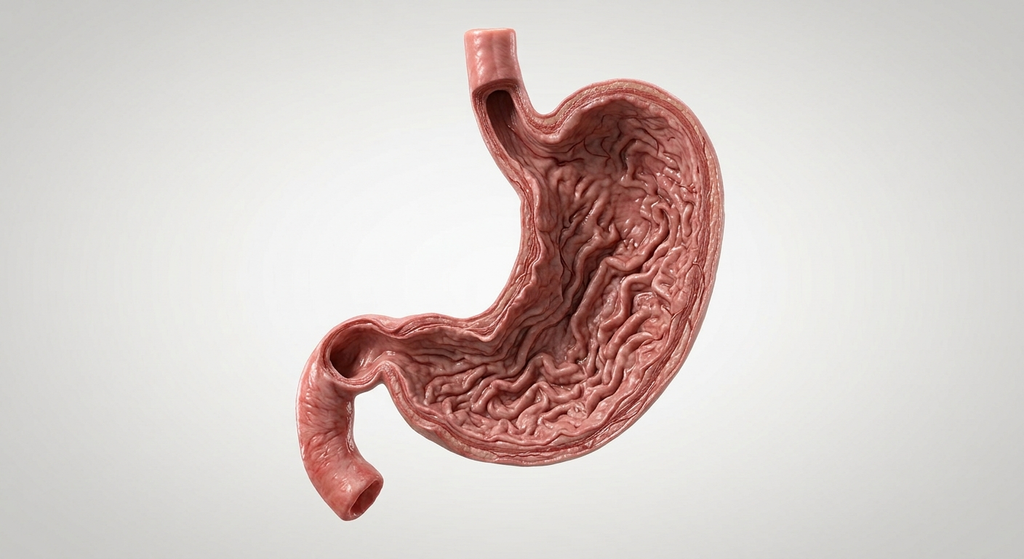
Your stomach contains acid strong enough to help break down food, yet the stomach itself is not normally digested by that acid. Every day, its inner surface faces an environment that could damage living tissue. So how does it survive?
One important part of the answer is that the stomach lining is constantly maintained. Some of its surface cells are replaced within just a few days. Rather than relying on the same cells to last forever, the stomach continually produces new ones to help preserve its protective barrier.
Research on the mouse stomach has found that some immature cells involved in renewing the surface lining turn over in less than three days. The exact lifespan varies depending on the cell type and its location, so this should not be interpreted as a fixed timetable for every cell in the human stomach.
The fascinating part is that the stomach does not have to choose between digesting food and protecting itself. It performs both jobs at once, using several layers of defense and a continuous process of cellular maintenance.
Why Doesn’t Stomach Acid Digest the Stomach Itself?
The stomach produces hydrochloric acid, which helps create the conditions needed for digestion. The acid unfolds proteins in food, making them easier for digestive enzymes to break down. It also helps activate pepsin, an enzyme that cuts proteins into smaller pieces.
This combination is useful for digestion, but it creates a challenge for the stomach’s own tissues. If acid and digestive enzymes could freely attack the cells lining the stomach, the organ would be vulnerable to repeated injury.
The stomach avoids this problem through several defenses that work together.
The first is a slippery layer of mucus covering the inner surface. This mucus helps separate the epithelial cells from the stomach’s contents and slows the movement of harmful substances toward the tissue underneath.
But mucus is not the whole story. The surface cells also release bicarbonate, a substance that can neutralize acid. Within the mucus layer, bicarbonate helps create a more favorable environment close to the cells, even when the stomach contents are highly acidic.
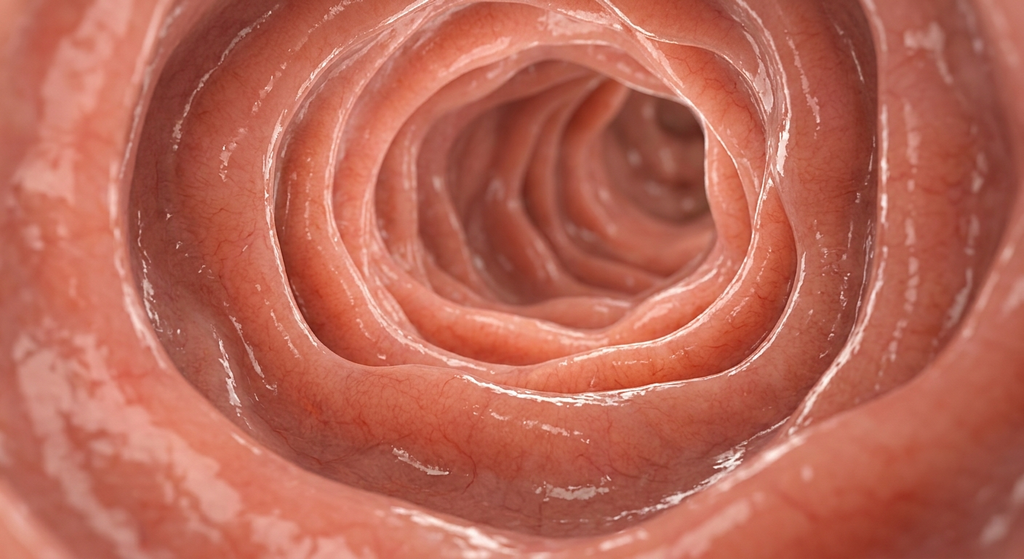
Think of it as a protected boundary between two very different environments. The stomach cavity needs to remain acidic for digestion, while the living cells underneath need conditions that allow them to function. The mucus-bicarbonate system helps maintain that separation.
The epithelial cells themselves provide another layer of defense. Neighboring cells are connected by structures called tight junctions, which restrict the passage of substances between them. The cells also have specialized surface membranes that help resist damage.
Blood vessels beneath the lining supply oxygen and nutrients and support normal tissue maintenance and repair. Together, these defenses make the stomach lining much more resistant than an unprotected layer of cells would be.
This protection is remarkably effective, but it is not perfect. The stomach lining can still be damaged by infection, certain medications, or other factors that weaken its defenses. Its survival depends on maintaining the barrier, not on being completely immune to injury.
The Stomach Does Not Keep the Same Surface Cells Forever
Even a well-protected surface experiences wear and tear. Cells become damaged, reach the end of their normal lifespan, or are shed as part of everyday maintenance.
The stomach deals with this by continually producing replacement cells. Specialized cells within its gastric glands divide and generate descendants that mature into the different cell types needed by the lining.
Some of these new cells move toward the surface, where mucus-producing cells help maintain the protective covering. Other descendants develop into cells with different jobs deeper within the glands.
This process is not random. The stomach has an organized structure in which cells occupy particular regions and perform specialized functions. New cells must mature into the right types and reach the appropriate locations to maintain the tissue.
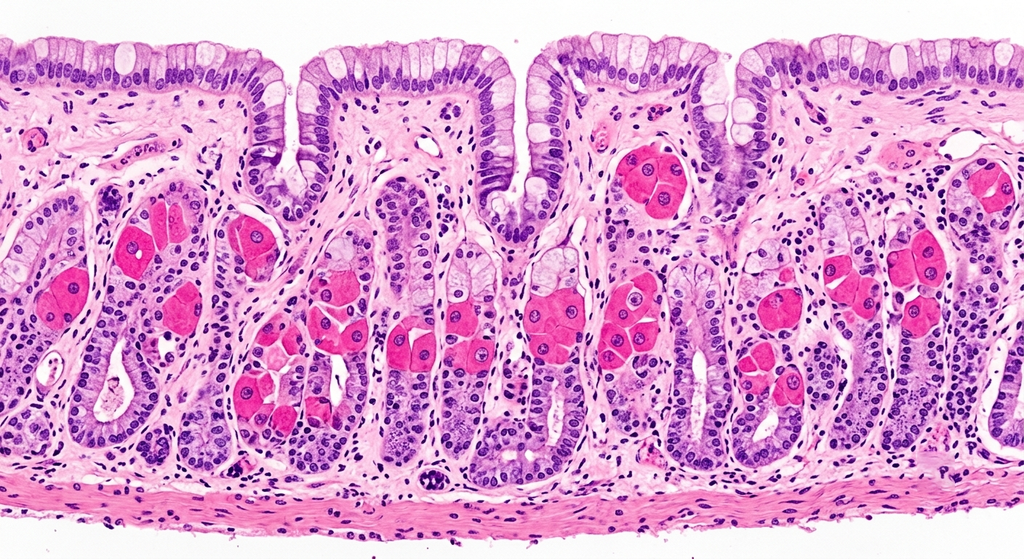
The difference in lifespan between cell types is especially important. Some immature cells involved in renewing the mouse stomach lining turn over in less than three days, while certain mature gland cells can survive much longer.
In other words, the stomach does not replace its entire wall every few days. It renews particular cell populations at different rates.
A useful comparison is a busy building. The surfaces exposed to constant use may need frequent maintenance, while the deeper supporting structure can remain in place much longer. The stomach is far more complex than a building, but the comparison illustrates why different parts of the same structure do not need to be replaced on the same schedule.
The rapid renewal of the stomach’s surface is only one part of its maintenance system. It works alongside mucus production, bicarbonate secretion, blood flow, and the ability of surviving cells to repair small defects.
The Stomach Can Begin Repairing Damage Before New Cells Are Made
Routine cell replacement is not the only way the stomach protects itself. Sometimes the surface is damaged before the cells that normally replace it have had time to mature.
In that situation, the stomach can use a faster response.
When a small, superficial area of the lining is injured, surviving epithelial cells at the edge of the damaged region can flatten and migrate across the exposed surface. This process is called epithelial restitution.
The key point is that these cells can move into place without first dividing to produce a new population. The immediate priority is to cover the exposed area and restore the barrier.
Studies of gastrointestinal tissue have shown that this process can begin within minutes. Under suitable experimental conditions, superficial defects may be covered within approximately 15 minutes to an hour. The exact timing depends on the tissue, the severity of injury, and the conditions in which the damage occurs.
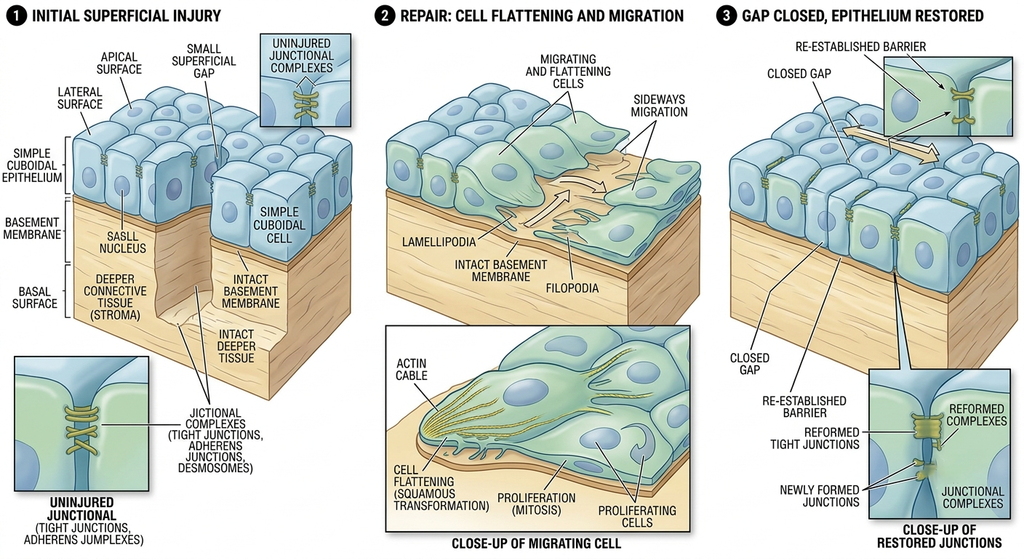
Imagine a small tear in a sheet. Before replacing the entire sheet, the material around the tear can shift to cover the opening. That is not a perfect description of how cells behave, but it captures the difference between rapid surface repair and the slower process of making new cells.
Once the immediate defect has been covered, cell proliferation and further tissue remodeling can help restore the lining more fully.
This distinction matters because not every injury is equally easy to repair. A tiny superficial defect is very different from an injury that extends into deeper tissue. More extensive damage can trigger inflammation, changes in cell growth, and a longer healing process.
A stomach ulcer, for example, is not simply a patch of surface cells that needs to be replaced after a few days. It can involve deeper tissue damage and requires a more complex repair response.
The stomach therefore has two related but distinct strategies: it continually replaces cells during normal maintenance, and it can rapidly move surviving cells to cover certain superficial injuries.
Why Does the Stomach Need So Many Different Cell Types?
The stomach lining is not made of one uniform kind of cell. Its glands contain several specialized cell populations, each contributing to digestion, protection, or the regulation of stomach function.
Surface mucus-producing cells help protect the lining. Parietal cells produce hydrochloric acid and intrinsic factor, a protein needed for vitamin B12 absorption. Chief cells produce pepsinogen, the inactive precursor of pepsin. Other cells release hormones and signaling molecules that help regulate digestion.
These cells do not all have the same job, so they do not all need the same lifespan.
Surface cells face the stomach’s contents directly and contribute to a barrier that must be maintained continuously. Deeper gland cells perform other tasks and may survive much longer. Their replacement patterns reflect their location, function, and the biological signals that regulate their growth.
The stem and progenitor cells that supply the stomach lining are therefore important. They help replenish different cell populations and maintain the organization of the gastric glands.
However, healthy renewal is not simply a matter of making cells as quickly as possible. Their descendants must develop into the correct cell types, and the tissue must preserve a balance between producing new cells and allowing mature cells to perform their specialized functions.
Too little replacement can weaken the lining. Abnormal patterns of cell growth and differentiation can also be harmful, particularly when chronic inflammation changes the normal organization of the tissue.
Healthy renewal is about producing the right cells, in the right places, at the right time.
Is the Stomach Lining the Fastest-Regenerating Tissue in the Human Body?
The claim that stomach cells regenerate faster than any other cells in the body sounds convincing when some cells turn over in only a few days. But it is too broad to treat as an established scientific fact.
The first problem is that the stomach contains many different cell types. Some immature cells involved in surface renewal divide rapidly, while certain mature gland cells survive much longer. There is no single turnover time that applies to the entire stomach.
The second problem is that other tissues renew themselves just as quickly. Cells lining the small intestine also have short lifespans. Many intestinal cells are replaced within a few days, although other types live longer.
The third problem is that regeneration can mean different things. It might refer to the normal replacement of aging cells, the speed at which a small wound is covered, or the restoration of tissue after deeper injury. These are related biological processes, but they are not interchangeable measurements.
For example, the stomach may cover a small superficial defect through cell migration within minutes, even though normal cell replacement takes days. Comparing those two times as if they measured the same process would be misleading.
A more accurate conclusion is that the stomach has a rapidly maintained surface and an effective system for protecting its lining. It is not necessary to declare it the undisputed fastest-regenerating tissue in the body to appreciate how remarkable that system is.
The science becomes more interesting when we look at how the different mechanisms cooperate rather than trying to crown a single winner.
When the Protective System Fails
The stomach’s defenses usually maintain a workable balance between acid exposure and tissue protection. But that balance can be disrupted.
For example, infection with Helicobacter pylori can contribute to chronic inflammation and damage to the gastric lining. Nonsteroidal anti-inflammatory drugs, including ibuprofen and aspirin, can also interfere with protective mechanisms in some circumstances. The risks depend on the medication, dose, duration, and individual circumstances.
When the protective barrier is weakened, acid and digestive substances can contribute to further injury. If the damage persists or extends into deeper tissue, inflammation and ulceration may develop.
Rapid cell renewal cannot guarantee that this will never happen. New cells still need the right environment to survive and function, and deeper injuries require more than ordinary surface turnover.
This is why the stomach’s protection should be understood as a coordinated system rather than a simple race to replace cells as quickly as possible. Mucus, bicarbonate, tight junctions, blood flow, cell migration, and cell production all contribute to maintaining the lining.
A Living Surface That Never Stops Being Maintained
The stomach’s inner surface is not a permanent coating. It is living tissue that is continually maintained while the organ carries out one of its most demanding jobs: digesting food in an acidic environment.
Some cells involved in surface renewal turn over within a few days. Other cells last much longer. When superficial damage occurs, nearby cells can move rapidly to cover the exposed area, while more extensive injuries require additional repair.
These processes help explain why the stomach does not normally digest itself. Its protection depends on multiple defenses working together, not on acid being harmless or the lining being indestructible.
The remarkable part is not that the stomach can never be damaged. It is that the organ can digest food while maintaining the living surface that makes this possible.
Beneath the acidic contents of your stomach, cells are being renewed, the protective barrier is being maintained, and small defects can be repaired as they arise. It is a continuous process of maintenance—one that allows your stomach to keep working without sacrificing the tissue that makes digestion possible.
Scientific Sources
- Mills JC, Shivdasani RA. “Gastric epithelial stem cells.” Gastroenterology. 2011;140(2):412–424. PMID: 21144849. DOI: 10.1053/j.gastro.2010.12.001. Read the study on PubMed
- Laine L, Takeuchi K, Tarnawski A. “Gastric mucosal defense and cytoprotection: bench to bedside.” Gastroenterology. 2008;135(1):41–60. PMID: 18549814. DOI: 10.1053/j.gastro.2008.05.030. Read the study on PubMed
- Wallace JL, Granger DN. “The cellular and molecular basis of gastric mucosal defense.” FASEB Journal. 1996;10(7):731–740. PMID: 8635690. DOI: 10.1096/fasebj.10.7.8635690. Read the study on PubMed
- Hagen SJ. “Mucosal defense: gastroduodenal injury and repair mechanisms.” Current Opinion in Gastroenterology. 2021;37(6):609–614. PMID: 34475337. DOI: 10.1097/MOG.0000000000000775. Read the study on PubMed
- Lacy ER. “Epithelial restitution in the gastrointestinal tract.” Journal of Clinical Gastroenterology. 1988;10 Suppl 1–77. PMID: 3053884. DOI: 10.1097/00004836-198812001-00012. Read the study on PubMed