[Bit#170] Survival Strategy of Sponges: The Most Primitive Creatures Surviving 600 Million Years
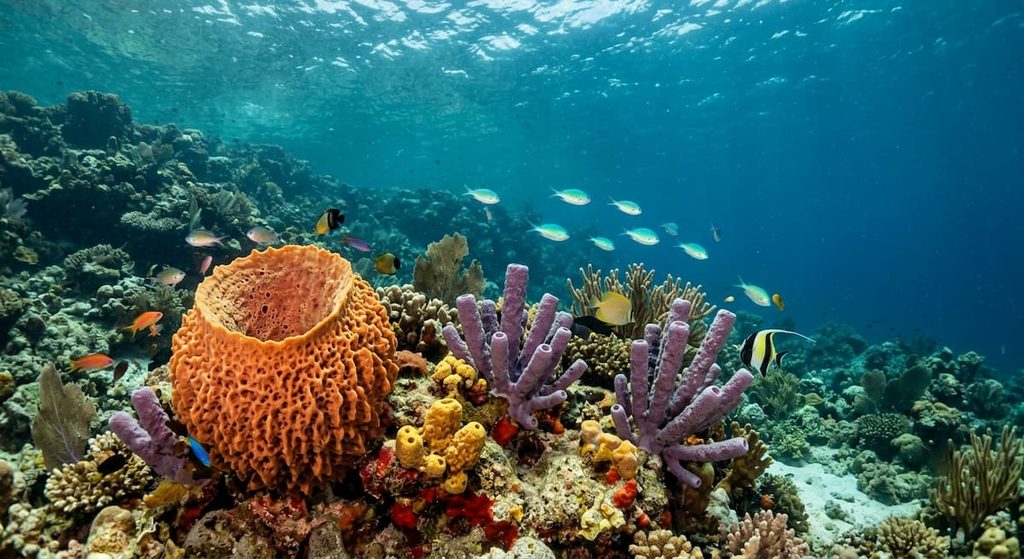
Sponges, one of the oldest multicellular animals on Earth, have no brain, no heart, and no nervous system. They merely look like perforated lumps attached to the ocean floor. However, these primitive organisms maintain the entire marine ecosystem and provide crucial clues for developing anticancer and antiviral drugs in modern medicine. We delve into the wondrous survival strategy of how these immobile, simple creatures have survived for over 600 million years and continue to aid human survival.
1. A Perfect Bio-Filter Without a Brain or Heart
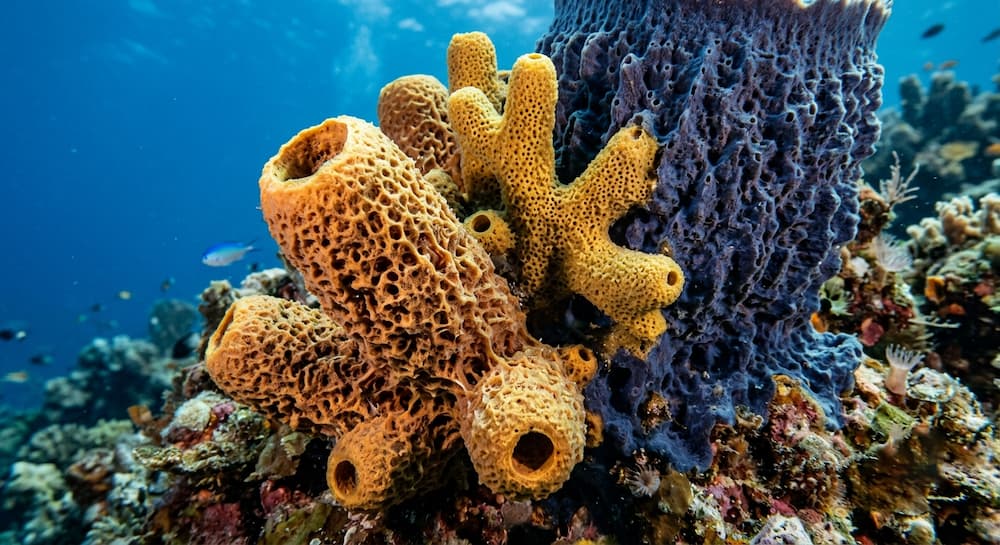
There is a strange mass attached to rocks in the deep sea. It does not move, nor does it have eyes or a nose. At first glance, it looks just like a marine plant or a stone. However, this organism is the sponge, the oldest multicellular animal on Earth. Surprisingly, sponges have no brain, heart, or nervous system. How did they survive in the harsh ocean without a heart to circulate blood or a brain to think?
The secret lies in an intricate water canal system that runs through their entire body. Numerous microscopic pores are scattered across the sponge’s surface. Sponges constantly absorb seawater through these pores. Then, using specialized cells inside their body, they filter out organic matter and bacteria from the water. The process of sucking in and expelling seawater is their entire life support system. It is literally a perfectly functioning bio-filter.
How much water does a sponge filter in a single day? The answer is astounding. A single small sponge processes seawater thousands of times its own volume daily. A sponge the size of one cubic centimeter purifies tens of liters of water each day. Without electricity or mechanical devices, it creates this massive current solely through the whip-like beating of cell flagella. It serves as the ultimate cleaner, maintaining ocean clarity by absorbing impurities and bacteria.
Isn’t it fascinating when you think about it? Even without complex organs or sensory systems, it focused entirely on core functions necessary for survival. Instead of giving up a brain or heart that consumes massive energy, it chose a structure that yields maximum efficiency with minimal energy. This perfect biological design hidden within simplicity is the first secret behind how sponges thrived on Earth for 600 million years.
2. Extreme Regeneration and Structure Enduring 600 Million Years
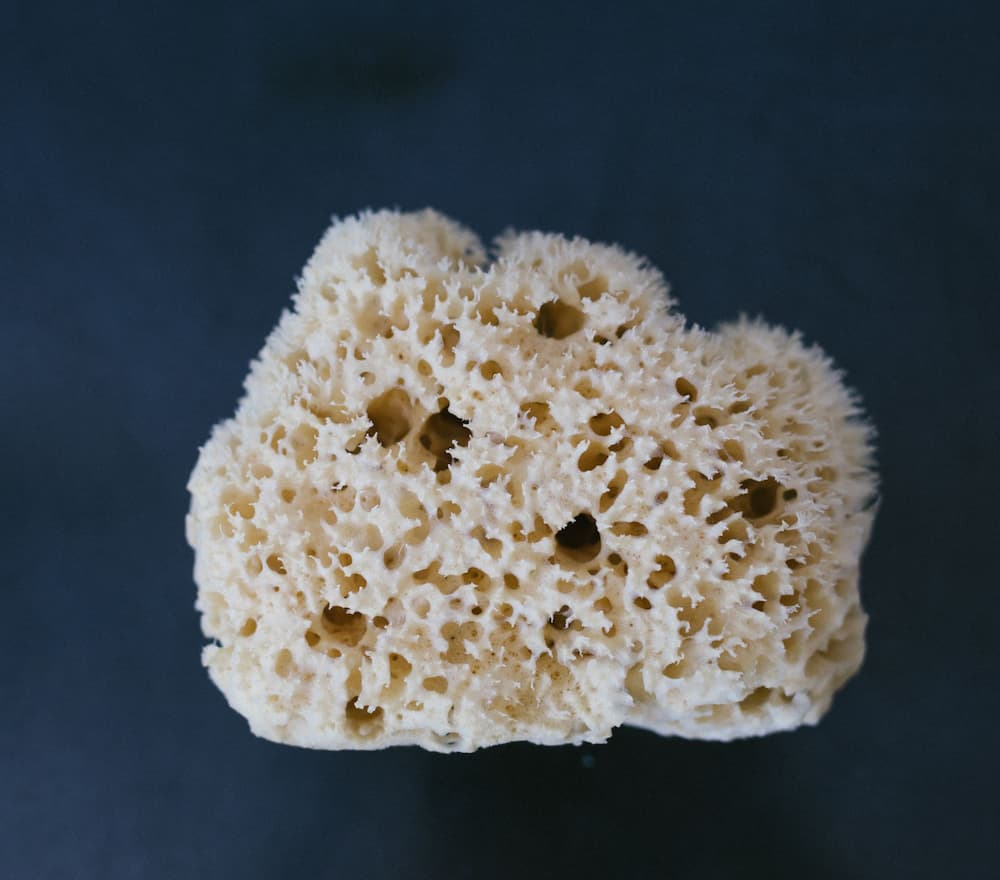
What happens if you put a sponge into a blender and grind it up? Any ordinary creature would die instantly on the spot. However, sponges are different. If you leave the blended sponge fragments still in seawater, an amazing thing occurs. The disassembled cells move on their own to find each other. They then cluster back together and reassemble into a complete, single sponge. They possess an incredible, movie-like regenerative ability in reality.
How is such a miraculous event possible? The secret lies in the unique flexibility of sponge cells. Sponge cells are not permanently fixed to a specific role. They hold a large number of undifferentiated cells that can freely change their shape and function depending on the situation. If the body is torn or destroyed, these cells instantly transform into the required cell types. The original form of stem cells was already perfectly loaded into organisms 600 million years ago.
The internal structure that maintains a soft body without a skeleton is also intriguing. Inside a sponge’s body, microscopic glass-like spicules and tough protein fibers called spongin are intertwined. This glass-spicule structure firmly supports the body shape so it does not collapse even amid rough waves. It even doubles as an excellent defensive weapon to prevent predators from eating them recklessly. No predator welcomes a mouthful of prickling glass spicules.
Flexible cells that easily change form and rigid glass-spicule structures achieve perfect harmony. Even without a brain or eyes, they completely bounce off external attacks and physical impacts. This extreme flexibility, unattached to a fixed form, is the ultimate survival weapon that allowed sponges to overcome every massive mass extinction over hundreds of millions of years.
3. Ecosystem Engineers and Water Purifiers of the Ocean
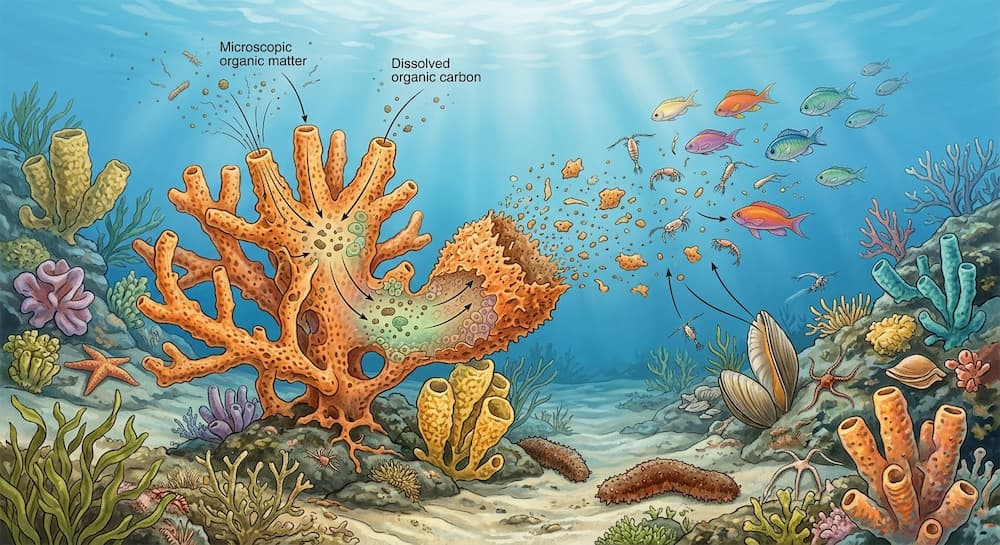
Sponges do not stop at merely playing the role of water-clearing cleaners. They are talented architects supporting the vast ocean ecosystem from behind and ecosystem engineers circulating energy. Behind thriving coral reefs and abundant fish swimming freely, there are always sponges working quietly.
The most surprising action sponges contribute to the sea is a biochemical mechanism called the sponge loop that recycles energy. Microscopic organic particles and dissolved organic carbon float invisibly in the seawater. Most other marine organisms cannot directly use this microscopic carbon as nutrients and simply waste it. However, sponges operate their unique, massive, and refined filtering system to absorb this aquatic carbon completely.
Afterward, sponges constantly shed their cells and slough off outer layers based on these nutrients. The sponge byproducts and cellular debris discharged during this process become excellent food for lower predators such as crabs, shrimp, small fish, and sea slugs. They convert organic carbon, which was almost wasted in the vast ocean ecosystem, into useful nutrient forms, lifting it up to higher stages of the food web.
Furthermore, the complex internal structure of a sponge’s body provides a perfect shelter for small, weak marine creatures. It becomes a safe haven to hide from harsh predators, maximizing biodiversity. By continuously pumping seawater to keep water clean while providing food and shelter to other organisms simultaneously, this primitive creature without eyes or a brain silently performs as a giant pillar sustaining all marine life.
4. A Treasure Trove in the Sea Holding Medicine for Humanity
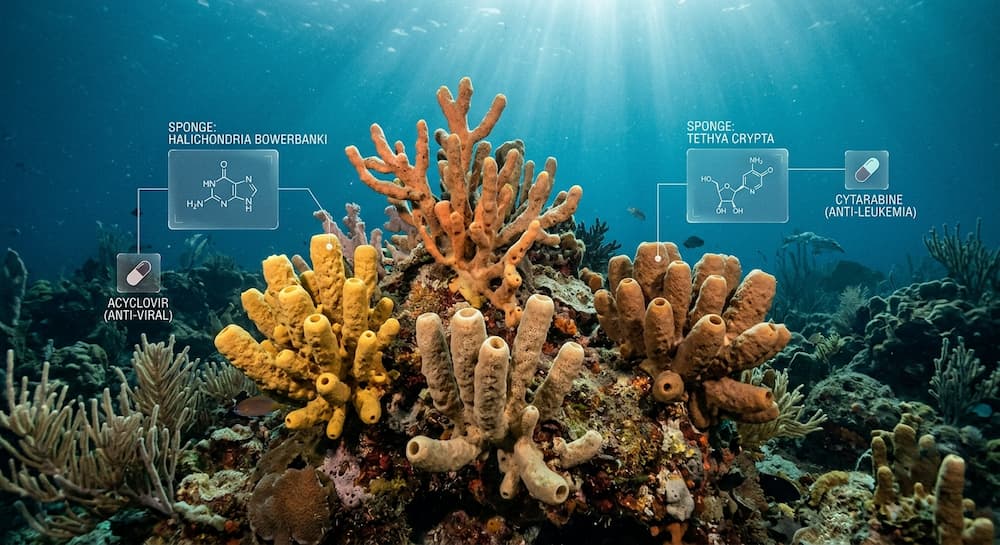
How do immobile sponges withstand predator attacks and bacterial infections in the rough sea? The answer lies in potent chemicals. Lacking legs to flee, sponges produce various highly toxic secondary metabolites to protect themselves. These range from toxins that deter predators to antimicrobial substances that block surrounding microbial growth. Amazingly, these chemicals have become the key to a dramatic turnaround in treating human diseases.
The biochemical substances produced by sponges sent shockwaves through modern medicine. In fact, acyclovir, one of the earliest antiviral drugs, and cytarabine, used as a leukemia treatment, were developed based on compounds extracted from Caribbean sponges. Peculiar substances from sponges demonstrated the ability to inhibit cancer cell proliferation and block viral replication. Chemical substances produced by primitive creatures without a brain are saving human lives.
This is not all. Recently, researchers have been conducting studies to eradicate superbugs resistant to existing antibiotics using novel compounds extracted from sponges. Candidate drugs for treating brain disorders like Alzheimer’s and various refractory inflammations are being discovered sequentially inside sponges. This small mass quietly attached to ocean rocks was actually the largest natural pharmaceutical factory on Earth.
This is precisely why we cannot dismiss sponges as simple primitive organisms. The biochemical wisdom accumulated while weathering all kinds of oceanic changes over 600 million years is hard to match even with human science and technology. Inside the sponge body filtering seawater silently, countless secrets of life yet to be uncovered and innovative treatments that will change humanity’s future reside.
Conclusion
Sponges, lacking movement and thought, survived 600 million years of mass extinctions with a minimal structure, sustaining marine ecosystems and offering drug clues to humanity. Have we believed that only life with complex, massive organs is superior? Looking at sponges that survived longest by emptying and simplifying, we reflect deeply on what wisdom of emptying is genuinely needed in human lives that continually become complex.
![[Bit#123] Miracle Substance in Sweet Wormwood Defeats Malaria](https://hiddenbitknowledge.com/wp-content/uploads/2026/08/main.Sweet-Wormwood-768x419.jpg)
![[Bit#138] How Mudskippers Breathe on Land: The Secrets of Cutaneous Respiration](https://hiddenbitknowledge.com/wp-content/uploads/2026/08/main.Mudskipper-767x428.jpg)
![[Bit#161] The Secret of 400 Year Longevity: How Greenland Sharks Rewrote Aging Science](https://hiddenbitknowledge.com/wp-content/uploads/2026/09/main.Greenland-shark-768x419.jpg)
![[Bit#134] Ultralight Flight of the Albatross : The Secret of Endless Energy Free Flight](https://hiddenbitknowledge.com/wp-content/uploads/2026/08/main.Albatross-flying-ocean-768x439.jpg)
![[Bit#103] Self-Luminous Plants: Genetically Modified Glowing Trees to Replace Streetlights](https://hiddenbitknowledge.com/wp-content/uploads/2026/07/main.Bioluminescent-plants-768x431.jpg)
![[Bit#78] The Perfect Predator: The 300 Million Years Secret Hidden by Dragonflies](https://hiddenbitknowledge.com/wp-content/uploads/2026/06/main.dragonfly-768x512.jpg)