Why Do Some Wrinkles Disappear and Others Stay? [Bit#222]

A smile can create a few lines around your eyes or mouth in less than a second. Stop smiling, and they may disappear just as quickly.
But years later, some of those same lines may still be visible when your face is completely relaxed.
Why?
It is tempting to think the answer is simply aging. As skin gets older, it loses elasticity, so wrinkles become harder to erase.
That explanation is partly right, but it misses something important.
A wrinkle is not just a line that appears on aging skin. It is also the visible result of skin being repeatedly moved, folded, stretched, and returned to its original shape. The interesting question is what happens when that recovery becomes less complete over time.
In other words, the difference between a wrinkle that disappears in seconds and one that stays for years may depend not only on how much the skin moves, but how well it can recover after being moved.
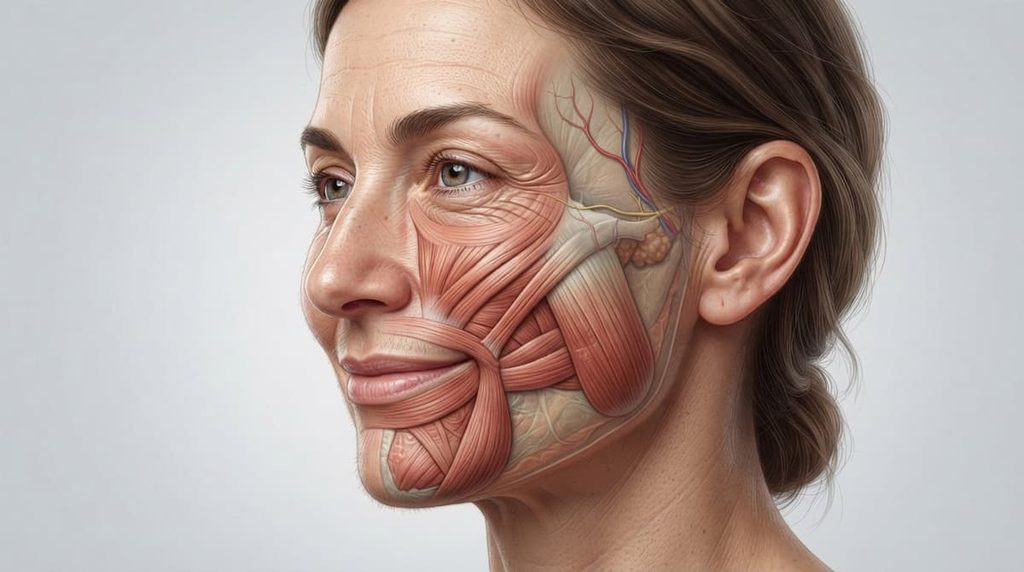
Your face is constantly deforming
Even when you are not thinking about your skin, your face is moving.
You talk, smile, frown, squint, raise your eyebrows, and move your mouth. Each expression changes the position and shape of the skin covering your facial muscles.
Researchers have been able to measure these movements directly.
In one study, Japanese women were photographed both with strong facial expressions and with their faces at rest. The researchers found that wrinkle levels increased with age in both conditions, and that wrinkles seen during facial movement tended to occur in similar locations to wrinkles visible when the face was relaxed.
Another study used three-dimensional motion analysis to examine how the skin of the forehead moved when people raised their eyebrows. It found that the amount of skin movement was related to the severity of wrinkles during facial expression, but the relationship was different for wrinkles visible when the face was at rest.
That distinction is important.
A face can move a lot without every temporary crease becoming a permanent wrinkle. Something else about the skin determines how much of that deformation remains after the movement stops.
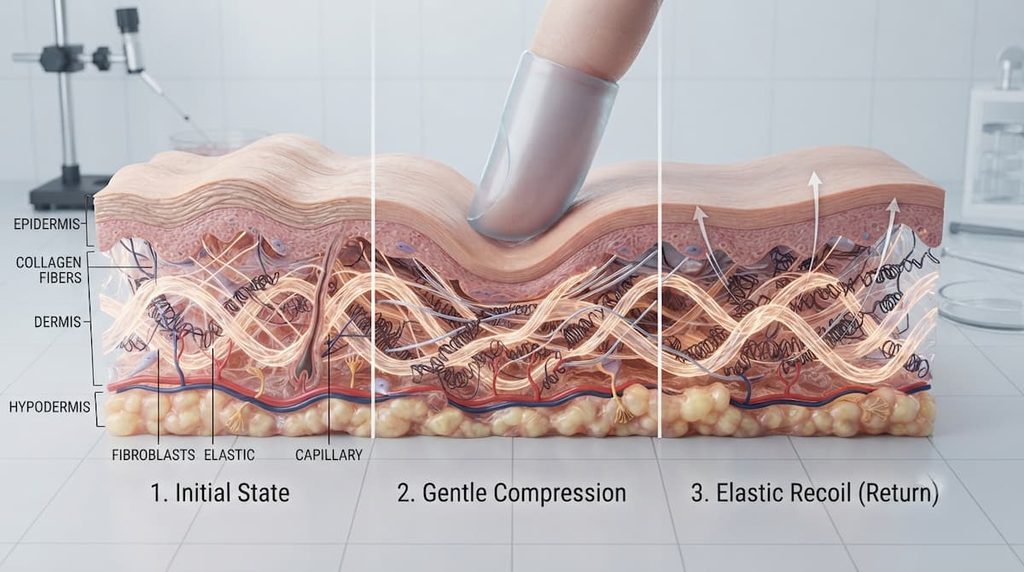
Why does a temporary line disappear?
Young skin is not rigid.
When facial muscles contract, the overlying skin bends and stretches. Once the expression ends, the skin can move back toward its previous configuration.
This ability is partly related to the mechanical properties of the skin.
A study of 97 healthy women measured skin mechanics, hydration, age, and wrinkle characteristics using objective instruments. With increasing age, the skin showed reduced elastic recovery and greater wrinkle measurements. Higher skin hydration was also associated with lower wrinkle measures and shallower wrinkle furrows.
The idea is easier to understand with a simple analogy.
Imagine folding a fresh rubber sheet.
You bend it, release it, and it quickly returns close to its original shape.
Now imagine repeatedly bending an older, less resilient material. It may still move, but its recovery is no longer as complete.
Skin is far more complex than rubber, of course. It is living tissue containing collagen, elastin, water, cells, and other structural components. But the basic mechanical idea helps explain why the same facial movement does not produce the same visible result throughout life.
A temporary expression line is therefore not necessarily a permanent mark waiting underneath the skin.
It is a deformation that the skin can usually recover from.
The question is how that ability changes over decades.
A wrinkle may have a history
One of the most revealing studies on this question followed the same people over eight years.
Researchers photographed 122 women ranging from 10 to 72 years old, both with and without a smiling expression. They then compared the wrinkle pattern seen during smiling at the beginning of the study with the pattern of wrinkles visible without expression eight years later.
The result was striking.
Each person’s pattern of persistent facial wrinkles at the eight-year follow-up was predicted by the pattern of lines that had appeared when that person smiled at the beginning of the study.
This does not mean that every smile line is destined to become permanent.
But it suggests that temporary expression lines and later persistent wrinkles are not completely unrelated phenomena.
The location of a line that appears only during an expression can provide clues about where a more lasting wrinkle may eventually appear.
That changes how we should think about wrinkles.
Instead of imagining a permanent wrinkle suddenly appearing one day, it may be more useful to think of some wrinkles as the result of a long process.
A line appears.
It disappears.
The same area bends again.
It recovers.
The cycle repeats.
Over many years, the skin’s ability to return completely to its previous state changes.
Eventually, some of the deformation can become visible even when the expression is gone.
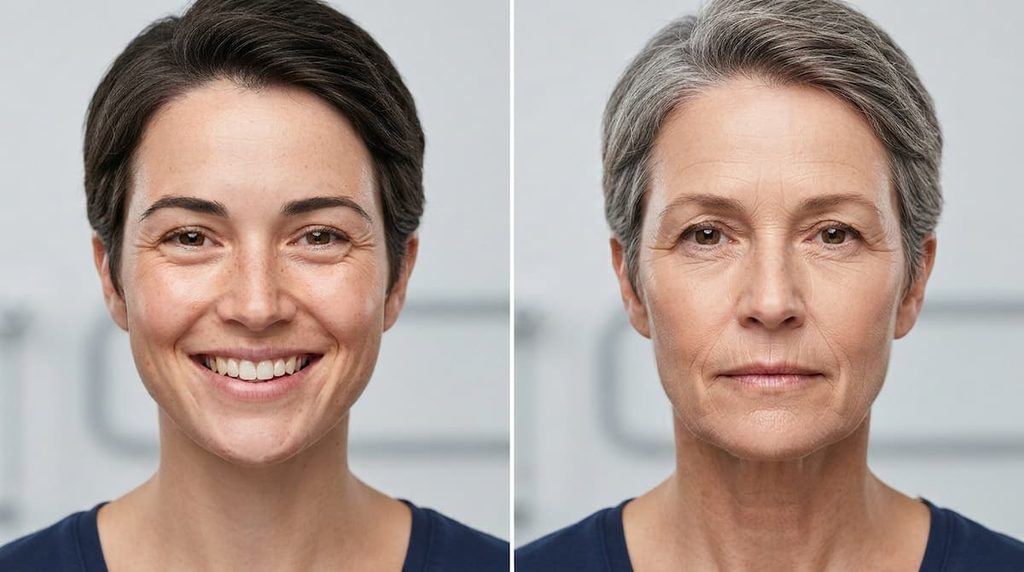
Aging changes the skin while it is moving
Most studies of skin aging examine the face in a neutral, relaxed state.
But real faces are almost never completely still.
A 2024 study looked specifically at this dynamic side of aging. Researchers used motion capture to measure cheek-skin movement during facial expressions in 86 Japanese women aged 20 to 69.
They found that the response of cheek skin became more delayed with age. They also found that the stretchiness of the lower cheek decreased with age. Interestingly, variation between individuals within the same age group also tended to increase with age.
This gives us another way to understand why two people of the same age can have very different-looking skin.
Aging does not simply change what the skin looks like when the face is still.
It can also change how the skin behaves when the face moves.
That distinction matters because facial expressions are mechanical events. The skin has to move with the muscles underneath it, and the way it moves can change over time.
So the visible wrinkle on a relaxed face may be the endpoint of changes that have been occurring during thousands of ordinary facial movements.
But facial movement is not the whole story
There is an important trap here.
It would be easy to take these findings and conclude that wrinkles are simply caused by making facial expressions.
The evidence does not justify that simple explanation.
The eight-year study found that expression-line patterns predicted later persistent wrinkles, but it also identified other factors associated with faster wrinkling. The researchers reported associations with factors such as a drier, more alkaline stratum corneum, lighter complexion, middle age, and becoming menopausal. They also explicitly distinguished factors that influence the rate of wrinkling from factors that can be considered causal.
And there is another major factor that cannot be ignored: sunlight.
Cumulative lifetime sun exposure is a well-established contributor to facial photoaging. Research on photoaging describes chronic ultraviolet exposure as contributing to changes in the skin’s extracellular matrix, including collagen and elastic-fiber damage, which are associated with visible aging such as wrinkles.
This means that a permanent wrinkle is better understood as the result of several processes interacting over time.
Repeated facial movement provides mechanical deformation.
Aging changes the skin’s mechanical behavior and recovery.
Environmental exposure, especially ultraviolet radiation, adds cumulative damage.
Individual biological and lifestyle differences influence how quickly these changes become visible.
The final wrinkle is where all of these processes meet.
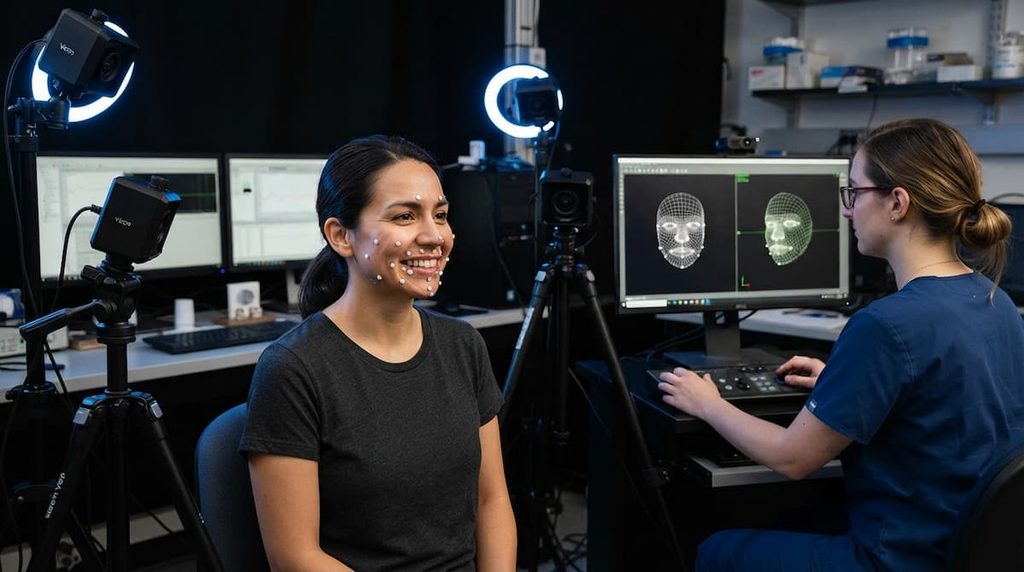
So why do wrinkles differ from person to person?
This is why age alone cannot explain someone’s wrinkles.
Two people can be the same age but have different histories of facial movement, sun exposure, skin properties, and other biological factors.
Even the way their facial skin moves can differ.
The 2024 cheek-skin study found that individual variation in dynamic skin behavior increased within older age groups. That does not prove that these differences directly cause different wrinkle patterns, but it shows that aging does not produce an identical mechanical change in every person’s skin.
This also explains why comparing wrinkles by age alone can be misleading.
Age provides part of the background.
It does not provide the whole story.
A person’s wrinkles are better viewed as the accumulated result of a skin system that has been moving and recovering thousands of times, while its mechanical properties and environmental history have changed along the way.
The wrinkle you see today may be part of a much longer process
There is something surprisingly ordinary about the beginning of a wrinkle.
It can start with a smile.
Or a squint.
Or a raised eyebrow.
At that moment, there may be nothing permanent about it. The skin folds, the expression ends, and the line disappears.
But the same region can experience that deformation again and again.
The important question is not simply whether the skin moves.
It is whether the skin can keep returning to its previous state after all that movement.
Research cannot tell us that every temporary line will eventually become permanent. Nor can it reduce wrinkles to a single cause.
What it does suggest is more interesting.
Some of the lines that appear temporarily during facial expression can be connected to the persistent wrinkles that appear years later. At the same time, aging changes the mechanical behavior of the skin, while factors such as hydration and ultraviolet exposure influence the environment in which those changes occur.
So a wrinkle is not simply a number written on your skin.
It is closer to a record of repeated movement and changing recovery.
The face has been moving all along.
The surprising part is that the skin remembers some of those movements longer and longer as time passes.
Scientific Sources
1. Hillebrand GG, Liang Z, Yan X, Yoshii T. “New wrinkles on wrinkling: an 8-year longitudinal study on the progression of expression lines into persistent wrinkles.” British Journal of Dermatology. 2010;162(6):1233-1241. PMID: 20184587. DOI: 10.1111/j.1365-2133.2010.09709.x. Read the study on PubMed
2. Choi JW, Kwon SH, Huh CH, Park KC, Youn SW. “The influences of skin visco-elasticity, hydration level and aging on the formation of wrinkles: a comprehensive and objective approach.” Skin Research and Technology. 2013;19(1):e349-e355. PMID: 22672420. DOI: 10.1111/j.1600-0846.2012.00650.x. Read the study on PubMed
3. Fujimura T, Hotta M. “The preliminary study of the relationship between facial movements and wrinkle formation.” Skin Research and Technology. 2012;18(2):219-224. PMID: 22092807. DOI: 10.1111/j.1600-0846.2011.00557.x. Read the study on PubMed
4. Fujimura T. “Investigation of the relationship between wrinkle formation and deformation of the skin using three-dimensional motion analysis.” Skin Research and Technology. 2013;19(1):e318-e324. PMID: 22724632. DOI: 10.1111/j.1600-0846.2012.00646.x. Read the study on PubMed
5. Kurosumi M, Yabuzaki J, Kuribayashi M, Mizukoshi K. “Age-related changes in cheek skin movement: A case study of Japanese women.” Skin Research and Technology. 2024;30(7):e13768. PMID: 38961690. PMCID: PMC11222652. DOI: 10.1111/srt.13768. Read the study on PubMed