[Bit#100] The Secret of the Tuatara: A Living Dinosaur That Survived 200 Million Years
Introduction
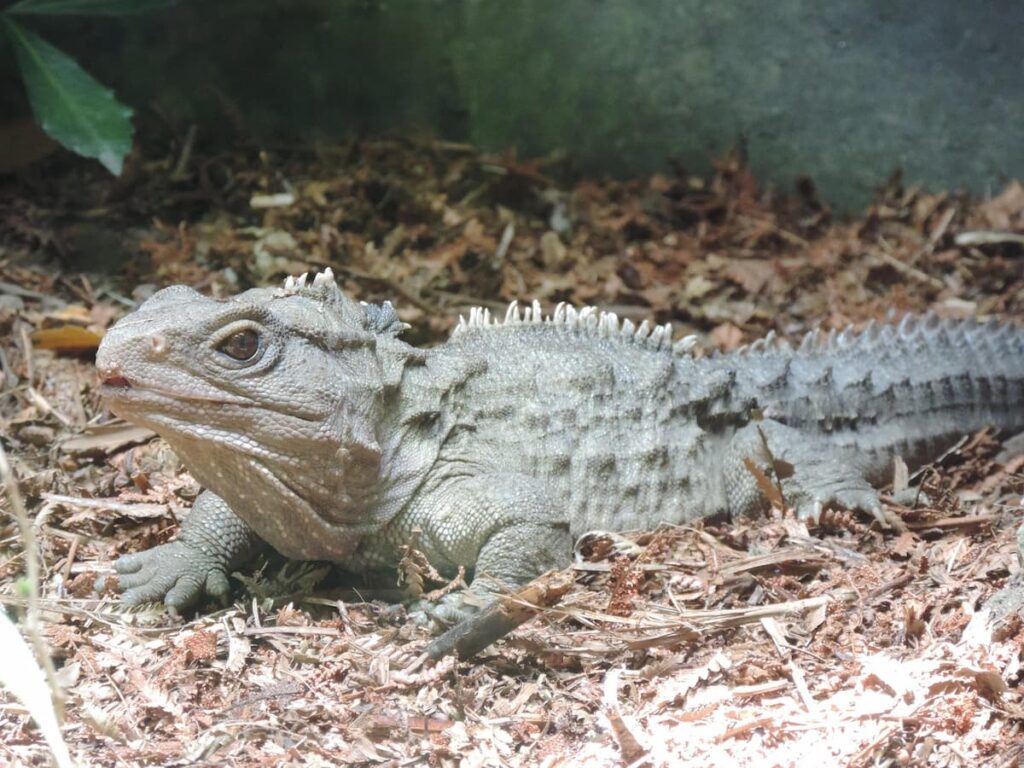
As one of the oldest living organisms on Earth, the tuatara looks like a reptile, but it is the sole survivor of an independent lineage that dates back to the age of dinosaurs. This creature remains active even at 5 degrees Celsius and possesses a genuine third eye on the top of its head. In this article, we will examine why this small creature managed to survive the harsh storms of evolution and what message its unique biological characteristics offer to modern humanity.
1. The Sole Descendant of Ancient Reptiles, Not a Lizard
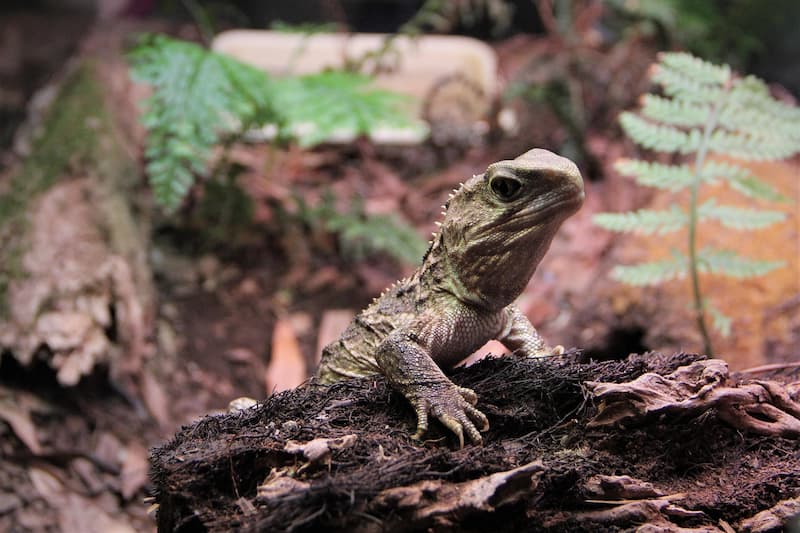
At first glance, it looks like a perfect lizard. Its green body and long tail stand out. It even has sharp scales. However, the tuatara is not a lizard. It is a unique creature that has walked a completely different evolutionary path in the reptile world. Why is that?
Reptiles living on Earth are broadly divided into three major groups. There is the order Squamata, which includes snakes and lizards. There is also the order Testudines, to which turtles belong. Additionally, the order Crocodilia exists for crocodilians. The tuatara belongs to none of these. It is the sole survivor of an independent group called Rhynchocephalia. It retains the ancient characteristics from the age of dinosaurs.
How then does the tuatara differ from a lizard? The difference is clear right from the bone structure. Its skull features two openings, a characteristic of ancient reptiles. The shape of its jawbone is also extremely unique. The upper jaw has two rows of teeth. The lower jaw has only one row. When chewing food, the lower jaw fits precisely between the two rows of upper teeth. It is a structure that cuts food like scissors. This is a unique mechanism not found in modern lizards.
The shape of its vertebrae also remains stuck in the past. Both ends of the bones are concave. This is a primitive structure mainly found in fish or early amphibians. This is precisely why scientists call the tuatara a living fossil. They are not relatives of lizards. They are creatures that retain the ancestral form from before lizards and snakes diverged.
The tuatara first appeared on Earth about 220 million years ago. It endured numerous crises during the Mesozoic Era. It persistently survived through the mass extinction of the dinosaurs. It held on until the end as a single remaining family.
Why did only this creature remain in its ancient form? It is thanks to the isolated island environment of New Zealand. There were no powerful predators. Climate change was minimal as well. It did not face intense evolutionary pressure. Today, we can still feel the breath of an ancient reptile from 200 million years ago.
2. The Third Eye on Top of the Head and Its Extraordinary Functions
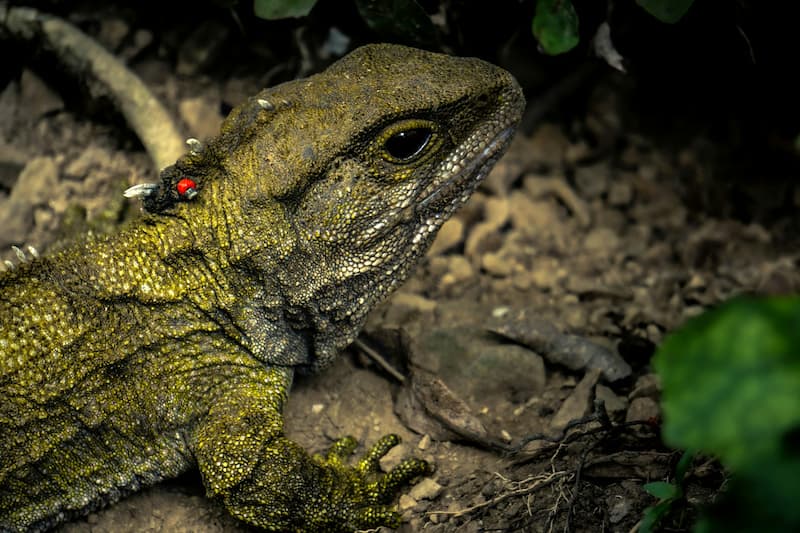
Let us carefully observe the crown of the tuatara’s head. Surprisingly, another eye is hidden there. It is called the parietal eye, or the third eye. This is a structure that usually remains only as a trace in most reptiles or amphibians. However, the tuatara is different. This parietal eye actually possesses a complete structure.
It actually contains a lens and a retina. The nerve is directly connected to the brain as well. Because it is hidden under the skin, you cannot clearly see its shape. However, its function to detect the amount of light works perfectly. Why does it have such a bizarre eye on top of its head?
Scientists assume it is used to measure ultraviolet radiation. The tuatara synthesizes vitamins while basking in the sun. At this time, the third eye precisely calculates the intensity of light. It also plays a role in regulating the internal biological clock. It distinguishes between day and night and senses seasonal changes.
The younger the tuatara, the clearer this eye appears. This is because the skin on the crown of its head is thin right after hatching. As it grows older, its scales and skin gradually thicken. Eventually, it becomes hidden from the outside. However, this does not mean its function disappears. It still accurately detects light penetrating through the thick skin.
This parietal eye is a legacy of the ancient Earth environment. It is a core device that has maintained biological rhythms by measuring ultraviolet levels for eons. It seems to mock our common sense that creatures only have two eyes.
3. A Unique Metabolic System That Survived in the Cold

Most reptiles love warm sunlight. This is because energy to move is generated only after warming up their bodies. However, the tuatara chose a completely different path. This creature enjoys cool, and even cold, weather.
The temperature at which the tuatara is most active is between 5 and 10 degrees Celsius. When other lizards freeze and stiffen in the cold, they confidently walk through the forest searching for food. On the contrary, when the temperature exceeds 25 degrees Celsius, they feel a threat to their lives. This is because if their body temperature rises too high, a fatal overload occurs in their metabolism. Why did they acquire such a unique constitution?
The secret lies in an extremely low metabolic rate. The breathing and heartbeat of the tuatara are surprisingly slow. It may breathe only once per minute. It can even hold its breath and stay still for an hour without breathing. It is a strategy to radically reduce energy consumption. Since it burns energy slowly, there is no reason to maintain a high body temperature.
This slow metabolism leads to a tremendous lifespan. Tuataras basic lifespan exceeds 100 years. It takes as long as 35 years just to complete their growth. They do not rush reproduction either. Females lay eggs roughly once every four years. The rate at which their cells age belongs to a completely different dimension compared to other living things.
When others ran fast, it chose a life of standing still. Through the unique survival strategy of slowness, the tuatara has proudly survived beyond the worst cold and environmental changes on Earth.
4. Endangered Status and the Warning Conservation Gives Us

Even the king of survival, who endured for 200 million years, was helpless in front of the appearance of humans. The tuatara, which once flourished throughout the main islands of New Zealand, has now completely disappeared from the wild there. Why did a creature that survived numerous mass extinctions on Earth vanish?
The cause lies in invasive species introduced by humans. Rats, stoats, and pigs were brought to the island. The tuatara, which digs holes in the ground to lay eggs, became easy prey for them. Rats, in particular, ruthlessly ate tuatara eggs and young hatchlings. The slow breeding rate of the tuatara could not keep up with the predation speed of invasive species at all.
Ultimately, the tuatara was pushed out to remote small islands without predators. The New Zealand government implemented strong conservation measures to save them. They created dedicated sanctuaries where invasive predators were eradicated and began artificial breeding. They rescue eggs, hatch them safely, and return them to nature once they reach a certain size. Thanks to these efforts, the population, which was on the brink of extinction, is gradually recovering.
The crisis of the tuatara sends a clear message to us. It shows how easily the balance of an ecosystem can be broken. A creature that endured hundreds of millions of years crumbles easily due to a single external variable. We must realize once again through the eyes of this ancient reptile why preserving Earth’s biodiversity is so important.
Conclusion
The tuatara has quietly observed countless changes on Earth for a distant period of 200 million years. While numerous species appeared and disappeared, they firmly held their place with unchanging slowness. To modern humanity, which endlessly pursues rapid change and growth, the existence of this ancient creature that silently kept its position may tell us a different kind of wisdom for survival. Will we truly be able to hand down ancient legacies like the tuatara intact to the next generation of Earth?
![Allelopathy: How Plants Use Chemistry to Influence Their Neighbors [Bit#183]](https://hiddenbitknowledge.com/wp-content/uploads/2026/10/main-image-6-768x419.jpg)
![[Bit#163] Plant Nyctinasty: The Secret Cellular Science Behind How Plants Sleep](https://hiddenbitknowledge.com/wp-content/uploads/2026/09/main.plant-sleep-767x428.jpg)
![[Bit#26] Mosquito: The World’s Deadliest Assassin or a Savior of Bio-Technology?](https://hiddenbitknowledge.com/wp-content/uploads/2026/05/5617e31f2ae8-768x509.jpg)
![[Bit#107] Extreme Survivors of the Arid Land: The Hidden Scientific Secrets of Cacti](https://hiddenbitknowledge.com/wp-content/uploads/2026/07/main.Cactus-Desert-768x512.jpg)
![How Frozen Frogs Come Back to Life [Bit#186]](https://hiddenbitknowledge.com/wp-content/uploads/2026/10/main-image-9-768x419.jpg)
![[Bit#109] Aspirin: How Science Turned Toxic Willow Bark into Medicine?](https://hiddenbitknowledge.com/wp-content/uploads/2026/07/main.Aspirin-768x432.jpg)