How Geckos Climb Glass Walls [Bit#185]
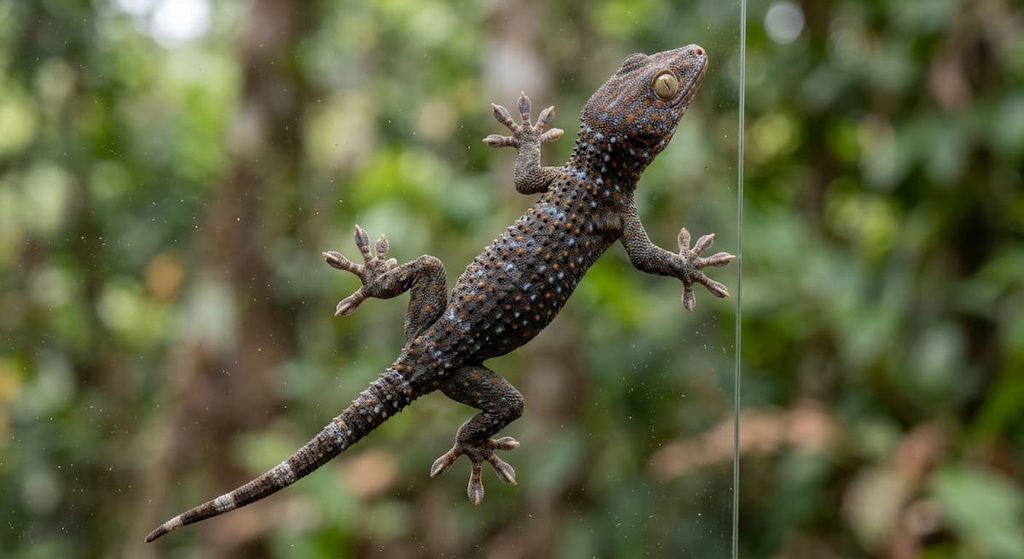
A gecko can walk up a smooth glass surface, cling to a ceiling, and move away again without leaving a trail of glue. Its feet do not work like suction cups, and they are not coated in a sticky liquid. Instead, they rely on an intricate biological structure that allows the animal to make thousands of tiny contacts with a surface.
The secret lies beneath the toes. Gecko feet are covered with microscopic structures that interact with surfaces in ways that ordinary human skin cannot. Each structure contributes only a small amount of force, but together they can support the animal’s weight while allowing it to move quickly.
Scientists have spent decades studying this ability because it challenges a simple assumption: a surface that feels smooth to us is not necessarily easy for an animal to grip, and strong attachment does not always require a sticky substance.
Understanding how geckos climb glass means looking closely at their feet, the molecular interactions at the contact surface, and the movements that let them attach and detach with remarkable control.
The Secret Is Hidden in the Feet
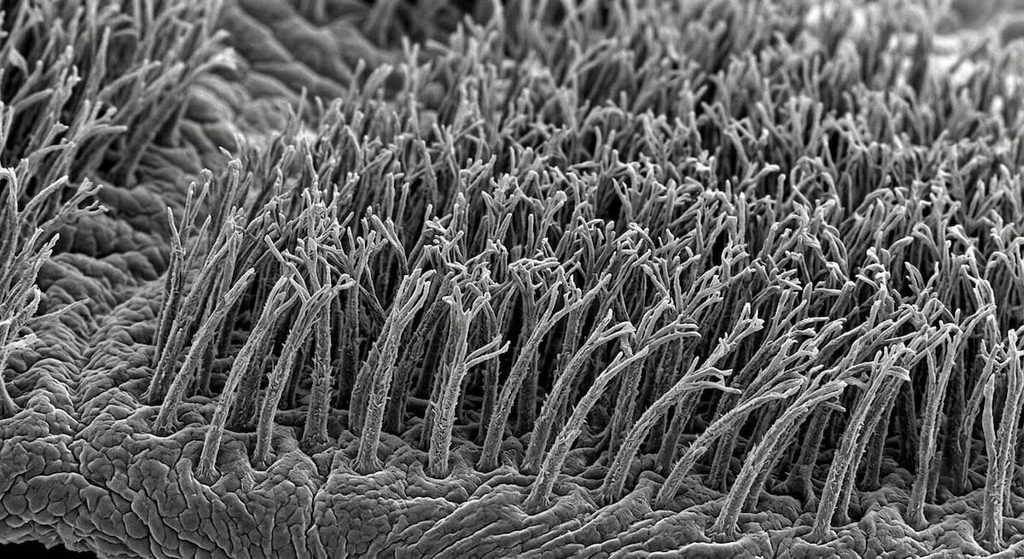
A gecko’s toe may look ordinary to the naked eye, but its underside has a highly organized structure. The surface is covered with tiny hair-like projections called setae. These are not hairs in the same sense as mammalian fur. They are specialized structures made of keratin, the same broad class of structural protein found in human hair and fingernails.
Each seta branches into even smaller structures that end in flattened tips often called spatulae. This arrangement creates a large number of tiny contact points. Rather than relying on a single patch of skin to hold the animal in place, the gecko distributes contact across many microscopic structures.
The importance of these structures became clear when researchers measured the adhesive force of an individual gecko foot-hair. The experiments showed that a single seta could generate measurable adhesion, and that its orientation and loading conditions strongly influenced the force it produced.
This finding helped explain how the entire foot could support a gecko on a vertical surface. When many setae contact the surface at once, their individual contributions combine. The foot’s performance therefore depends not only on the number of structures present, but also on how effectively they make contact.
A glass wall seems perfectly smooth, yet contact at the microscopic scale is more complicated. Even polished surfaces have irregularities. The gecko’s flexible, branched structures help it approach the surface closely enough for molecular interactions to become important.
The foot is not simply a patch of natural glue. It is a finely organized contact system whose performance depends on structure, direction, and movement.
How Tiny Contacts Create Strong Adhesion
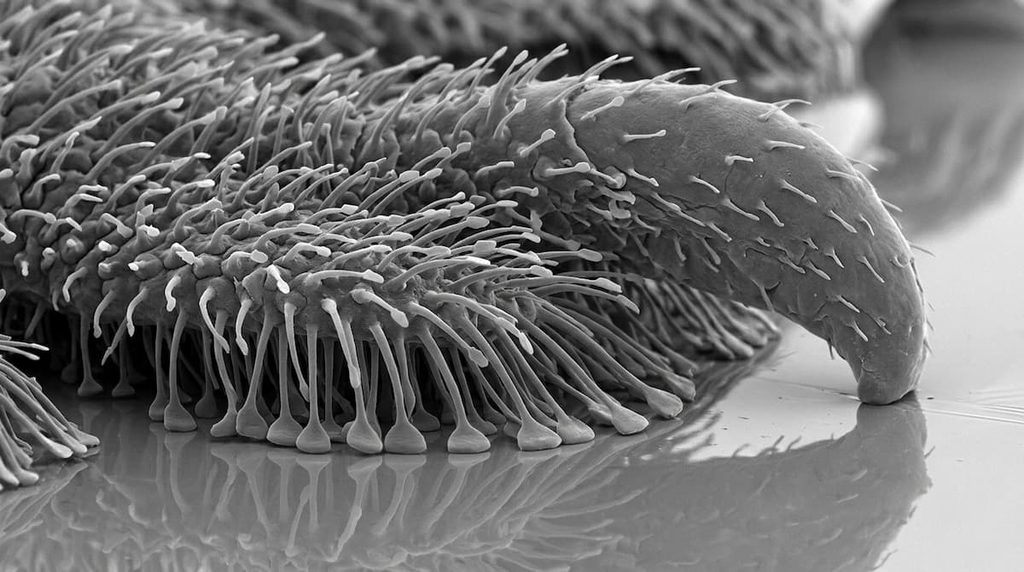
The force that helps geckos adhere to many surfaces is commonly associated with van der Waals interactions. These are weak attractions that can arise between atoms and molecules because of their electrical properties. Under suitable conditions, such interactions operate even when the materials are not chemically bonded together.
One interaction between a single pair of molecules is extremely weak. A gecko, however, has an enormous number of microscopic contact points across its toes. When many of these points are positioned close to a surface, their combined interactions can produce substantial adhesion.
In 2002, researchers published experimental evidence supporting a major role for van der Waals forces in gecko adhesion. Their work compared adhesion across surfaces with different properties and challenged explanations that depended mainly on water-mediated or oily interactions.
The key idea is not that a gecko has a mysterious force unavailable to other materials. Rather, its feet are built to take advantage of ordinary molecular interactions on an unusually large and controllable scale.
The geometry matters. If the tips of the setae cannot approach a surface closely enough, the relevant molecular attractions become much less effective. If the structures make intimate contact across many points, the total adhesive force can increase.
This is one reason the microscopic arrangement of the foot is so important. The same material arranged in a different shape might not achieve the same result. Geckos combine flexible structures with a contact pattern that can be adjusted as they move.
The result is a biological system in which tiny interactions become useful because the animal has evolved a way to create, distribute, and control them.
Why Geckos Can Let Go So Easily
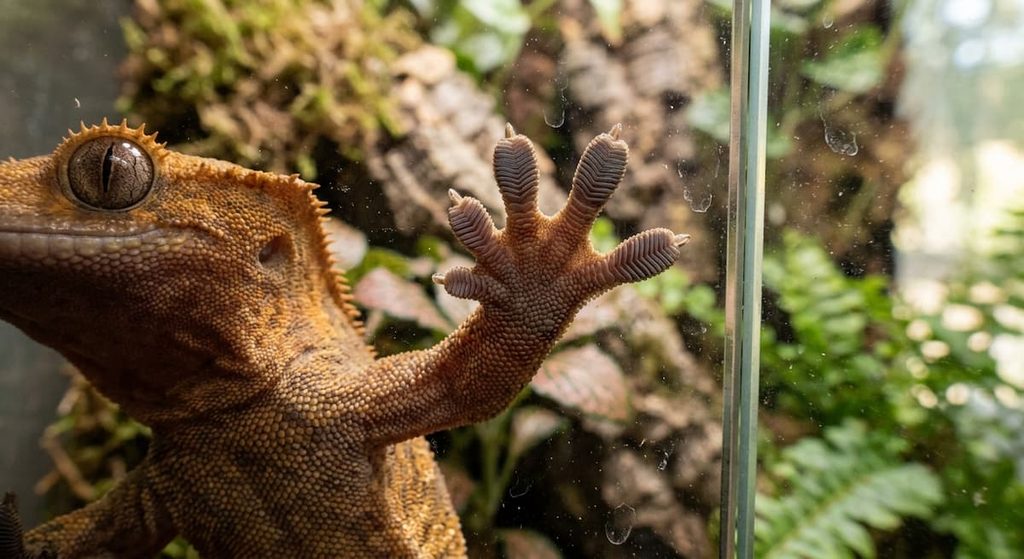
A strong adhesive may seem useful only if it can hold firmly. For a climbing animal, however, staying attached is only half the challenge. Each foot must also release at the right moment so that the gecko can take another step.
Geckos manage this through the way they position and move their toes. The adhesive structures do not behave like a permanently sticky surface that grips equally in every direction. Their performance depends on how they are loaded and oriented relative to the surface.
Research on gecko toe attachment and detachment has examined how the toe’s geometry, friction, and movement work together. The findings support a system in which contact can be strengthened or reduced through changes in the way the foot is applied and peeled away from a surface.
This resembles the difference between pulling a flexible strip straight away from a surface and gradually peeling it back from an edge. The direction of movement changes how the contact structures bear the load. A gecko can use its toes to establish contact and then alter their position to release that contact.
This controlled release is essential for locomotion. If every step required the animal to overcome the same maximum adhesive force, climbing would be less efficient. By adjusting the contact, a gecko can hold on when it needs support and detach when it needs to move.
The result is not simply a powerful adhesive foot. It is a coordinated biological mechanism that combines microscopic structures with whole-limb movement.
The distinction matters because adhesion cannot be understood from the material alone. The same foot can behave differently depending on how it contacts a surface, how force is applied, and how the toe moves during release.
Is Van der Waals Force the Whole Story?
Van der Waals interactions are central to the standard explanation of gecko adhesion, but researchers have also investigated how humidity, water, surface chemistry, and other interactions affect the process. The evidence does not justify treating every surface or every environmental condition as identical.
A 2005 study examined the adhesive force of gecko setae under different conditions and interpreted its results as evidence for a substantial role for capillary forces associated with water. This interpretation differed from work emphasizing van der Waals interactions. Differences in experimental setup, surface conditions, and the behavior of isolated structures are important when comparing these findings.
Later research added another layer of detail. A 2021 study reported evidence of acid-base interactions involving lipids on gecko setae and a sapphire surface. This suggests that chemical properties at the interface can contribute to adhesion under particular conditions.
The sapphire result should not automatically be treated as proof that exactly the same interactions dominate on ordinary glass. Different surfaces have different chemical and physical properties, and laboratory measurements may isolate processes that operate alongside other forces in a living animal.
These findings do not erase the importance of van der Waals interactions. Instead, they make the explanation more precise. Gecko adhesion is best understood as a system shaped by specialized microscopic structures and the conditions at the contact surface, rather than as the product of one universal force acting identically everywhere.
This is also why researchers need to distinguish between measuring a force and identifying its exact molecular origin. An experiment can show that a structure adheres strongly without proving that only one mechanism is responsible.
The broader lesson is that biological systems often use several interacting features at once. The gecko’s foot is remarkable not because it breaks the rules of chemistry, but because its structure makes subtle interactions useful for movement.
What Scientists Can Learn from Gecko Feet
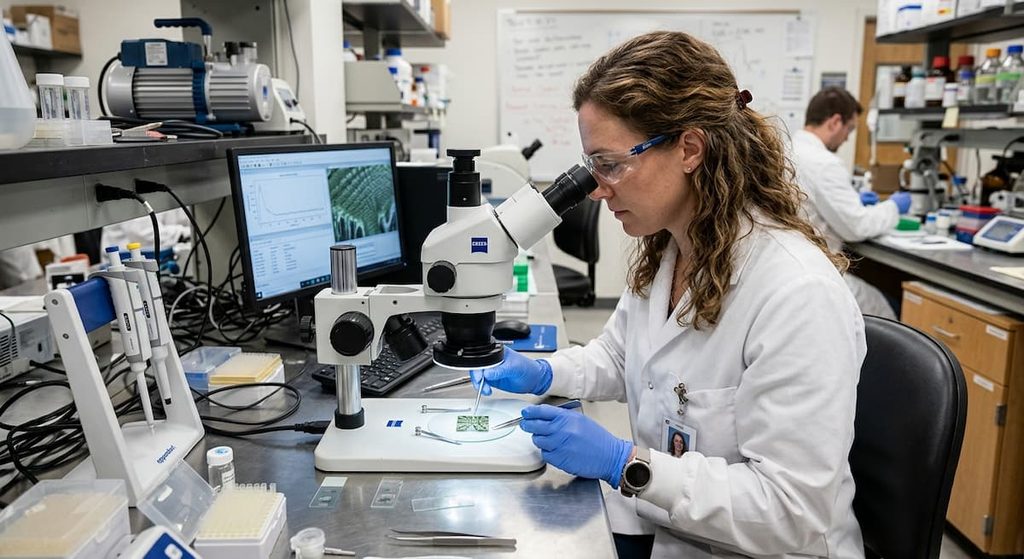
The gecko’s ability to climb has inspired research into artificial adhesives. Engineers want materials that can attach securely, release on demand, and work without leaving a conventional sticky residue. Such materials could be useful in robotics, handling delicate objects, or creating reusable gripping surfaces.
Gecko-inspired designs often imitate the principle of making many small contacts rather than depending on one large adhesive patch. Some designs also explore how the angle and arrangement of microscopic structures affect attachment and release.
Yet copying the appearance of a gecko’s foot is not enough to reproduce its performance. A working adhesive must be tested under realistic conditions, including repeated use, contamination, wear, humidity, and different surface materials. A design that performs well in a controlled experiment may not behave the same way in every environment.
Living geckos also combine their foot structures with active movement. Their ability to adjust contact while walking is part of the overall system. An artificial material may need additional mechanisms to reproduce that level of control.
The biological lesson is therefore broader than simply making a stronger adhesive. Nature can achieve useful performance by combining specialized structures with precise control over how those structures interact with their surroundings.
Grip Without Glue
A gecko’s feet demonstrate how biological structure can turn tiny molecular attractions into a practical advantage. Microscopic setae create numerous contact points, the geometry of those structures helps them approach surfaces closely, and controlled toe movements allow the animal to attach and detach while climbing.
Scientists continue to investigate how different forces and surface conditions contribute to the process. That ongoing research is a reminder that even a familiar animal behavior can conceal a complex biological mechanism.
The gecko does not need a pool of glue beneath each toe. Its feet make use of interactions that are already present in nature, organized through a specialized structure and controlled by movement. A seemingly impossible climb becomes understandable when we look at the right scale: not just at the animal on the glass, but at the tiny structures connecting them.
Scientific Sources
1. Autumn K, Liang YA, Hsieh ST, et al. “Adhesive force of a single gecko foot-hair.” Nature. 2000;405(6787):681-685. PMID: 10864324. DOI: 10.1038/35015073. Read the study on PubMed
2. Autumn K, Sitti M, Liang YA, et al. “Evidence for van der Waals adhesion in gecko setae.” Proceedings of the National Academy of Sciences of the United States of America. 2002;99(19):12252-12256. PMID: 12198184. DOI: 10.1073/pnas.192252799. Read the study on PubMed
3. Tian Y, Pesika N, Zeng H, et al. “Adhesion and friction in gecko toe attachment and detachment.” Proceedings of the National Academy of Sciences of the United States of America. 2006;103(51):19320-19325. PMID: 17148600. DOI: 10.1073/pnas.0608841103. Read the study on PubMed
4. Sun W, Neuzil P, Kustandi TS, Oh S, Samper VD. “The nature of the gecko lizard adhesive force.” Biophysical Journal. 2005;89(2):L14-L17. PMID: 15980177. DOI: 10.1529/biophysj.105.065268. Read the study on PubMed
5. Singla S, Jain D, Zoltowski CM, et al. “Direct evidence of acid-base interactions in gecko adhesion.” Science Advances. 2021;7(21):eabd9410. PMID: 34138740. DOI: 10.1126/sciadv.abd9410. Read the study on PubMed